Hanging in Suzanne Lim's room is a photograph that anchors her entire relationship with the past. Captured in black and white inside a dance hall during the 1950s, the image shows her grandparents mid-swing, dressed immaculately and radiating the confidence of a generation captivated by modern fashion. That single frame became the genesis for the 33-year-old graphic designer's deep fascination with vintage clothing—a passion that would eventually transform into a deliberate archival project and a window into Malaysia's social and cultural evolution.
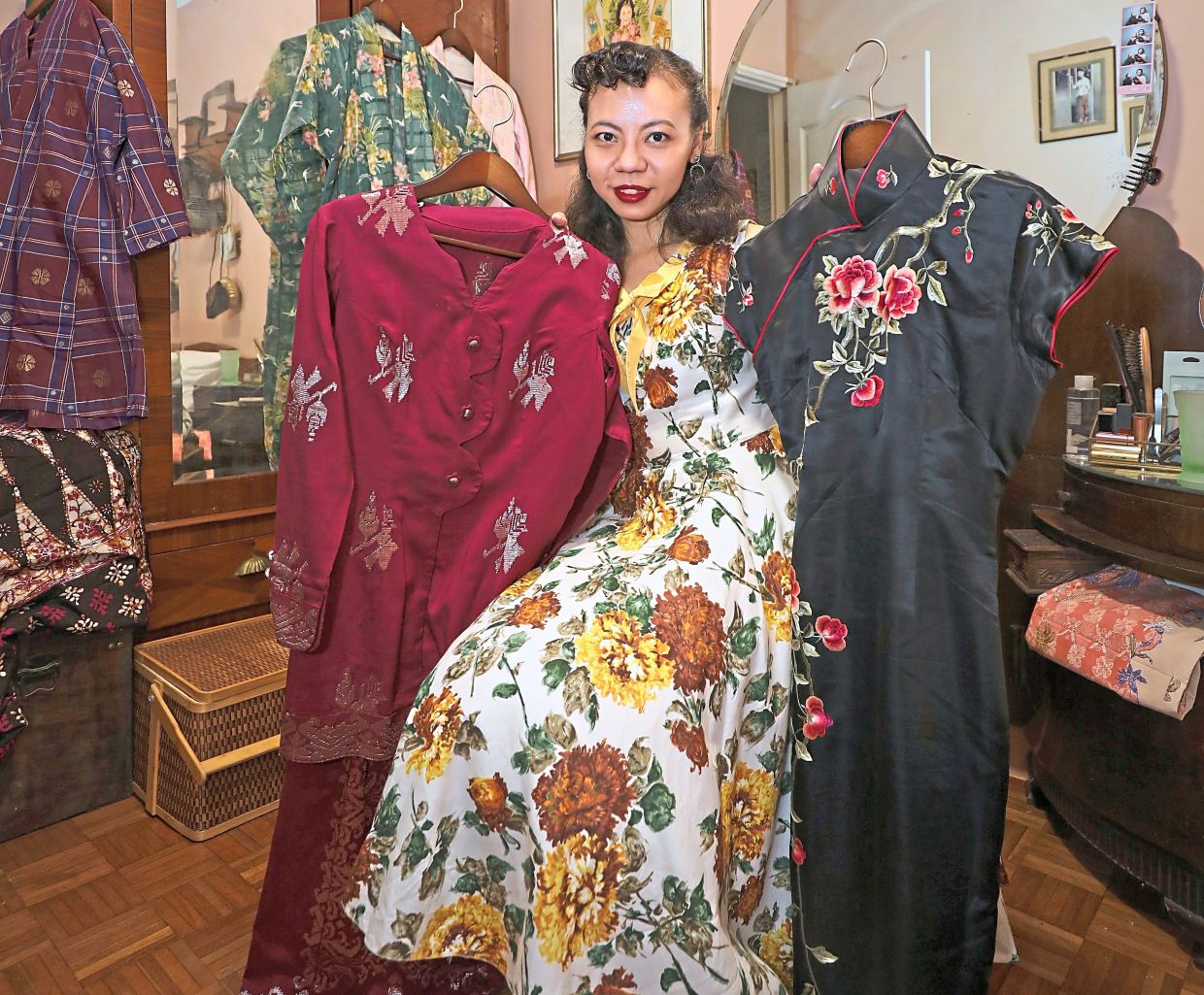
Lim's grandparents were figures of their time in ways that extended far beyond mere aesthetics. Her grandfather's enthusiasm for rock and roll culture and her grandmother's work as a taxi dancer created a household where fashion and movement were intertwined, where dressing well was not vanity but a form of cultural participation. This family legacy shaped Lim's own trajectory: she began dancing at four years old, progressed through formal Latin and ballroom training, and competed in dance competitions that required her to inhabit different historical periods through costume. The physical experience of wearing elaborate costumes during her secondary school years, when she performed traditional dances as part of the cultural club, proved formative. Each performance introduced her to the construction and purpose of traditional Malay garments—the intricate embroidery of a kebaya, the structured lines of a cheongsam, the symbolic patterns woven into songket and batik.
What began as childhood exposure crystallised into an adult collection when Lim purchased her first vintage Malaysian piece. She describes the moment with the clarity of someone recognising a calling: the transaction spiralled into an obsession she could not resist. Today, her wardrobe functions simultaneously as a personal archive and a curatorial statement, one she shares through social media photography that deliberately positions these garments against heritage backdrops. The aesthetic strategy serves a purpose beyond Instagram engagement—each image becomes a hypothesis about how Malaysians dressed, moved, and presented themselves in decades past.
For Lim, vintage clothing operates as historical evidence that textbooks and museum displays often fail to convey. Fashion, she argues, encodes information about economic conditions, social hierarchies, and cultural values in ways that formal historical narratives sometimes overlook. A dress's construction reveals labour practices and available materials. The condition of preserved pieces speaks to who could afford preservation. The accessories accompanying an outfit tell stories about trade networks and cultural exchange. By wearing these garments and documenting that wear, Lim transforms herself into a living text, interpreting the past through embodied practice rather than passive observation.
Mohamad Alif Daniel Mohammad Nor approaches this terrain from a different angle, though his endpoint converges with Lim's. At 25, the recent graduate's relationship with historical material culture emerged from his late grandmother's storytelling. Those narratives, shared across kitchen tables and family gatherings, sparked curiosity that branched into multiple directions simultaneously—music history, historical cinema, military uniforms and regalia. In his mid-teens, he began acquiring historical objects, initially focusing on duit pisana (Japanese occupation currency notes), before channelling his enthusiasm into Persatuan Reka Ulang Sejarah (PRUS), an organisation dedicated to historical re-enactment. Through PRUS, Mohamad Alif Daniel discovered that engaging with history through material objects and embodied practice yields insights that classroom learning cannot provide. Fashion and historical clothing, he explains, teach not just facts but mentality—how people thought, what they valued, which identities they performed and which they resisted.
The distinction between Lim's approach and Mohamad Alif Daniel's methodology matters less than their shared conviction: vintage and traditional clothing serves as a bridge between generations, making abstract historical concepts tangible. Lim acknowledges a critical reality facing cultural institutions across Malaysia—museums and historical archives increasingly struggle to attract younger audiences, particularly through conventional channels. The absence of young people in these spaces creates a knowledge gap, one that Lim believes her social media presence can help address. She frames her work explicitly as cultural translation, attempting to present accurate representations of historical dress to audiences who might never encounter these garments in museums or heritage centres.
Yet Lim operates within conscious constraints. Not every outfit she photographs maintains strict period accuracy; she frequently applies contemporary styling to vintage pieces, layering historical garments with modern accessories or photography techniques. She justifies this hybrid approach as a creative necessity—absolute historical recreation would alienate the very audiences she seeks to engage. However, she maintains firm boundaries around this creative freedom. When she has access to authenticated textiles and pieces, she privileges historical fidelity. Even simply demonstrating that particular Malaysian textiles and construction techniques exist, she argues, renders that heritage more concrete and defensible against erasure.
The resurgence of vintage clothing consumption among Malaysian youth appears to correlate with broader cultural patterns around digital saturation and tactile nostalgia. Lim has observed increasing numbers of young Malaysians collecting vintage objects and clothing, a phenomenon she attributes partly to a countermovement against the immateriality of digital life. There exists, she suggests, a contemporary hunger for something physically present, something that requires handling and inhabitation, something that offers a form of escapism from the relentless abstraction of contemporary existence. This yearning does not manifest as simple antiquarianism—young collectors and wearers are not attempting to resurrect the past intact but rather to extract inspiration from it, to create hybrid identities that honour tradition whilst asserting modern creative agency.
This negotiation between preservation and innovation raises questions about cultural ownership and authenticity that Lim articulates with careful precision. The freedom to reinterpret historical garments carries responsibility; boundaries exist to prevent cultural dilution and misrepresentation that might actually destabilise Malaysian identity. The concern is not merely aesthetic but ontological—if traditional garments become completely decoupled from their historical contexts, they risk losing the meaning they carry. Mohamad Alif Daniel has observed parallel dynamics through his own social media presence. Photographs showcasing traditional attire have catalysed responses from followers who express profound gratitude, revealing that his visibility has given permission to people who previously felt shame wearing these garments in public. That transformation—from concealment to pride—suggests that heritage revival serves psychological and social functions that extend far beyond fashion.
The movement coalescing around vintage Malaysian clothing and historical re-enactment ultimately reflects a generation attempting to reclaim narratives about themselves and their society. By wearing kebaya, by preserving batik, by documenting cheongsam in heritage settings, young Malaysians are making a statement about what deserves preservation, what warrants attention, what deserves to be visible. This is not nostalgia performed as political conservatism but rather as active resistance to cultural forgetting. In a region where rapid modernisation often treats the past as obsolete, these enthusiasts insist on the continued relevance of historical material, demonstrating that heritage is not museum-bound but living, wearable, and generative of contemporary meaning.

