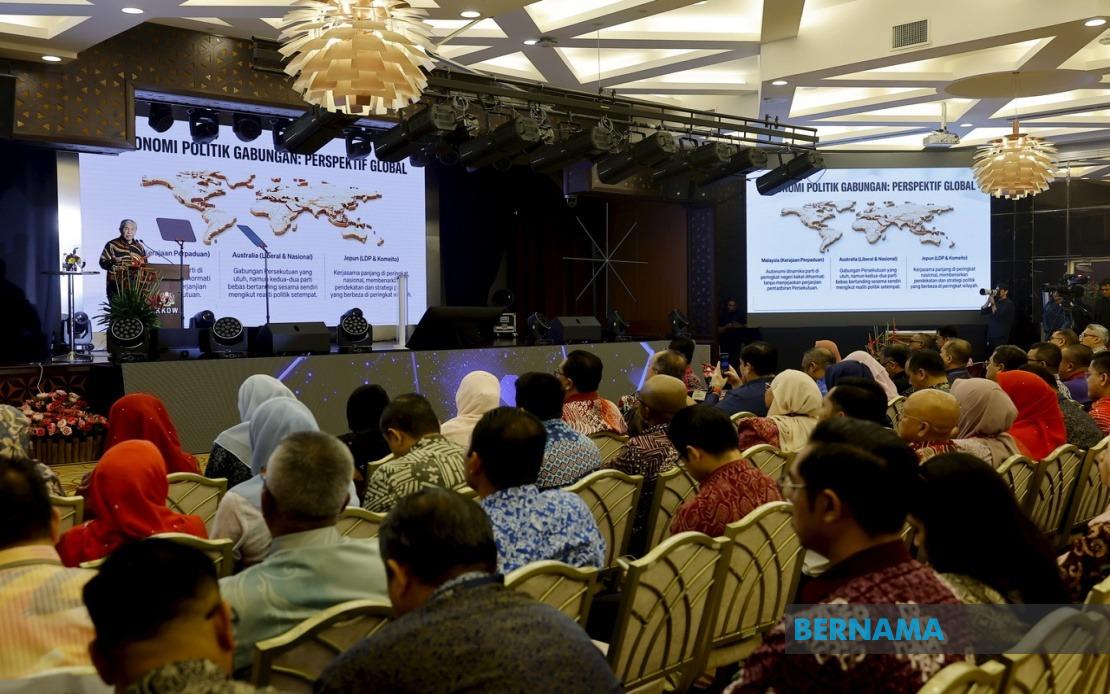
Deputy Prime Minister Datuk Seri Dr Ahmad Zahid Hamidi has moved to reassure the nation that ongoing political competition across Malaysian states presents no threat to the stability of the federal government or its legislative agenda. Speaking at the Rural and Regional Development Ministry's monthly gathering in Putrajaya on August 6, Ahmad Zahid, who also chairs Barisan Nasional, sought to distinguish between the dynamics unfolding at state level and the cohesion required at the centre, where the Unity Government continues to function according to founding principles agreed upon by its coalition partners.
The assurance carries particular weight given the recent electoral contests in Johor and Negeri Sembilan, which have reignited political jostling among component parties within the broader coalition. Rather than viewing these developments as harbingers of instability, Ahmad Zahid framed them as natural expressions of political competition that operate within carefully defined boundaries. His comments suggest the federal administration remains confident that the architectural foundations of the Unity Government—built on explicit mutual understanding and binding agreements—will withstand the inevitable pressures of electoral cycles at the subnational level.
Central to Ahmad Zahid's argument is the principle that the federal government's continuity and operational effectiveness depend fundamentally on parliamentary stability rather than absolute alignment across all governance tiers. As long as the composition of Parliament remains unchanged and the government retains its legislative majority, the machinery of state continues operating unimpeded. This distinction matters significantly for Malaysia's complex federal system, where governing coalitions must simultaneously manage competition at state level while maintaining unity where it truly counts—in securing legislative support for the administration's agenda and budget allocations.
The minister elaborated that the government's capacity to discharge its responsibilities to citizens depends not on eliminating political rivalry altogether, but on ensuring that rivalry operates within the confines of the coalition agreement that underpins the Unity Government's formation. Under this framework, government programmes and projects will proceed as planned, implementation timelines will be met, and policy priorities will advance without disruption. This reflects a pragmatic recognition that Malaysian politics has long accommodated simultaneous competition and cooperation—a balancing act that becomes more pronounced in coalition administrations where multiple parties retain distinct organisational identities and electoral interests.
Ahmad Zahid further articulated the concept of political autonomy within coalition governance, a framework that permits individual component parties to pursue their own political strategies and contest elections vigorously, provided they respect the binding commitments made when agreeing to form or join the federal government. This approach acknowledges a fundamental reality of coalition politics: parties do not shed their identities or surrender their principles upon entering a wider alliance. Instead, they negotiate the terms under which they can operate semi-independently while remaining accountable to collective agreements. The deputy prime minister's characterisation suggests that the Unity Government's architects designed it with precisely this tension in mind, building in space for intra-coalition competition while establishing clear red lines regarding core commitments.
The timing of these remarks reflects heightened sensitivity to perceptions of federal instability. Coalition governments in Malaysia face constant speculation about their durability, particularly when state-level contests produce outcomes that shift the balance of power between component parties. By explicitly stating that state-level developments will not alter the government's direction or compromise implementation of planned policies, Ahmad Zahid was signalling to both coalition partners and the broader business and investor communities that the federal government's trajectory remains intact regardless of movements at state level. Such reassurances carry economic implications, as policy continuity and governmental stability directly influence investor confidence and market sentiment.
This framing also carries implications for how Malaysia's federal-state power dynamics operate in practice. Unlike fully centralised systems, Malaysia's constitutional arrangement requires federal governments to negotiate with state governments across numerous policy domains, from land and agriculture to education and health. When political competition intensifies at state level, the resulting shift in state-level party compositions can complicate federal-state relations, particularly if states fall under opposition control or alternate coalition arrangements. By emphasising that federal stability does not hinge on state-level outcomes, Ahmad Zahid was implicitly suggesting the government is prepared to engage constructively with state administrations regardless of their political complexion, at least in implementing programmes falling within federal purview.
The comments also address internal coalition dynamics with some delicacy. Different component parties have varying incentives to compete at state level—some derive significant revenue and political authority from controlling state governments, while others are primarily invested in federal office. Ensuring that robust state-level competition does not metastasise into federal-level instability requires careful management of coalition discipline and constant reaffirmation of shared commitments. Ahmad Zahid's remarks serve partly as a reminder to coalition partners of their mutual interest in preserving federal stability, even as they contest for advantage in state elections.
From a regional perspective, Malaysia's experience managing political competition within coalition structures offers lessons relevant to other Southeast Asian democracies grappling with similar questions about sustaining multi-party governments. The emphasis on distinguishing state-level dynamics from federal-level stability suggests an evolution in how Malaysian political leaders conceptualise coalition governance—not as requiring uniform political control across all levels, but as manageable through explicit agreements and clearly demarcated spheres of operation.
Looking ahead, the success of Ahmad Zahid's reassurance will be measured by whether the federal government continues delivering on policy commitments and whether the coalition maintains its parliamentary majority through potential defections or other disruptions. The test will come not merely in the absence of formal government collapse, but in whether the administration can execute complex, multi-year programmes and maintain investor and public confidence despite ongoing state-level competition. In this sense, Ahmad Zahid's statement represents not just a statement of current fact, but a commitment the government must continually validate through its performance and the behaviour of coalition partners in coming months.

