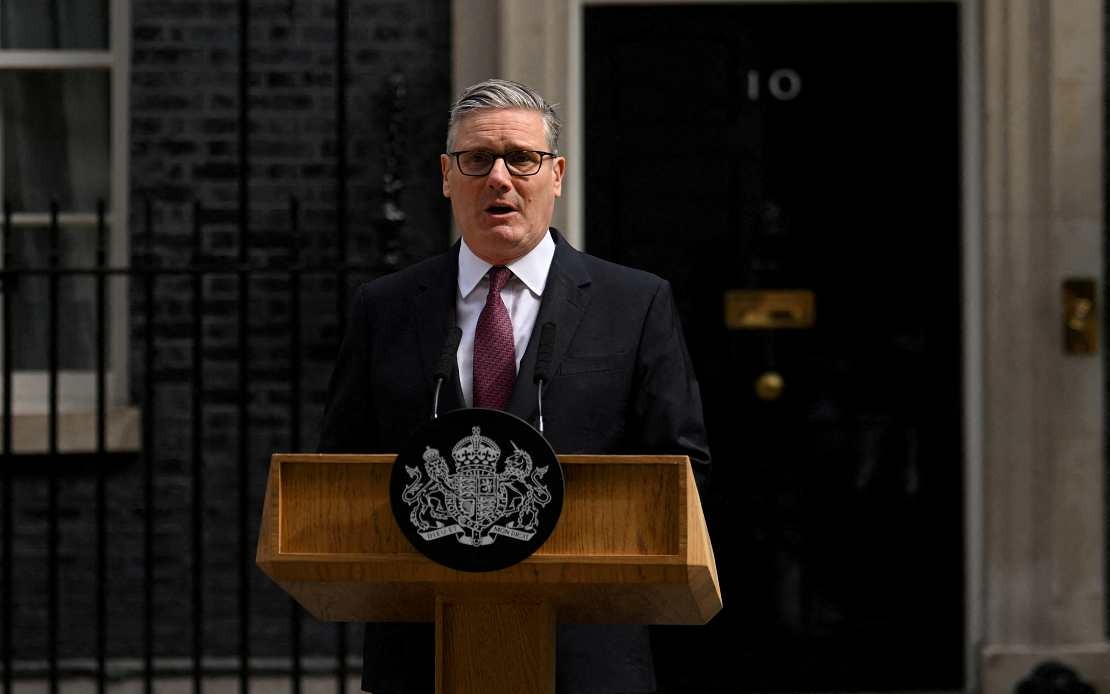
Keir Starmer has formally resigned as British Prime Minister, concluding his tenure with a brief but symbolically significant address at Downing Street before proceeding to Buckingham Palace to formally submit his resignation to King Charles. In his parting remarks delivered on Monday, the departing premier expressed contentment with his accomplishments and signalled that the reins of power would pass to Andy Burnham, marking a watershed moment in British politics after nearly two and a half years of Labour governance.
Starmer's departure statement underscored a narrative of national improvement and renewed stability. He asserted that Britain had become "stronger and fairer" during his tenure, framing his resignation not as an admission of failure but as a planned transition following the completion of core objectives. His measured tone and composed demeanour, with his wife Victoria Starmer at his side alongside colleagues and supporters, suggested an orderly handover rather than a crisis-driven exit. The imagery of departure from the Prime Minister's official residence carried considerable weight, as Downing Street has served as the seat of executive power for centuries.
The timing and circumstances of Starmer's resignation carry particular significance for regional observers in Southeast Asia, where British political stability has historically influenced Commonwealth relations and international economic confidence. Labour's internal decision to facilitate a leadership transition without the acrimony or prolonged uncertainty that might otherwise accompany such changes demonstrates institutional resilience. For Malaysia and other ASEAN nations that maintain historical ties with Westminster, the smooth functioning of British democratic institutions reinforces confidence in the broader Western political architecture.
Starmer's reference to his six-and-a-half-year journey with the Labour Party provides essential context for understanding the scale of his accomplishment. He inherited a party in the aftermath of its catastrophic 2019 election defeat under Jeremy Corbyn, when Labour secured its worst electoral performance in nearly a century. The subsequent reconstruction of the party machinery, rehabilitation of its public image, and ultimate achievement of a landslide victory in 2024 represented a remarkable turnaround that few political analysts had anticipated when Starmer assumed party leadership.
The assertion that his work was complete suggests Starmer views his primary mandate as having been fulfilled. His tenure appears to have been framed internally as a restoration project—rebuilding Labour's credibility with the electorate and restoring competent administration following the preceding Conservative government's turbulent final years. Having accomplished these strategic objectives, Starmer evidently determined that the appropriate moment had arrived to transfer leadership to fresh hands, allowing his successor to chart the party's course for the next phase of governance.
Andy Burnham's emergence as the designated successor warrants closer examination, particularly given his profile within Labour circles and his previous experience as mayor of Greater Manchester. Burnham represents a different generation of Labour politicians, bringing regional governance experience and a reputation for pragmatic problem-solving. His ascension suggests the party is prioritizing managerial competence and electoral sustainability over ideological innovation, a posture that may resonate with voters fatigued by political turbulence.
The succession arrangement reflects broader patterns within modern parliamentary democracies, where planned transitions between leaders of the same party have become increasingly common. Unlike systems where leadership changes frequently trigger constitutional crises or fresh elections, the Westminster arrangement permits orderly transfers of power provided a single party maintains its parliamentary majority. This continuity of governance, even as the figurehead changes, offers stability to markets, international partners, and domestic institutions dependent upon policy consistency.
For Malaysian readers following British politics, Starmer's resignation exemplifies the cyclical nature of democratic leadership. Whereas single-party systems may endure extended periods under the same leader, democracies typically experience regular transitions even when controlling parties retain office. The degree of civility and planning evident in Starmer's departure contrasts sharply with the acrimonious internal contests that sometimes characterise leadership changes, suggesting Labour has learned valuable lessons about managing internal conflicts.
The two-year timeframe of Starmer's premiership, though briefer than many of his predecessors, encompassed significant policy implementation and institutional stabilisation. His government navigated inheritance of a public sector beset by strikes, deteriorating public services, and depleted fiscal reserves. Whether sufficient progress was achieved on these fronts to justify his early departure remains subject to broader public judgment, though his confidence in the nation's improved trajectory suggests internal satisfaction with progress made.
Burnham's assumption of the premiership will inevitably prompt reflection on political succession planning more broadly. In systems where the ruling party selects its own leaders through internal mechanisms rather than electoral contests, the preferences of parliamentary colleagues and party machinery determine outcomes. This approach offers efficiency and stability but potentially diminishes public participation in the selection of national leaders, a tension inherent in parliamentary systems worldwide.
The transition also carries implications for regional diplomatic relationships. Prime ministerial changes often prompt recalibration of international engagements and priorities, and Burnham will inherit not only domestic policy portfolios but also Britain's complex set of bilateral and multilateral relationships. Malaysia's trade ties with Britain, regional security partnerships, and Commonwealth connections may all face subtle shifts as the new administration establishes its own diplomatic preferences and priorities.
Starmer's statement that he was departing "with a smile" conveyed philosophical acceptance of the transition process, framing his departure as a natural conclusion rather than an involuntary exit. This positive framing may assist in managing public perception of the leadership change and maintaining Labour's electoral viability heading toward future contests. The party's ability to navigate this transition smoothly will significantly influence its prospects for sustained electoral dominance and the stability of British governance in the years ahead.

