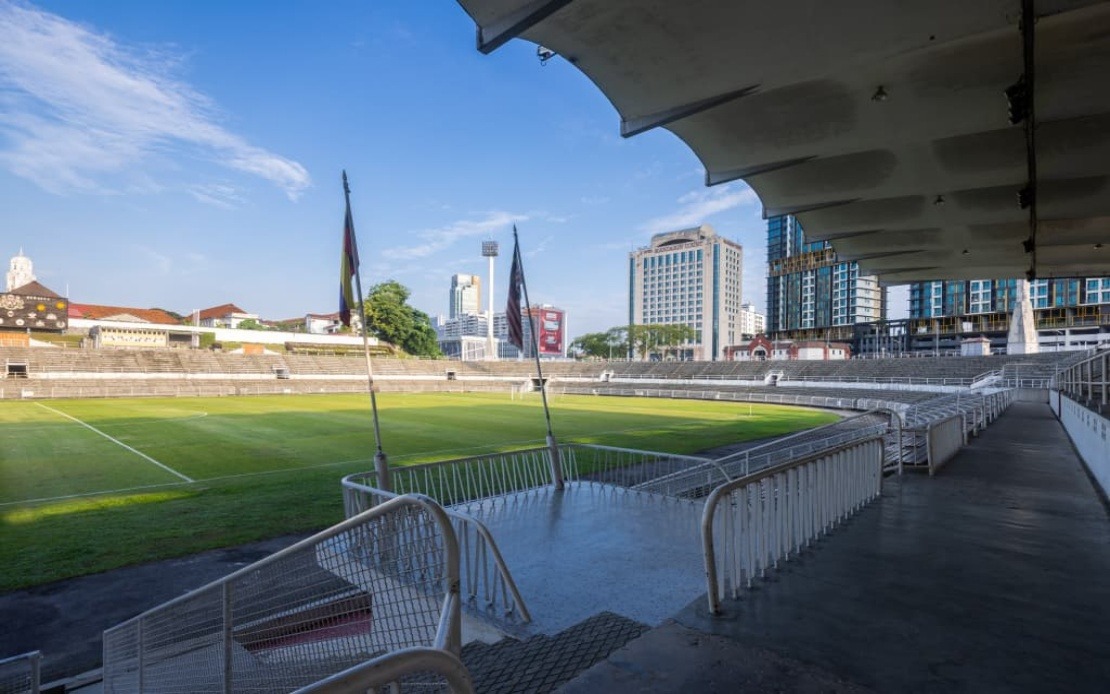
Nearly seven decades after becoming the cradle of Malaysian independence, Stadium Merdeka remains far more than a relic of the past. This iconic venue, where the first Prime Minister Tunku Abdul Rahman Putra Al-Haj proclaimed Malaya's freedom with seven resounding cries of "Merdeka" on August 31, 1957, continues to function as a vital bridge connecting contemporary Malaysians to the pivotal moment their nation was born. As modern development reshapes the Kuala Lumpur skyline—including the imposing Merdeka 118 tower that now stands beside it—the stadium's enduring presence serves as a powerful reminder that the struggle for independence and the values it represents remain central to national consciousness.
The construction of Stadium Merdeka itself reflected the ambition and urgency of a nation preparing to stand alone. Completed within a single year at a cost of approximately RM2.3 million, the facility was purpose-built to accommodate one of history's most significant national moments. The scale and speed of its construction symbolized the determination of Malayan leaders to create a worthy setting for independence. According to Universiti Putra Malaysia's social anthropology expert Prof Dr Sarjit Singh Gill, who chairs the National Council of Professors' National Unity Cluster, the stadium transcends its function as a sports venue. He emphasizes that it embodies far deeper significance—functioning as a historical monument that encapsulates the nation's identity, dignity, and cultural heritage in concrete and steel.
The stadium's historical importance expanded beyond the 1957 proclamation. In 1963, it again served as the setting for another defining moment when Malaysia formally declared its federation, extending independence to Sabah and Sarawak while marking the effective end of British colonial administration across the entire region. This dual historical significance—encompassing both the initial independence declaration and the subsequent expansion of the federation—positions Stadium Merdeka as the focal point for understanding Malaysia's transition to sovereignty. For many Malaysians, particularly those born after these events, the stadium represents something almost mythical: the physical space where their nation emerged from colonial rule.
The path to Stadium Merdeka's preservation was not inevitable. During the late 1990s, the venue faced serious threats from redevelopment proposals that could have fundamentally altered or destroyed this heritage site. Public opposition proved decisive in mobilizing support for its survival, ultimately compelling government intervention. When Permodalan Nasional Berhad (PNB) assumed management of the stadium in 2000, the organization accepted responsibility for preserving what had become recognized as an irreplaceable national treasure. This transition marked a critical shift from viewing the stadium as an aging sports facility toward understanding it as a cultural and historical asset worthy of systematic preservation.
Under PNB's stewardship, preservation efforts have been guided by rigorous historical documentation. Restoration work relied extensively on original Public Works Department construction drawings to ensure authenticity. Notably, later architectural additions—including upper-level seating tiers that had been added over subsequent decades—were carefully removed to restore the venue to its original 20,000-seat capacity. Detailed restoration attention extended to specific features including the scoreboard, facilities infrastructure, distinctive mosaic tilework, and the signature cantilevered roof structure. This meticulous approach reflects a commitment to historical accuracy rather than superficial cosmetic updates. Datuk Dr Izwan Ibrahim, Chief Executive Officer of PNB Merdeka Ventures Sdn Bhd, articulates this philosophy clearly: preserving the stadium's authenticity stands as paramount, ensuring that its narratives and significance remain genuinely accessible to all Malaysians rather than sanitized or reimagined for contemporary tastes.
The stadium's transformation into a public space has revitalized its role within Malaysian society. Beyond hosting National Day celebrations, it now functions as a working community venue featuring a refurbished track accessible to runners and athletes. Cultural events, particularly the Bazram Merdeka bazaar held during Ramadan, draw substantial crowds—the 2024 iteration attracted over 250,000 visitors, demonstrating sustained public interest in the venue. This evolution reflects a deliberate strategy to keep the stadium living and vibrant rather than allowing it to become a museum piece frozen in time. The challenge lies in balancing heritage preservation with contemporary functionality, a tension that PNB appears to be navigating thoughtfully.
Engaging younger Malaysians represents a central priority in the stadium's ongoing mission. For generations born well after 1957, independence exists primarily as historical content encountered through curriculum materials and family narratives rather than as lived experience. PNB's leadership recognizes that experiential learning—actually visiting the stadium, walking its grounds, and absorbing its atmosphere—creates fundamentally different understanding than textbook knowledge. Izwan Ibrahim emphasizes that when young people visit Stadium Merdeka in person, they develop direct connections to the historical moment rather than remaining intellectually distant from it. Early evidence suggests this approach is succeeding, with neighboring schools increasingly incorporating the stadium into educational programming, allowing students to connect abstract historical concepts to concrete spaces and tangible heritage.
International recognition has reinforced Stadium Merdeka's status as a site of global significance. In 2008, the venue received a UNESCO Asia-Pacific Heritage Award, formal acknowledgment of its cultural importance beyond Malaysia's borders. The subsequent gazettal as a National Heritage site in 2009 provided legal protection and formal status within Malaysia's conservation framework. These designations reflect growing international understanding that the stadium represents not merely local or regional history but exemplifies processes of decolonization that reshaped the global order during the twentieth century.
The human dimensions of preservation work often remain invisible to visitors, yet they prove essential to maintaining the stadium's integrity. Alias Daud, a long-serving PNB staff member who spent 35 years dedicated to facility maintenance and care, exemplifies the commitment required to preserve heritage effectively. For Daud, the stadium transcends employment—it represents something approaching home, a place infused with deep personal meaning accumulated through decades of observation and stewardship. He witnesses the diverse Malaysians who pass through the gates, each carrying their own interpretations and memories connected to the space. During Merdeka month particularly, the atmosphere intensifies as government agencies, schools, and universities schedule visits, generating renewed energy around the stadium's historical narratives. Younger visitors, Daud observes, frequently express surprise and respect upon learning that this particular venue hosted independence's proclamation, suggesting that direct encounter with heritage sites can powerfully reshape historical understanding.
The stadium's enduring prominence amid contemporary urban development creates compelling visual metaphors. As Kuala Lumpur's skyline transforms with new construction—including the massive Merdeka 118 structure now dominating its immediate vicinity—Stadium Merdeka persists as a relatively modest but resolute presence. This juxtaposition between old and new, heritage and modernity, carries symbolic weight. The stadium's continued existence amid rapid development represents a deliberate societal choice to preserve connection with foundational national moments even as economic imperatives drive constant urban transformation. This balance between progress and preservation reflects broader questions about how developing nations maintain cultural continuity while embracing modernization.
For regional observers, Stadium Merdeka's preservation offers instructive examples relevant across Southeast Asia. The stadium demonstrates that heritage preservation requires sustained institutional commitment, adequate resources, and public support maintained across decades. It illustrates how spaces initially constructed for specific ceremonial purposes can evolve into multifunctional venues serving contemporary communities. Most significantly, it exemplifies how physical heritage sites can actively engage younger generations through experiential programs rather than passive observation. As other nations in the region grapple with how to preserve sites associated with decolonization and nation-building, Stadium Merdeka's approach—combining rigorous historical documentation with contemporary public programming—provides relevant precedents.
Stadium Merdeka ultimately represents something beyond architecture or historical record. It functions as a physical anchor for national identity, a place where abstract concepts like sovereignty and freedom acquire tangible presence. As modern Malaysia navigates complex contemporary challenges, this venue reminds successive generations of the determination and sacrifice required to establish independence. The stadium's ongoing vitality—through public programs, educational initiatives, and community events—ensures that the spirit embodied in Tunku Abdul Rahman's proclamation remains actively present rather than confined to historical archives. In this sense, Stadium Merdeka succeeds most profoundly not as a memorial to the past but as a living institution that connects Malaysians across generations to the foundational commitments that established their nation.

