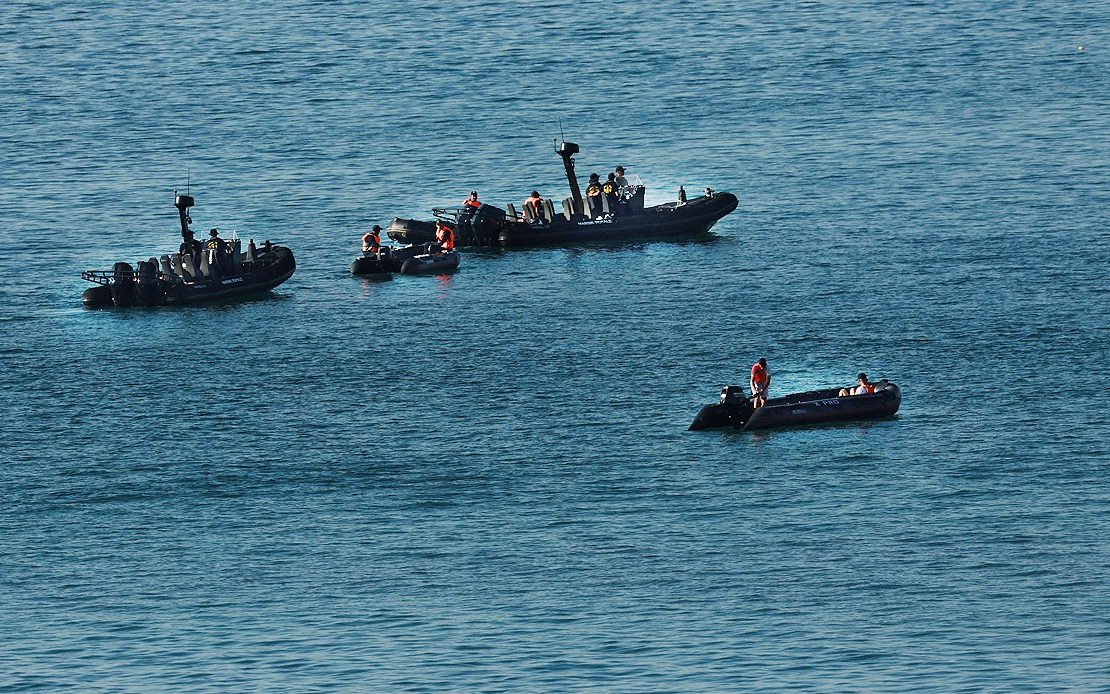
The scale of the humanitarian tragedy unfolding in and around Ceuta has become starkly apparent as Spanish authorities continue systematic searches along the North African coast, with recovery operations now focused on retrieving the bodies of those who perished during a chaotic influx of migrants from neighbouring Morocco. The official death toll stands at 67 individuals who drowned while attempting to swim into European Union territory, though concerns persist that the final count may be considerably higher as search-and-rescue operations remain ongoing. The Spanish exclave, a territory of only 85,000 residents, was inundated by approximately 50,000 migrants within a matter of days, creating a logistical crisis that has strained resources and sparked significant political controversy.
Prepared for the worst, Spanish authorities have established temporary facilities capable of handling up to 200 deceased bodies, underscoring the grim scale of what has been described as one of the most dramatic surges of irregular migration to European shores in recent years. The construction of these morgue facilities reflects the authorities' acknowledgment that the recovery operation may yet yield more tragic discoveries. Most of the migrants who successfully entered Ceuta have since voluntarily returned across the border to Morocco, yet this partial resolution has done little to quell the political firestorm that has engulfed the Spanish government's handling of the episode.
The crisis has become deeply divisive within Spain's political establishment, with numerous EU leaders—particularly those from countries already grappling with substantial asylum pressures—openly criticising Prime Minister Pedro Sánchez's left-wing administration for its perceived failure to anticipate and prevent the mass crossing. The criticism reflects broader tensions within the European Union over immigration policy, burden-sharing mechanisms, and the effectiveness of coordinated border management strategies. Sánchez's government, which had previously emphasised its commitment to humane migration policies, now faces accusations from both left and right that its approach created vulnerabilities that migrants and smuggling networks rapidly exploited.
To prevent a recurrence of the crisis, Spanish officials have begun implementing new physical barriers at sea, installing buoys and other structures designed to obstruct future crossing attempts from Moroccan waters. These measures, visible in recent coast guard footage showing calm conditions off Ceuta, represent a significant hardening of Spain's immigration stance and reflect the administration's determination to reassert control over its maritime borders. The installation of these barriers is not merely a reactive security measure but part of a broader strategic response to anticipated future migration pressures, particularly given the geographic proximity of Morocco and the desperate circumstances affecting vulnerable populations across North Africa.
The barriers serve a dual purpose: practical obstruction and legal fortification. Spanish authorities identified a critical loophole that contributed to the recent surge after Spain's Supreme Court issued a ruling that fundamentally altered the legal landscape governing irregular border crossings. The court determined that individuals who enter Spanish territory by crossing the border irregularly through unfortified sections—specifically maritime crossings—retain the right to individual asylum assessments rather than automatic deportation. This judgment inadvertently created a legal pathway that smuggling networks rapidly leveraged to encourage migrants to attempt the dangerous sea crossing, with tragic consequences.
By constructing physical barriers in the water, Spain is attempting to circumvent this Supreme Court ruling through geographic means, essentially redesignating the seaward approach to Ceuta as a fortified boundary that would not qualify for the asylum assessment provisions outlined in the court's decision. This strategy reflects the complex interplay between judicial oversight, executive authority, and border control policy that characterises European migration management in the contemporary era. The approach, however, raises questions about whether physical barriers will prove effective against determined migrants willing to risk dangerous sea passages.
The Ceuta crisis illuminates the precarious position of Spain's North African territories, which sit at the intersection of African migration pressures, European border obligations, and complex bilateral relationships with Morocco. The Spanish government must now balance humanitarian concerns with the political necessity of demonstrating control over its borders—a calculation that has become increasingly fraught in an environment where migration policy functions as a litmus test of governmental competence and sovereignty. The installation of barriers, while symbolically important, may ultimately prove insufficient if underlying push factors in North Africa and pull factors within Europe remain unaddressed.
For Malaysia and other Southeast Asian nations, the Ceuta crisis offers instructive parallels regarding irregular migration patterns, the role of smuggling networks, and the tension between humanitarian obligations and border security imperatives. Southeast Asia has long confronted challenges similar to those now confronting Spain, particularly regarding maritime crossings and the human toll of irregular migration. The Rohingya maritime crisis, recurring incidents off Malaysian shores, and the complex dynamics of irregular labour migration throughout the region demonstrate that these are not uniquely European problems but rather global phenomena requiring coordinated, humane, and strategically coherent responses.
The Spanish government's evolving approach—combining barrier construction with capacity building for asylum processing—reflects lessons learned from years of migration management experience within the EU framework. These lessons, though contextualised within European legal and political systems, contain elements potentially applicable to Southeast Asian migration governance, particularly regarding the importance of addressing root causes while simultaneously maintaining orderly border procedures. The tragic loss of life in Ceuta serves as a sobering reminder that migration policy decisions carry profound human consequences that demand careful consideration of both security and humanitarian dimensions.

