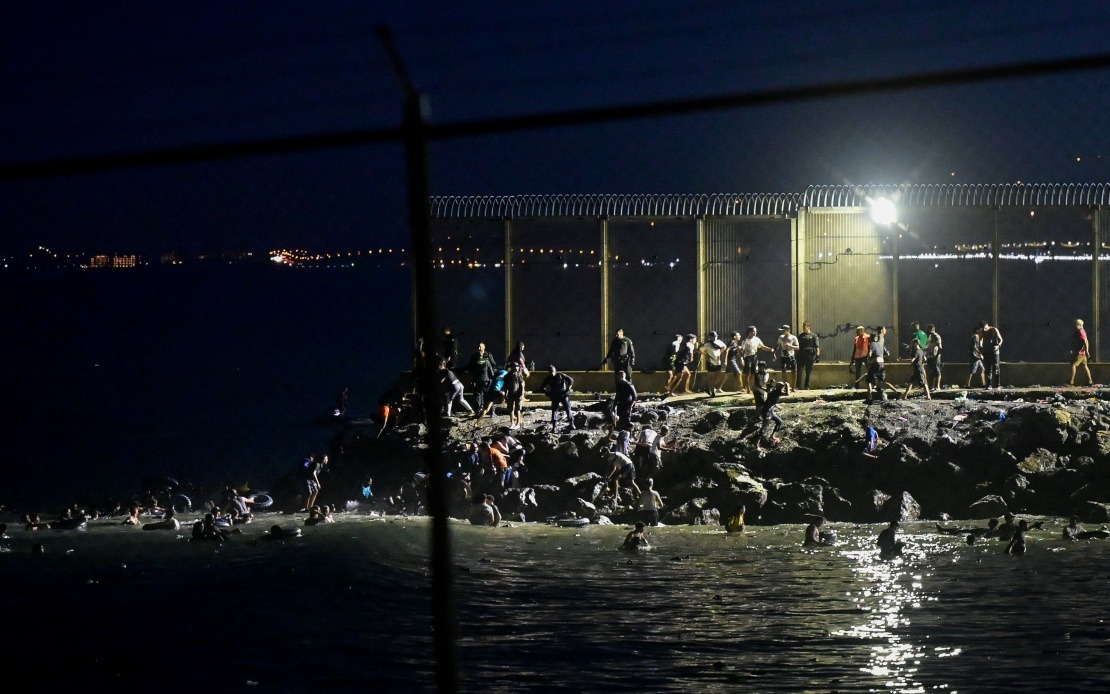
Spain's government has activated comprehensive border management protocols following a dramatic surge in migration attempts at its North African enclave of Ceuta, with Prime Minister Pedro Sanchez vowing to marshal all state resources to address the escalating crisis. The scale of Thursday's incidents, which saw thousands of young Moroccan nationals converge on the frontier, triggered an unprecedented response from Madrid's leadership, signalling the seriousness with which authorities view the breakdown of border management.
Sanchez took to social media to reassure Spanish residents and regional officials that governmental apparatus was being fully engaged to restore orderly conditions. His statement emphasised a coordinated approach involving cooperation with Moroccan counterparts and international partners, framing the crisis not merely as a security concern but as a challenge requiring diplomatic and administrative solutions. The Prime Minister's rhetoric stressed responsibility and collaborative problem-solving, suggesting Madrid seeks to avoid unilateral escalation that might strain bilateral relations with Morocco.
The operational response has broadened significantly beyond normal Civil Guard deployment, with Spanish armed forces being activated to provide auxiliary security support across the enclave. This military involvement represents an exceptional measure, indicating that civilian law enforcement capacity was deemed insufficient to manage the scale of the attempted incursions. Such mobilisation typically signals governmental assessment that the situation had deteriorated beyond routine border management parameters, warranting extraordinary measures.
Internal Minister Fernando Grande-Marlaska joined Sanchez in signalling immediate engagement with the crisis. Both officials committed to visiting Ceuta on Friday to conduct personal evaluation of conditions, a move designed to project political commitment and enable senior decision-makers to assess circumstances directly rather than relying on intermediaries. This high-level visitation underscores Madrid's determination to exercise active oversight during a critical period for the enclave's stability.
Ceuta's regional administration had previously submitted formal requests to the central government for reinforced assistance, indicating that local capacity had been overwhelmed by the coordination and scale of migration attempts. The breakdown in normal border procedures forced regional officials to escalate the matter through established governmental channels, prompting the comprehensive national response now underway. This administrative escalation pathway reveals the severity of circumstances faced by frontline authorities.
On Thursday, the coordinated nature of the crossing attempts became apparent as substantial numbers of predominantly young migrants assembled near the Castillejos-Ceuta frontier line, suggesting organisation beyond spontaneous individual initiative. Eyewitness accounts documented groups systematically attempting multiple entry routes, with some forcing border fencing whilst others utilised alternative pathways including marine approaches. The diversity of attempted entry methods indicates tactical planning to maximize penetration despite security obstacles.
Moroccan security apparatus responded by establishing containment cordons in strategic border zones and apprehending numerous individuals attempting to cross. Despite these interventionist efforts, Moroccan authorities found that substantial groups continued advancing toward the frontier, suggesting either insufficient police presence or deliberate prioritisation of specific zones over comprehensive coverage. This incomplete containment from Morocco's side compounded pressure on Spanish security arrangements.
For Southeast Asian observers, this European border crisis carries relevance regarding migration management strategies and resource allocation during mass movement scenarios. The scale and coordination witnessed at Ceuta parallel challenges confronting various Indo-Pacific nations managing irregular migration flows across maritime and terrestrial boundaries. Spain's mobilisation model—combining military deployment, diplomatic coordination, and inter-agency cooperation—represents an instructive case study in comprehensive border response infrastructure.
Moreover, the incident exemplifies persistent structural tensions between North African and European migration dynamics. Economic disparities, demographic pressures, and limited legal pathways for labour mobility continue generating irregular crossing incentives. The enclave's geographic position—accessible from multiple Moroccan cities yet representing European territory—creates unique vulnerability to mass movement attempts. Regional stability considerations influence both Spanish and Moroccan governmental calculations regarding border enforcement intensity and methods.
The political dimensions extend beyond immediate security concerns into questions of European cohesion and burden-sharing. As an external border area, Ceuta's migration pressures carry implications for European Union functioning and inter-member solidarity in managing irregular arrivals. Spanish responses to border crises influence broader European conversations regarding migration policy, securitisation, and humanitarian obligations—discussions increasingly important as global displacement figures rise.
Morocco's cooperation remains strategically essential for sustainable border management, particularly given its control over departure points and transit populations. The diplomatic framing emphasising partnership reflects Madrid's calculation that coercive unilateral enforcement proves ineffective without upstream cooperation from Morocco. This interdependence fundamentally shapes Spanish policy approaches and explains official rhetoric prioritising collaborative rather than adversarial characterisations of the crisis.
Looking forward, the incident will likely inform policy recalibration regarding Ceuta's security infrastructure, resource allocation, and inter-agency procedures. The unprecedented military deployment may establish precedent for future mass movement scenarios, while stimulating debate regarding border management efficiency and humanitarian considerations. Understanding the underlying migration pressures—employment availability, regional economic conditions, and transportation networks—remains critical for developing sustainable long-term solutions beyond episodic security responses.

