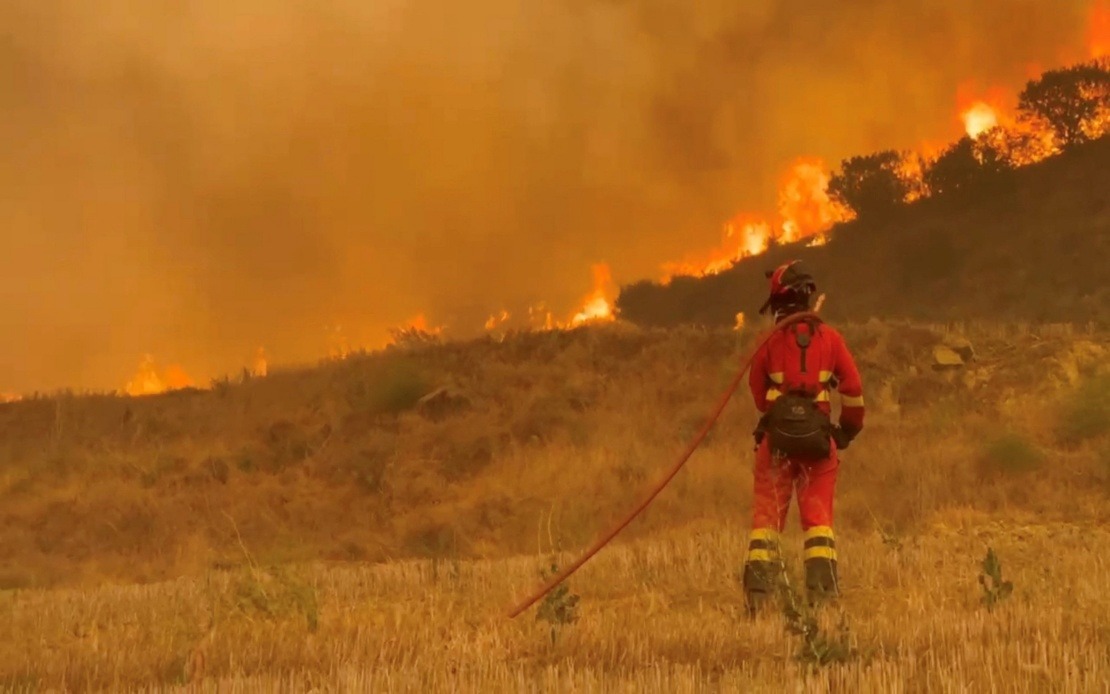
Spain is grappling with its most destructive wildfire of the year, with authorities struggling to contain a massive blaze that has consumed approximately 12,000 hectares across the northeastern province of Zaragoza. The fire, which ignited on Wednesday within the Cinco Villas region, has escalated into a serious crisis requiring the displacement of more than 1,100 residents from affected communities. Firefighting teams remain locked in intensive operations as the blaze continues to display alarming activity and expansion, particularly during overnight hours when cooler temperatures should theoretically slow its progression.
The geographical reach of the disaster has expanded dramatically since its inception. The fire's perimeter now stretches roughly 60 kilometres, encompassing five municipalities within Zaragoza and spilling across provincial boundaries into neighbouring Navarre. This vast expanse reflects both the intensity of the fire and the challenging terrain that rescue services must navigate. Multiple road closures have hindered access throughout the affected region, complicating evacuation procedures and hampering the deployment of emergency resources to critical zones. However, electricity infrastructure serving the evacuated towns has been successfully restored, mitigating additional hardships for communities awaiting the all-clear to return home.
The response mobilisation demonstrates the scale of Spain's wildfire challenge. On Thursday alone, authorities deployed approximately 400 ground-based firefighting personnel alongside 19 aircraft equipped with water-bombing capabilities. Through the night, operational priorities shifted toward defensive measures, with teams concentrating efforts on safeguarding residential structures in Uncastillo, a strategy that reflects realistic assessment of containment prospects. The Military Emergency Unit received activation orders and dispatched around 100 additional personnel, underscoring how regional wildfire management now routinely requires military involvement alongside civilian emergency services.
The Zaragoza conflagration is not an isolated incident. A second significant fire in La Mierla, located in Guadalajara province to the north, has already consumed approximately 900 hectares and remains actively spreading. This blaze has similarly necessitated evacuation procedures and preventative lockdown measures in surrounding communities as a precautionary measure. These parallel catastrophes strain Spain's finite firefighting resources, forcing difficult triage decisions about deployment priorities. The convergence of multiple major fires across different regions simultaneously reveals structural limitations in capacity when facing compound disasters during peak summer season.
A third wildfire near Lozoyuela, positioned north of Madrid, presents a more ambiguous situation. Emergency services characterise its trajectory as progressing favourably compared to the other blazes, yet it remains neither fully controlled nor safely contained. This intermediate status reflects the unpredictable nature of wildfire dynamics even when suppression efforts appear initially successful. The potential for rapid re-intensification remains present until authorities declare complete containment, a milestone often requiring several additional days of surveillance and weather monitoring.
Investigative authorities have already identified a suspect in connection with the Madrid-region fire, with the Civil Guard conducting an arrest. The regional government has indicated its intention to participate directly in subsequent legal proceedings as a civil party, signalling administrative determination to pursue accountability through judicial channels. This prosecutorial dimension adds a criminal investigation layer to the broader disaster response, though experts emphasise that arson, whether intentional or negligent, represents only one causative factor within the complex equation driving current wildfire prevalence.
Metereological conditions have dramatically amplified fire risk across the Iberian Peninsula. Sustained high temperatures, forceful wind patterns, and exceptionally low humidity levels create the archetypal environment for rapid fire propagation. Paradoxically, abundant dried vegetation accumulated following a wetter-than-average spring has provided abundant fuel for blazes. This fuel availability, combined with atmospheric instability, transforms even small ignition sources into potentially catastrophic conflagrations that overwhelm conventional suppression capabilities. The seasonal convergence of these factors creates predictable windows of extreme vulnerability.
Beyond immediate meteorological dynamics, broader environmental and socioeconomic forces have fundamentally altered wildfire patterns across rural Spain. Climate change has progressively extended peak fire season duration while intensifying the severity of individual events. Simultaneously, sustained depopulation of interior rural regions has resulted in reduced land management and fuel reduction practices that historically mitigated wildfire risk. As communities shrink and agricultural activities diminish, vegetation density increases unchecked, transforming landscapes into tinderboxes. This intersection of climatic change and rural abandonment represents a structural challenge requiring policy responses extending far beyond conventional firefighting tactics.
For Malaysian and Southeast Asian observers, Spain's wildfire crisis carries cautionary relevance. While equatorial and tropical climates create different fire ecology than Mediterranean Europe, the underlying pattern of climate disruption driving intensified disasters translates across geographical contexts. Southeast Asian nations have experienced escalating haze episodes from agricultural fires and peatland burning, phenomena directly exacerbated by warming temperatures and altered precipitation patterns. The Spanish experience demonstrates how even wealthy nations with substantial firefighting resources face mounting pressure from climate-driven disasters, suggesting regional preparedness requirements may require continuous upward revision.
The current Spanish crisis also illustrates how modern disasters increasingly exceed individual regional response capacity, necessitating cross-provincial and potentially international coordination mechanisms. Resource scarcity during compound emergencies forces difficult prioritisation decisions that ultimately leave some communities under-protected. This reality carries implications for Southeast Asian disaster management planning, where transboundary fire impacts already occur regularly and may intensify. Building redundancy, regional stockpiling, and mutual aid agreements represents pragmatic adaptation to a climate-altered risk landscape.
Spain's authorities continue monitoring the situation closely as overnight conditions determine whether fires will stabilise or experience renewed acceleration. The coming days remain critical as suppression efforts compete against seasonal factors that favour fire expansion. Until definitively controlled, these blazes will continue displacing residents, straining emergency services, and threatening critical infrastructure. The broader narrative, however, extends beyond immediate crisis management into fundamental questions about sustainable land use, climate adaptation, and the long-term viability of rural communities within progressively warming and drying landscapes.

