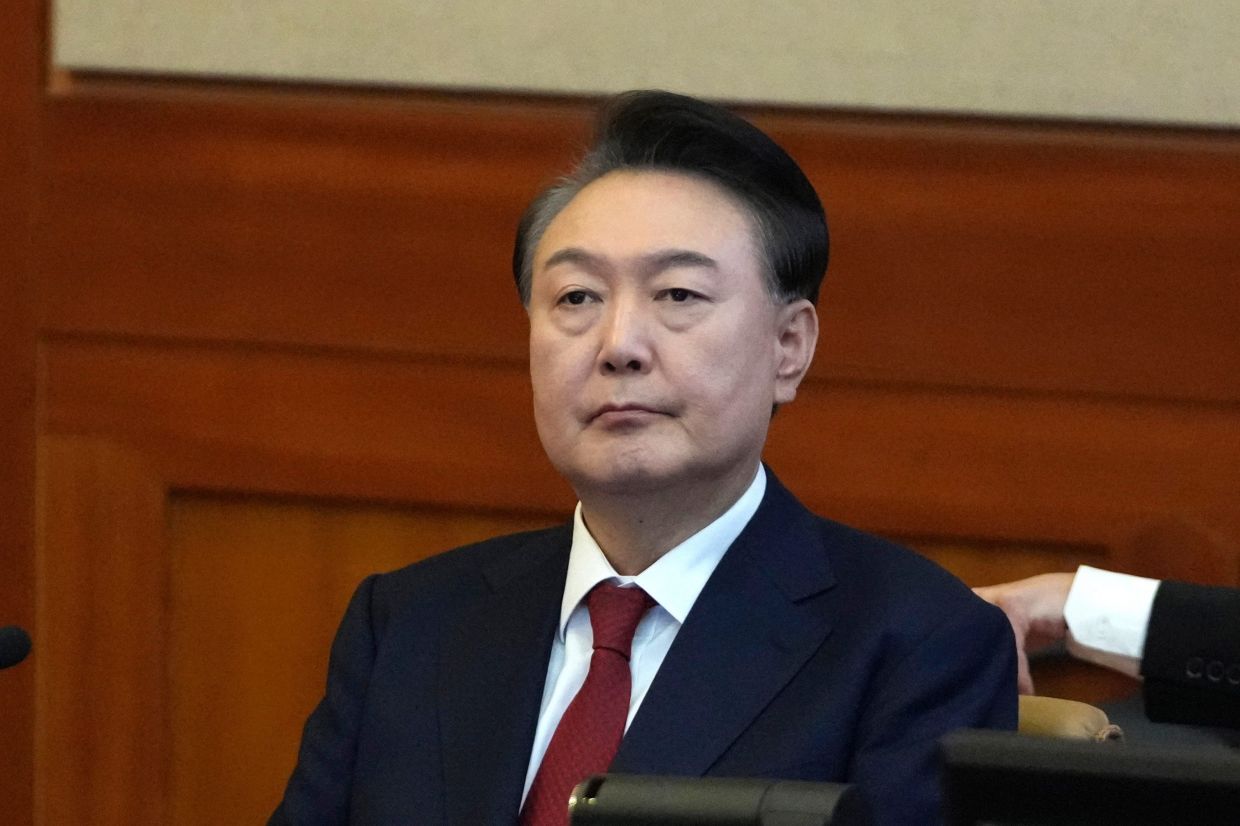
South Korea's Supreme Court has delivered its final judgment on former president Yoon Suk Yeol, confirming a seven-year prison sentence related to his abortive declaration of martial law in December 2024. The ruling, announced on Thursday, represents a definitive legal conclusion in one of the nation's most consequential constitutional crises in recent memory, cementing judicial accountability for the botched emergency measure that destabilised the world's 13th-largest economy.
The conviction stems from multiple offences committed during the chaotic build-up to and immediate aftermath of the martial law declaration. Yoon faces allegations of obstructing cabinet deliberations by handpicking only a select group of ministers for crucial pre-declaration discussions, rather than consulting the full cabinet as procedure required. Additionally, prosecutors proved that his administration fabricated an official martial law decree featuring forged signatures of the prime minister—a fraud designed to lend legitimacy to the proclamation. Evidence also showed that Yoon ordered officials to disseminate misleading information to international media outlets and directed military commanders to destroy records stored on secure military communications devices.
The Supreme Court's findings affirmed the lower and appellate court judgments without exception, with the bench declaring during televised proceedings that the underlying decisions "contained no errors." The judges systematically rejected arguments raised by both the prosecution, which had pursued a harsher 10-year term, and Yoon's legal representatives, who sought acquittal or a dramatically reduced sentence. This trilateral affirmation—from first instance through appeals to the nation's highest tribunal—underscores the consistency of evidence against the former leader across the entire judicial hierarchy.
The legal journey to this point has been remarkably swift by international standards. A lower court initially sentenced Yoon to five years in January after finding him guilty on most charges. Within months, an appellate court not only upheld that conviction in April but added a guilty verdict on the charge of authorising the misleading foreign media release and elevated the sentence to seven years. The rapid processing through multiple court levels reflects both the gravity of the charges and the urgency South Korea's judicial system placed on resolving this unprecedented constitutional emergency.
Yoon's defence team responded to the Supreme Court verdict with a public statement expressing "deep regret" and accusing the nation's highest court of reaching conclusions "without sufficient deliberation." The lawyers have signalled their intention to mount a constitutional challenge to the ruling, a manoeuvre that would require arguing the sentence itself violates the former president's fundamental rights under South Korea's constitution. Additionally, the defence team plans to lodge a formal complaint, though such remedies typically carry minimal prospects of success once a Supreme Court judgment has been rendered.
The martial law declaration itself remains a singular event in contemporary South Korean politics. In a late-night televised address broadcast across the nation on December 3, 2024, Yoon announced the suspension of civilian rule in what he framed as a necessary emergency measure. However, the declaration collapsed within approximately six hours as the National Assembly convened in emergency session and voted overwhelmingly to rescind it. This speed with which lawmakers nullified the order meant that martial law never took practical effect, yet the attempt alone triggered profound consequences: mass demonstrations erupted, domestic stock markets experienced sharp declines, and key international partners, particularly the United States, were caught unprepared by Yoon's unilateral action.
Throughout his legal proceedings, Yoon has maintained that his martial law bid was undertaken purely in service of national interests and constitutional governance. He has characterised the declaration as a necessary step to eliminate what he termed "anti-state forces" within government and to address what he claimed were escalating threats originating from North Korea. These justifications have found little traction with the judiciary, which focused instead on the procedural violations, document forgeries, and obstruction of legitimate governmental processes that accompanied the declaration.
The consequences for Yoon extend well beyond the seven-year sentence just confirmed. In a separate proceeding, a court previously imposed a 30-year prison term for orchestrating drone incursions into North Korean airspace, actions prosecutors alleged were designed to artificially manufacture a security crisis that would justify the subsequent martial law declaration. These concurrent sentences mean that even if Yoon serves them simultaneously, he faces substantial imprisonment extending well into his advanced years.
Yoon's removal from office occurred in April 2025, approximately four months after his martial law attempt, triggering a presidential election that reshuffled South Korea's political landscape. Lee Jae Myung, representing the centre-left Democratic Party, ascended to the presidency in the subsequent election, providing continuity to the non-conservative political movement and representing a stark reversal from Yoon's presidency. The transition underscores how decisively South Korean voters rejected the path Yoon attempted to chart for the nation.
For Malaysia and other Southeast Asian democracies, the Yoon case offers instructive lessons about institutional resilience and judicial independence. South Korea's parliament and courts functioned precisely as designed during the constitutional emergency, with lawmakers mobilising to overturn the extraordinary executive action and courts systematically examining the legality of the former president's conduct. The relatively transparent legal proceedings, the maintenance of due process protections even for a former head of state, and the final Supreme Court judgment all demonstrate how democratic institutions can absorb and process even severe shocks to the constitutional order.
The Supreme Court's confirmation of the seven-year sentence also reflects broader questions about executive authority and its legitimate boundaries. By holding a former president legally accountable for actions taken while in office, South Korea's judiciary has reinforced the principle that no elected official stands above the law—a foundational democratic norm that remains contested or underdeveloped in various regional contexts. The case suggests that even the highest constitutional offices operate within circumscribed legal limits and that attempts to expand executive power through martial law declarations or similar mechanisms will encounter judicial scrutiny.
As Yoon transitions from political figure to prison inmate, South Korea enters a new chapter in its democratic development. The legal closure on this particular case does not resolve deeper questions about how the nation should address the underlying political divisions and institutional tensions that Yoon claimed justified his emergency declaration. Nevertheless, the Supreme Court's final judgment provides definitive legal accountability and establishes a clear historical record that the nation's courts stood as guardians of constitutional order when civilian governance faced its most serious challenge in decades.

