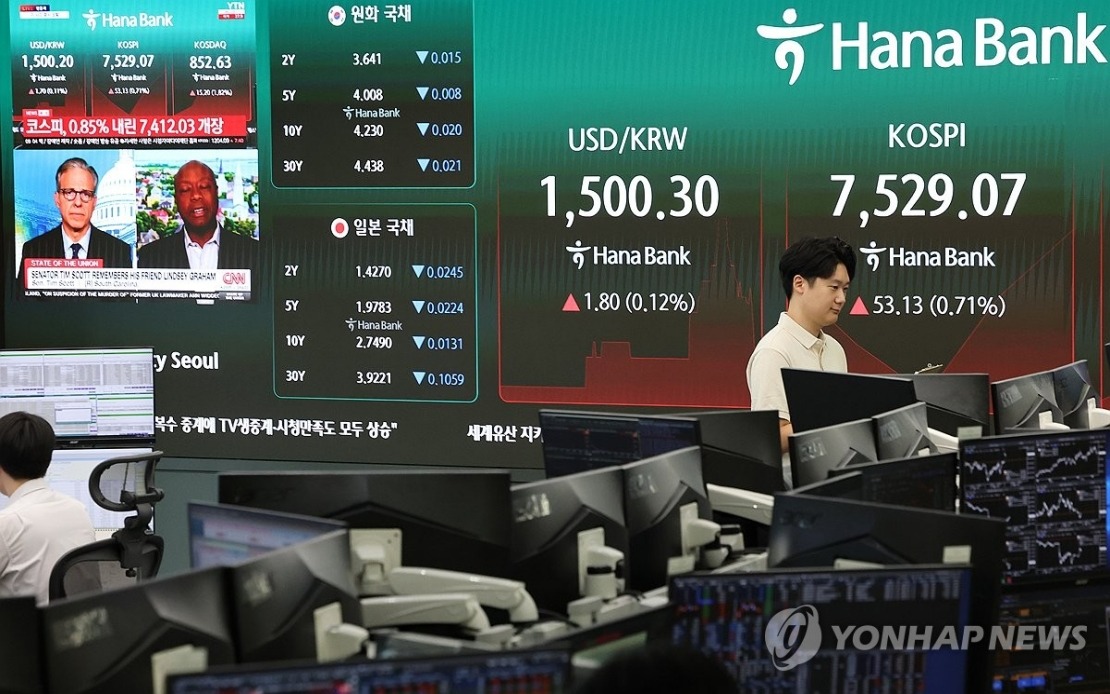
South Korea's primary bourse operator triggered an automatic trading halt on Monday afternoon as the benchmark Korea Composite Stock Price Index (KOSPI) experienced a sharp downturn, marking the seventh such suspension this year as geopolitical risks continue to unsettle regional financial markets. The Korea Exchange (KRX) activated the circuit breaker mechanism at approximately 1:28 p.m. local time, pausing all trading of KOSPI-listed shares for twenty minutes after the index had fallen more than 8 percent from the previous trading session's closing level.
The sudden market turbulence reflected investor anxiety triggered by renewed military posturing between the United States and Iran, with tensions centred on control and transit through the strategically critical Strait of Hormuz. This vital waterway, which sits between Iran and Oman, remains one of the world's most important shipping lanes for energy supplies, making any escalation in the region a direct concern for oil-dependent Asian economies including South Korea. The fresh exchange of strikes between Washington and Tehran rattled market sentiment across multiple trading floors, as participants reassessed their exposure to potential supply chain disruptions and commodity price volatility.
Circuit breaker mechanisms exist as essential safeguards within equity markets, designed to provide orderly halts during periods of extreme selling pressure and allow traders time to reassess positions without succumbing to panic-driven cascades. The KRX's activation underscores the vulnerability of South Korea's equity market to external shocks, despite the nation's advanced economic infrastructure and sophisticated financial institutions. When the KOSPI tumbled past the predefined threshold, the automatic halt was triggered, giving market participants a pause to digest developments and potentially cool heightened emotions before resuming transactions.
The frequency of circuit breaker activations this year—seven instances through mid-July alone—suggests that South Korean equities have faced considerable headwinds from multiple sources of uncertainty. These include not only geopolitical tensions in the Middle East, but also broader macroeconomic concerns, trade policy unpredictability, and shifting monetary conditions across global markets. For Malaysian investors and financial professionals, the KOSPI's volatility carries significance given the regional interconnectedness of Southeast Asian and Northeast Asian equity markets, with many Malaysian institutional investors maintaining substantial exposure to Korean technology, automotive, and financial stocks.
The circuit breaker system reflects international best practices adopted by major bourses worldwide following the 1987 stock market crash, which demonstrated the dangers of uncontrolled market panics. South Korea's implementation of these safeguards, combined with its sophisticated trading infrastructure, positions it as one of Asia's more resilient financial centres. Nevertheless, Monday's suspension demonstrates that even well-developed markets remain susceptible to sudden shocks when geopolitical developments intersect with investor sentiment.
The Strait of Hormuz incident carries particular weight for Asian markets given the region's heavy dependence on oil transported through these waters. South Korea, as a major oil importer with significant petroleum refining and petrochemical industries, faces direct exposure to any disruption in energy supplies or volatility in crude oil pricing. This reality means that whenever tensions in the region escalate, Korean equities typically experience immediate downward pressure as investors reprice risk and consider the potential economic consequences of higher energy costs.
Monday's trading suspension also highlighted the continued relevance of circuit breaker mechanisms in modern markets dominated by algorithmic trading and high-frequency strategies. Without automatic halts, the cascade of computerised selling during moments of acute uncertainty could produce even more severe drawdowns and potential market dysfunction. The twenty-minute pause allowed human traders and risk managers to regain control of trading decisions, preventing a feedback loop of algorithmic selling that could exacerbate the initial decline.
For investors across Southeast Asia, including Malaysia, the incident serves as a reminder of how quickly external developments thousands of kilometres away can impact regional financial markets. The deep integration of Asian equity markets means that sharp movements in major bourses like Seoul often precede or accompany similar pressure on regional indices including the Bursa Malaysia. Malaysian portfolio managers and individual investors with Korean holdings would have closely monitored developments during Monday's trading suspension, concerned about potential contagion effects.
The broader pattern of repeated circuit breaker activations throughout 2024 suggests that underlying volatility remains elevated compared to periods of market calm, reflecting genuinely unsettled conditions rather than mechanical overshoots. Whether triggered by geopolitical incidents, economic data disappointments, or policy surprises, the frequency of these halts indicates that markets are pricing in substantial uncertainty about future trajectories for growth, inflation, and stability. This environment argues for careful portfolio construction and diversification strategies among Malaysian investors with exposure to broader Asian markets.

