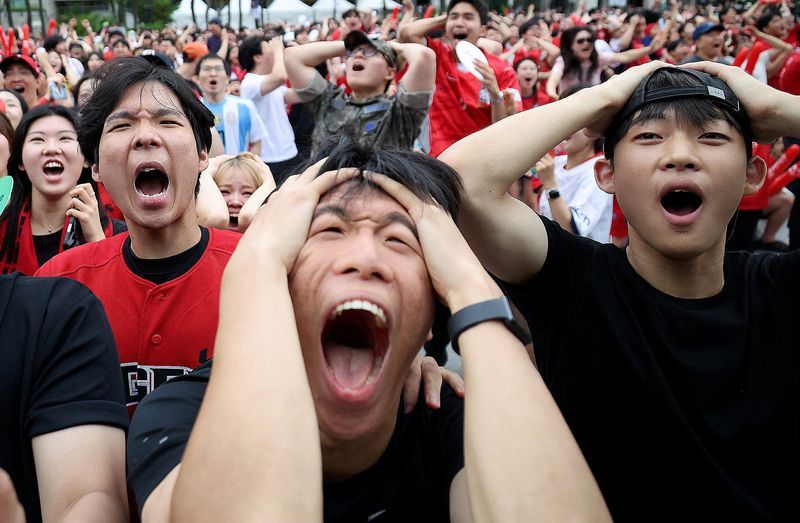
South Korea's political establishment is confronting a humbling failure on the global stage as President Lee Jae Myung publicly vented his frustration over the national football team's shockingly early exit from the World Cup. In an unusually candid outburst posted on social media on Sunday, Lee expressed bewilderment at an outcome that has rocked a nation accustomed to advancing from group stages at major tournaments. The dismissal, which occurred despite prevailing expectations that the squad would navigate what appeared to be a favourable group, has triggered an unprecedented institutional response and ignited broader questions about decision-making processes within South Korea's sports establishment.
The immediate cause of the crisis was straightforward enough in sporting terms. Consecutive defeats to Mexico and South Africa left South Korea languishing in third place within Group A, outside the qualification threshold that would have carried them into the tournament's knockout stage. Yet for Lee, the technical shortcomings on the pitch merely reflected a deeper, systemic problem rooted in how the national team's leadership had been selected and appointed. In his statement, Lee articulated a sharp critique of what he characterised as a culture of favouritism overriding merit-based decision making, arguing that the prioritisation of personal connections and institutional loyalty over genuine competence had directly contributed to the team's collapse when international scrutiny was highest.
The focal point of Lee's criticism was head coach Hong Myung-bo, whose reappointment to the role in 2024 had already generated considerable controversy within South Korean media circles. Hong's hiring process had been questioned by journalists and observers who alleged that the decision lacked transparency and appeared to reward loyalty rather than credentials or strategic vision. These allegations of nepotism and opaque recruitment procedures had been consistently denied by Hong himself and his supporters within the football establishment. However, Lee's public intervention, coming from the highest political office in the nation, represents an escalation that moves the accountability question from the sports pages into the realm of national governance and institutional integrity.
The President's statement delved explicitly into the philosophical underpinnings of what he viewed as a systemic governance failure. Lee articulated a broader principle about how organisational cultures that privilege internal relationships and factional loyalty over demonstrated competence inevitably produce poor outcomes. He emphasised that when such dynamics take root, the distinction between serving public interests and pursuing private advantage becomes fatally blurred. This framing suggests that for Lee, the World Cup failure serves as a symptom of institutional rot that extends beyond football and carries implications for how South Korea manages other critical sectors and appointments.
Lee's call for a formal investigation directed the Ministry of Culture, Sports and Tourism to undertake a comprehensive examination of the circumstances surrounding both Hong's appointment and the team's subsequent performance. The President specifically requested that the ministry not merely document what occurred but analyse the underlying causes and develop preventative measures to forestall similar debacles in future. This intervention represents an unusual level of political engagement with a sporting matter, reflecting both the cultural importance of football in South Korea and the degree to which the public and political class view the World Cup exit as symptomatic of governance failures.
The political reverberations of the team's failure have extended far beyond presidential pronouncements. Within days of the elimination, a petition circulated through South Korea's national assembly website calling for Hong's dismissal achieved the signature threshold required for formal consideration. More strikingly, social media platforms have been flooded with images from shops and establishments across South Korea displaying signs explicitly banning Hong from their premises—a visceral expression of public anger that reflects the depth of frustration among ordinary Koreans. These grassroots expressions of discontent demonstrate that the narrative of systemic leadership failure has gained considerable purchase with the general population.
For Malaysian observers and those elsewhere in Southeast Asia following these developments, the South Korean situation offers several instructive lessons. The episode illustrates how deeply football is interwoven with questions of national governance and institutional legitimacy in East Asian societies. A tournament failure can rapidly become a focal point for broader public concerns about accountability, transparency, and the distribution of power within elite institutions. In nations like Malaysia where sports administration has similarly attracted scrutiny regarding appointment processes and resource allocation, the South Korean case provides a cautionary example of how failure on the pitch can precipitate demands for systemic institutional review.
The contrast between Lee's public rhetoric and the actual functioning of South Korea's appointment mechanisms raises fundamental questions about governance. The President's emphasis on the need for enhanced monitoring and accountability systems suggests that existing institutional checks on those wielding appointment authority remain inadequate. This acknowledgment, coming from the nation's highest elected official, underscores that even affluent, developed democracies struggle with ensuring that meritocratic principles genuinely govern personnel decisions in important sectors like sports administration.
The investigation that the Ministry of Culture, Sports and Tourism is now being asked to undertake will likely focus on the decision-making processes that led to Hong's reappointment, the technical preparations provided to the team leading up to the World Cup, and the broader structural issues within Korean football that contributed to underperformance. Beyond the immediate findings, however, the inquiry represents a potential turning point in how South Korea approaches governance of its sports institutions, signalling heightened political willingness to interrogate appointment processes and demand evidence-based decision making.
The ramifications extend to Hong Myung-bo's immediate future as well. Facing unprecedented pressure from both political leadership and public sentiment, his position has become untenable regardless of the investigation's formal conclusions. The combination of presidential censure, legislative petitions for dismissal, and viral social media campaigns expressing public contempt makes his continuation in the role functionally impossible, suggesting that institutional change may precede formal investigative conclusions.
For South Korea's football development more broadly, the crisis creates both risk and opportunity. The immediate damage to the sport's reputation and the substantial financial and reputational costs of early World Cup elimination are substantial. However, the heightened political attention and institutional scrutiny could catalyse meaningful reforms in how the sport is governed, coached, and developed at the grassroots level. Whether the investigation becomes a genuine examination of systemic weaknesses or merely a political exercise that culminates in individual scapegoating will substantially determine whether South Korea emerges from this episode with strengthened institutions or merely a change in faces at the leadership level.

