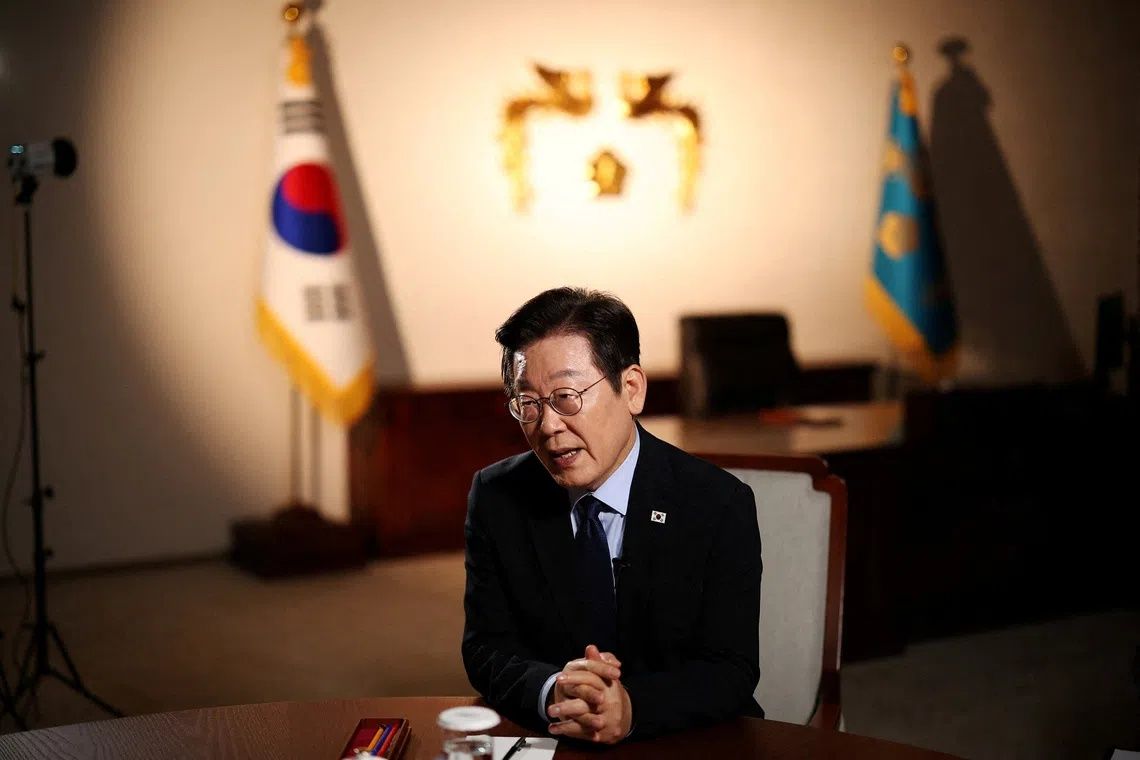
South Korean President Lee Jae Myung has thrown his weight behind a significant constitutional overhaul that would fundamentally reshape the nation's presidency, permitting leaders to serve consecutive four-year terms rather than the current single five-year mandate. According to the Yonhap news agency, a Blue House official disclosed this preference on Friday, signalling that such an arrangement represents the most politically palatable reform option available to the divided National Assembly. The proposal represents a notable departure from South Korea's existing constitutional framework, which has long restricted presidents to a single term to prevent executive overreach and the concentration of power that has historically defined the office.
Central to Lee's position is recognition of what critics have termed South Korea's "imperial presidency" — a structural reality where the sitting president wields extraordinary influence over the judiciary, media, and legislative bodies. The Blue House official's statement acknowledges that constitutional reform must grapple with this fundamental imbalance, suggesting that strengthening parliamentary oversight alongside presidency term modifications could create meaningful checks on executive authority. This dual emphasis represents a pragmatic acknowledgement that simply extending term limits without institutional reform risks perpetuating the very concentration of power that has undermined democratic governance throughout South Korea's post-war political history. For Malaysian observers, this debate mirrors ongoing conversations about executive versus legislative authority in established democracies, though South Korea's particular experience with authoritarian rule makes the stakes considerably higher.
The constitutional amendment process in South Korea remains deliberately cumbersome, requiring approval from at least 200 of the 300 National Assembly members — a supermajority threshold explicitly designed to prevent partisan manipulation of fundamental law. The Blue House official stressed that any reform must emerge through genuine political consensus rather than partisan manoeuvring, reflecting awareness that constitutional changes adopted without broad agreement could lack legitimacy. This cautious approach contrasts sharply with the contentious nature of South Korean politics, where opposition parties have frequently blocked presidential initiatives they deem self-serving. The official's insistence on consensus-based reform effectively acknowledges that Lee's proposal, however popular it may be with his base, requires substantial cooperation from opposition lawmakers who remain deeply sceptical of presidential intentions.
Lee's embrace of parliamentary strengthening represents a strategic political move that simultaneously deflects criticism while advancing his substantive agenda. By endorsing measures that would limit presidential power — on paper, at least — he positions himself as a reformer committed to democratic principles rather than self-interest. Critics, however, point out that presidents have historically paid lip service to checks and balances while working systematically to circumvent them once in office. The proposal's emphasis on a four-year term with re-election rights potentially offers presidents greater cumulative power than the current single five-year arrangement, depending on implementation details. For South Korean politics, this apparent paradox between strengthened parliament and extended presidential eligibility will likely dominate coming negotiations.
The regional implications of South Korean constitutional reform merit careful attention from Southeast Asian democracies grappling with similar tensions between executive authority and institutional restraint. South Korea's particular constitutional framework reflects historical lessons about preventing strongman rule, lessons particularly relevant to nations with their own experiences of authoritarian governance. The current single-term presidency was deliberately adopted following decades of military dictatorship and democratic instability, representing a hard-won consensus that presidential power requires structural limitation. Any modification to this framework signals shifting calculations about institutional design and democratic governance that could influence discussions across the region about optimal constitutional arrangements.
The timing of Lee's constitutional preference statement carries considerable political weight. South Korea faces mounting questions about presidential accountability following several scandals and investigations involving sitting and former presidents. Constitutional reform discussions often intensify when public confidence in institutions erodes, as citizens and political elites search for structural solutions to perceived governance failures. Lee's initiative thus arrives amid broader societal debate about whether South Korea's constitutional architecture adequately serves contemporary democratic expectations. The question of whether four-year terms with re-election eligibility would actually strengthen or weaken democratic governance remains contested among constitutional scholars and political analysts.
Parliamentary dynamics will ultimately determine whether this proposal advances beyond rhetorical endorsement to concrete amendment. The National Assembly contains substantial blocs opposed to any expansion of presidential authority, regardless of accompanying parliamentary empowerment measures. Opposition parties view term extension sceptically, particularly when proposed by sitting presidents, as such reforms inevitably benefit the incumbent more than hypothetical future leaders. Lee's framing of the proposal as part of broader constitutional modernisation represents an attempt to overcome this predictable resistance by connecting presidential term modification to the legitimately compelling goal of reducing executive dominance. Whether this rhetorical strategy succeeds will depend on whether opposition lawmakers perceive genuine benefits to parliamentary authority or regard them as cosmetic window-dressing.
The constitutional debate also intersects with South Korea's broader political trajectory and international standing. As a mature democracy with sophisticated institutions and robust civil society, South Korea continuously calibrates its constitutional framework to balance effectiveness with accountability. The nation's experience demonstrates that no single institutional design perfectly resolves this tension; rather, democracies must periodically revisit foundational documents as political circumstances evolve. Lee's proposal represents one moment in this ongoing process of constitutional recalibration, driven by specific political actors pursuing particular interests but occurring within a context of genuine democratic discourse. For regional observers, South Korea's willingness to seriously debate constitutional reform — however contentiously — underscores the difference between contested democratic deliberation and authoritarian imposition.
Implementation details will prove crucial should any constitutional amendment proceed. Provisions governing presidential eligibility, parliamentary powers over budgetary matters, judicial appointment mechanisms, and emergency executive authority will substantially determine whether reform genuinely redistributes power or merely reshuffles existing arrangements. The Blue House official's emphasis on basing amendments on political consensus tacitly acknowledges that poorly designed reforms could provoke fresh constitutional crises rather than resolve existing governance challenges. As South Korea navigates these complex negotiations, the outcome will reverberate throughout the region as a prominent example of how established democracies address institutional evolution and executive-legislative balance.

