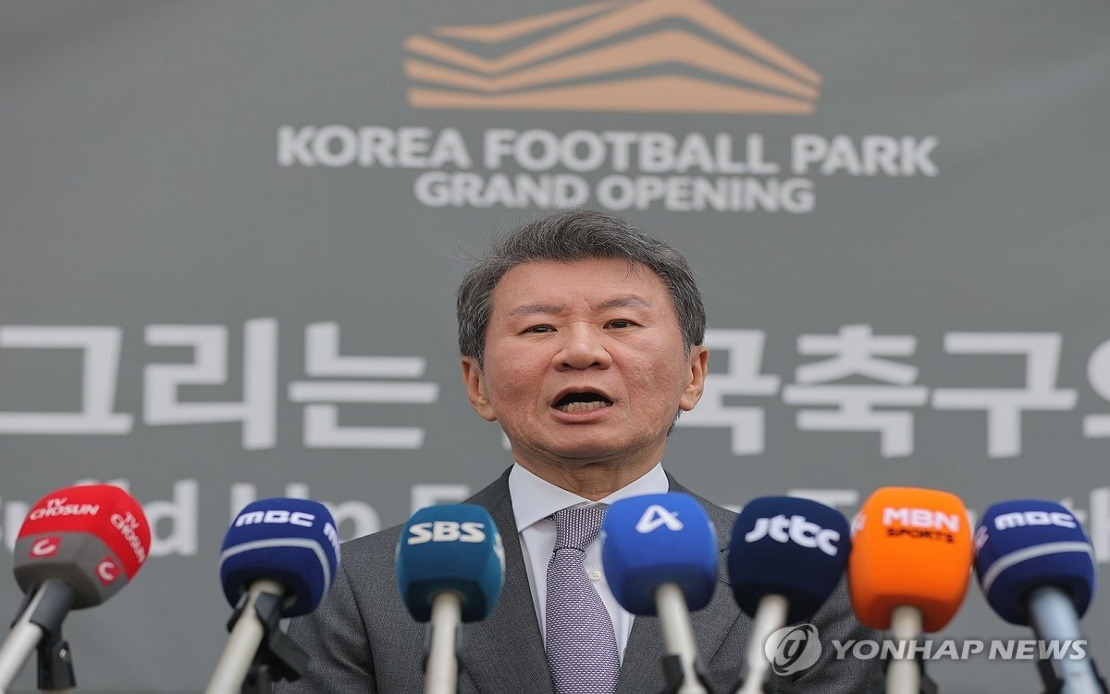
The Korea Football Association finds itself navigating a leadership vacuum after president Chung Mong-gyu submitted his resignation on Monday, departing his post two weeks before the FIFA World Cup concludes on July 20. His decision to step aside earlier than initially planned underscores the turmoil gripping Korean football following the national team's premature elimination at the group stage, a result that has exposed deeper institutional fractures within the sport's governing body.
Chung had announced in May that he would relinquish his role once the World Cup ended, yet the speed of South Korea's exit from the tournament accelerated his departure. The team, under the stewardship of Hong Myung-bo, managed only a single victory across three group matches while suffering two defeats, accumulating three points that proved insufficient to qualify among the eight best third-place finishers. This disappointing performance represents a significant setback for a nation that prides itself on its football pedigree in Asia. Hong himself tendered his resignation immediately after the team's elimination was confirmed, taking personal responsibility for the outcome.
Yet Chung's removal extends beyond the immediate sting of the World Cup failure. His leadership has faced considerable scrutiny over what detractors characterise as an opaque and irregular process surrounding Hong's appointment in July 2024. The South Korean Ministry of Culture, Sports and Tourism launched an extensive investigation into KFA operations, ultimately concluding that Chung and several other senior officials warranted disciplinary action due to governance irregularities uncovered during the examination. This finding has transformed what might otherwise be a straightforward succession into a politically charged institutional reckoning.
The relationship between the KFA and the government ministry has deteriorated markedly, with both entities entrenched in legal proceedings. The ministry has signalled its intention to conduct another comprehensive audit into the football federation's administration, using the World Cup exit as justification for renewed scrutiny. For Malaysian observers, this dynamic illustrates how sports governance can become entangled with political considerations when performance failures intersect with questions of administrative propriety—a pattern not unfamiliar in Southeast Asian sporting institutions.
Chung's departure triggers an automatic succession mechanism outlined in KFA regulations. One of the organisation's four vice presidents will assume interim control of the federation pending the election of a permanent successor. Given that Chung possessed nearly three years remaining on his fourth term, KFA regulations ordinarily require the electoral college to choose a replacement within a 60-day window. This tight timeline now faces potential alteration as governing bodies reassess election procedures in response to mounting political and public pressure.
The electoral college comprises representatives from regional football associations, K League club executives, players, coaches, and referees. The previous presidential election saw 183 of 192 eligible voters participate, demonstrating reasonably robust engagement in the selection process. However, government officials have begun questioning the legitimacy of this institutional arrangement. Chae Hwi-young, the culture and sports minister, has pointedly suggested that the KFA's electoral framework may prove unsustainable if the organisation fails to adequately acknowledge public dismay over both the World Cup performance and governance failures.
More substantively, the Korean Sport and Olympic Committee—the umbrella body overseeing all national sports federations—has scheduled a July 16 general meeting to consider structural reforms affecting how member associations elect their leaders. Officials have floated the possibility of extending the 60-day election window beyond its current parameters and, more dramatically, transitioning toward direct election voting mechanisms rather than the current college-based system. Such changes would represent a fundamental reconfiguration of how Korean football governance operates, potentially establishing precedents affecting other sports under KSOC jurisdiction.
The implications for regional football governance merit consideration. Southeast Asian football associations, including those affiliated with ASEAN bodies, occasionally face similar tensions between institutional autonomy and government oversight. The Korean precedent demonstrates how external political pressure—however justified by governance concerns—can reshape foundational institutional structures. Malaysia's own Football Association, along with counterparts across the region, may observe whether direct election systems enhance legitimacy or conversely create new vulnerabilities within national federations.
Chung's personal statement struck a carefully calibrated tone balancing accountability with reassurance. He acknowledged moments of disappointing performance while attributing all achievements to players and supporters, claiming personal responsibility for institutional missteps. He expressed conviction that Korean football possesses inherent resilience and will resurface as a regional and global force. This framing represents a calculated exit strategy—positioning his departure as selfless recognition of systemic deficiencies rather than humiliating removal, even as events demonstrate otherwise.
The broader context reveals how comprehensively World Cup elimination has destabilised Korean football's institutional framework. The tournament's conclusion will likely intensify scrutiny across all governance dimensions, not merely the coach selection process that triggered initial controversy. This situation differs markedly from the straightforward succession planning anticipated months earlier, instead evolving into a institutional restructuring exercise driven by performance failure and political leverage.
For Malaysian sports governance observers, the unfolding Korean situation offers instructive lessons regarding the intersection of athletic performance, administrative competence, and political engagement with national sports bodies. The Korean experience suggests that governance deficiencies—even when real—interact dangerously with national team underperformance, often producing institutional overhauls that extend far beyond addressing the original problems. As Korean football enters this uncertain transition period, questions persist regarding whether structural reforms will genuinely improve governance or merely reconfigure institutional relationships without addressing underlying performance and administrative challenges.

