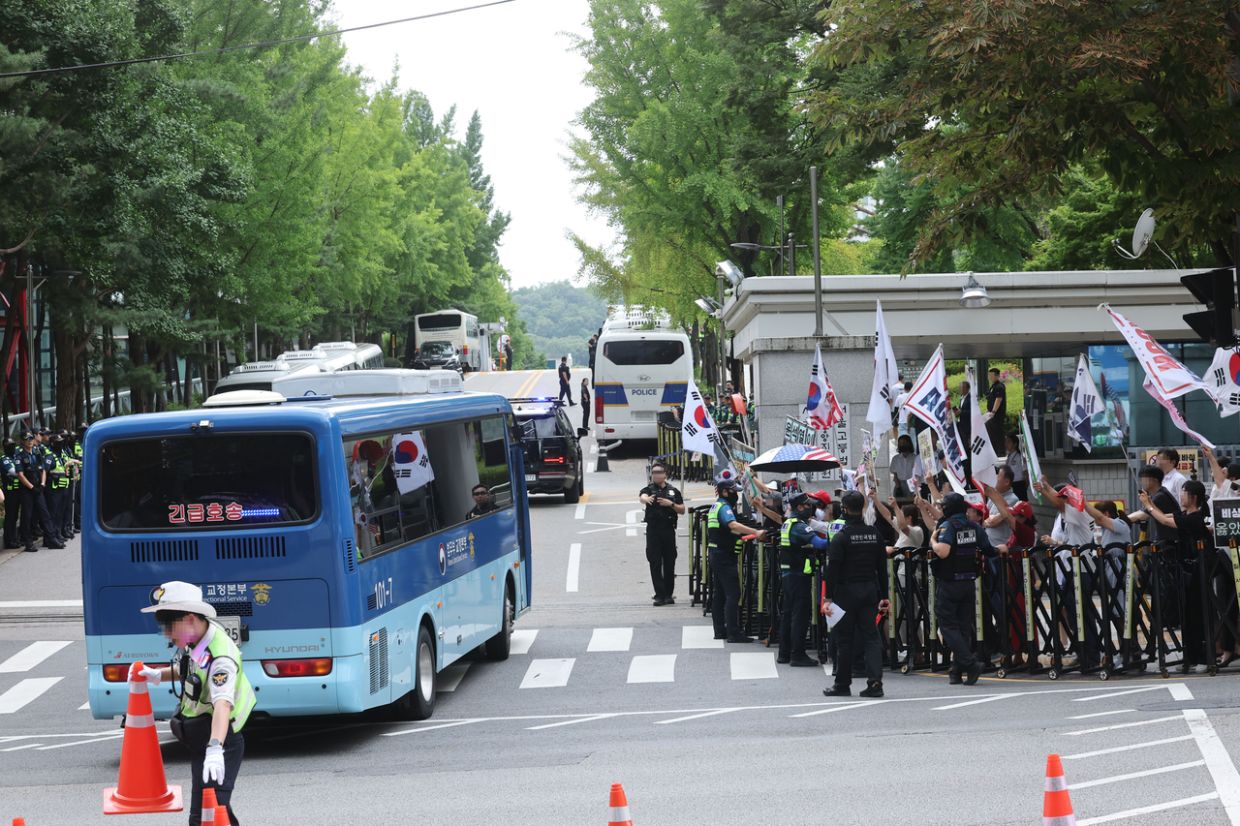
Former South Korean President Yoon Suk Yeol received a two-year prison sentence from Seoul Central District Court on Monday, found guilty of breaching the Political Funds Act by accepting complimentary polling services during his successful bid for the presidency. The conviction centres on the receipt of 14 surveys valued at 27.92 million won (approximately US$18,600) that were provided by political intermediary Myung Tae-kyun without proper compensation or declaration as required under election law.
The court's judgment reveals the intricate web of arrangements between Yoon, his wife and former first lady Kim Keon Hee, and Myung, establishing that they operated as a coordinated unit in obtaining the surveys. Rather than requiring prosecutors to demonstrate an explicit quid pro quo arrangement, the judges found that successive and tacit agreements existed among the three parties concerning both the provision of polling data and an associated political favour. The court determined that Yoon had authorized his wife to direct the timing, substance, methodology, and dissemination decisions for the polls, and that he possessed knowledge of these arrangements and implicitly endorsed them.
Judge Lee Jin-gwan articulated the broader constitutional implications of the case, emphasizing that opinion polling represents far more than mere commercial activity within democratic societies. His reasoning underscores a principle particularly relevant to Southeast Asian democracies grappling with campaign finance transparency: public opinion surveys fundamentally shape voter behaviour and their credibility underpins the legitimacy of electoral processes. When political figures circumvent prescribed financial disclosure mechanisms to obtain polling intelligence, the court found, the resulting asymmetry of information corrupts the fundamental fairness necessary for elections to reflect authentic public preference.
The sentence handed to Myung Tae-kyun, the political broker orchestrating the polling arrangement, reached 18 months imprisonment, with immediate detention ordered in the courtroom. Prosecutors had initially charged Yoon with acquiring 58 surveys valued above 270 million won between June 2021 and March 2022, but the court's evidentiary threshold proved more exacting, ultimately sustaining conviction on 14 surveys and assessing their financial benefit conservatively at the lower figure.
A crucial aspect of the verdict involved Yoon's alleged reciprocal commitment to secure the People Power Party's nomination for former legislator Kim Young-sun in exchange for the polling services. The court documented that Yoon did indeed promise this nomination outcome and subsequently leveraged his influence with Chang Je-won, then serving as chief of staff to the president-elect, to advance Kim Young-sun's candidacy within the party machinery. While establishing this quid pro quo arrangement, the judges notably determined that proving such direct reciprocity was unnecessary to establish a violation of campaign finance statutes, broadening the potential scope of liability in political funding cases throughout the region.
The divergence between Yoon's conviction and the acquittals granted to his wife Kim Keon Hee presents a striking paradox within a single investigation. Lower courts at both trial and appellate levels found Kim not guilty of related Political Funds Act violations stemming from the identical polling services. The distinction the court drew emphasized that prosecutors failed to establish that Kim herself received quantifiable financial benefit equivalent to the survey costs or that the polling provision constituted direct reciprocal exchange for the nomination commitment. This differentiation suggests the courts applied varying standards of causality and benefit assessment depending on the defendant's position and relationship to the political quid pro quo.
The Supreme Court's forthcoming judgment in Kim's separate case, scheduled for Thursday, carries potential implications extending beyond the immediate family dispute. Should the highest court reverse the lower courts' acquittals, it would signal heightened judicial vigilance regarding campaign finance breaches involving family members of political principals. Conversely, maintaining the acquittals would suggest that courts distinguish between direct beneficiaries of illicit polling arrangements and family members who may have facilitated but did not directly profit from them.
For Malaysian and broader Southeast Asian observers, the Yoon case illuminates persistent vulnerabilities in campaign finance regulation across democracies with ostensibly robust legal frameworks. South Korea possesses detailed statutory provisions governing political funding, yet the case demonstrates how intermediaries and informal arrangements can obscure the true nature of political exchanges. The reliance upon circumstantial evidence and implied agreements, rather than explicit documentation, reveals how political actors navigate statutes through carefully calibrated informality.
The judicial emphasis on protecting opinion polling integrity carries particular resonance in the Southeast Asian context, where survey manipulation and selective dissemination of polling results have featured prominently in contentious elections. The court's reasoning that unregulated polling advantage distorts electoral fairness addresses concerns that affect newer and more established democracies alike, particularly where commercial polling agencies may maintain close relationships with political factions.
The conviction also reflects evolving judicial approaches to political finance enforcement in mature democracies. Rather than requiring prosecutors to construct narratives of explicit negotiation, courts increasingly examine the totality of relationships and patterns of benefit distribution to infer prohibited arrangements. This shift has implications for how campaign finance laws may be enforced across Asia, potentially lowering evidentiary thresholds in cases involving political insiders where direct documentation remains deliberately absent.
Yoon's imprisonment represents a remarkable reversal of fortune for a politician who secured the presidency merely years prior, reflecting South Korea's historical pattern of pursuing legal accountability against former leaders. Yet the bifurcated outcome between Yoon and his wife, along with the Supreme Court's pending decision, suggests the judicial system continues refining its analytical frameworks regarding campaign finance liability, with ramifications extending to political ecosystems throughout the region.

