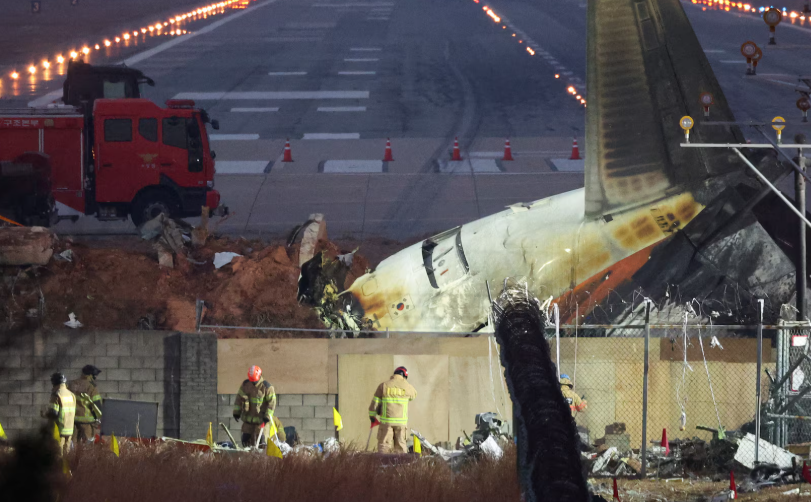
South Korean authorities have intensified their criminal investigation into the Jeju Air catastrophe by conducting coordinated raids on key government and airport bodies. Police descended on the Korea Airports Corp, the transport ministry, and the Busan Regional Office of Aviation on Tuesday in what marked an escalation in their efforts to establish culpability for a disaster that claimed 179 lives when a passenger aircraft crashed at Muan International Airport on December 29, 2024.
The raids represent a significant development in determining whether officials and organisations failed in their duties leading up to or immediately following the crash. Investigators seeking to build evidence for charges related to professional negligence have now conducted multiple searches of the transport ministry, with Tuesday's operation being the third visit by authorities to the department. The targeting of multiple agencies simultaneously suggests prosecutors are pursuing a broad investigation rather than focusing narrowly on a single point of failure.
Korea Airports Corp, which operates most of the nation's major domestic aviation terminals with the notable exception of Seoul's Incheon International Airport, has become a central focus of the inquiry. The corporation's responsibilities encompass the management and oversight of facilities at Muan International Airport, where the Jeju Air flight came to rest following what authorities have suggested involved significant failures in safety protocols or emergency response procedures.
Among the 74 individuals and organisations already named as suspects, charges of professional negligence resulting in death or injury represent the core accusations. These charges carry substantial legal weight in South Korea's criminal framework and typically require prosecutors to demonstrate that individuals in positions of responsibility deviated from established safety standards or failed to exercise reasonable care. The expansion of the investigation to include potential charges of causing a serious public disaster would represent an even more serious allegation, one that could carry harsher penalties upon conviction.
The deliberate collection of documentary evidence during the raids points toward a prosecutorial strategy that builds on technical and administrative records rather than relying solely on witness testimony or accident reconstruction analysis. Investigators are likely seeking maintenance logs, safety inspection reports, communication records, and operational procedures that would establish whether proper protocols were followed or neglected. Such materials can prove decisive in establishing chains of responsibility and determining whether negligence was systemic or isolated.
For Southeast Asian readers, the case offers important lessons regarding aviation safety governance and accountability mechanisms. Malaysia's own airport and airline regulatory frameworks operate within a different legal context, yet the underlying principles regarding duty of care in aviation safety remain universal. The thoroughness of South Korea's investigation, conducted by authorities with substantial investigative resources, demonstrates how serious nations treat civil aviation disasters and the criminal dimension that can extend well beyond civil liability or regulatory penalties.
The investigation's focus on whether responsible agencies handled the crash properly encompasses not only the circumstances that led to the accident itself but also the immediate emergency response and recovery operations. This broader scope suggests that authorities are examining whether adequate coordination existed among agencies, whether emergency protocols were properly activated, and whether communication systems functioned as intended during the critical moments following impact.
The progression from initial investigation to raids on institutional actors indicates that police have likely gathered sufficient preliminary evidence to justify criminal searches and the seizure of relevant documents. South Korean law requires that such actions meet evidentiary thresholds, meaning investigators must have presented compelling reasons to judicial authorities before securing warrants. This procedural requirement ensures that investigations operate within legal boundaries while maintaining sufficient investigative power to pursue serious allegations.
The involvement of the Busan Regional Office of Aviation alongside the broader transport ministry and airport operator reflects aviation safety's multi-layered regulatory structure. Different agencies hold different responsibilities—from airport operations to airline certification to air traffic control coordination—and determining which entity or entities failed in their duties requires examining the intersection of these jurisdictions and responsibilities.
For the families of the 179 victims and the broader South Korean public, the continued investigative intensity signals commitment to establishing accountability. Criminal investigation of major aviation disasters remains contentious territory, as the line between accident and negligence requires careful legal analysis. Yet public confidence in aviation safety depends partly on transparent investigation and the willingness of authorities to pursue criminal liability when evidence supports such charges.
The case also reflects broader conversations across East Asia regarding corporate and governmental accountability following catastrophic incidents. South Korea's willingness to name dozens of suspects and conduct multiple raids demonstrates an assertive prosecutorial approach that differs from some jurisdictions where investigations might conclude with technical findings alone. This reflects the democratic expectation that serious preventable incidents warrant not just technical explanations but also criminal consequences for those whose negligence contributed to loss of life.
As the investigation continues, the accumulation of documentary evidence from these raids will likely prove crucial in determining the final scope of charges and the specific individuals and organisations held responsible. The criminal process will demand that prosecutors meet evidentiary standards required by South Korean law, ensuring that convictions rest on demonstrable failures rather than speculation. The parallel investigation of whether agencies properly handled the crash itself may ultimately reveal systemic vulnerabilities requiring regulatory reform alongside criminal accountability.

