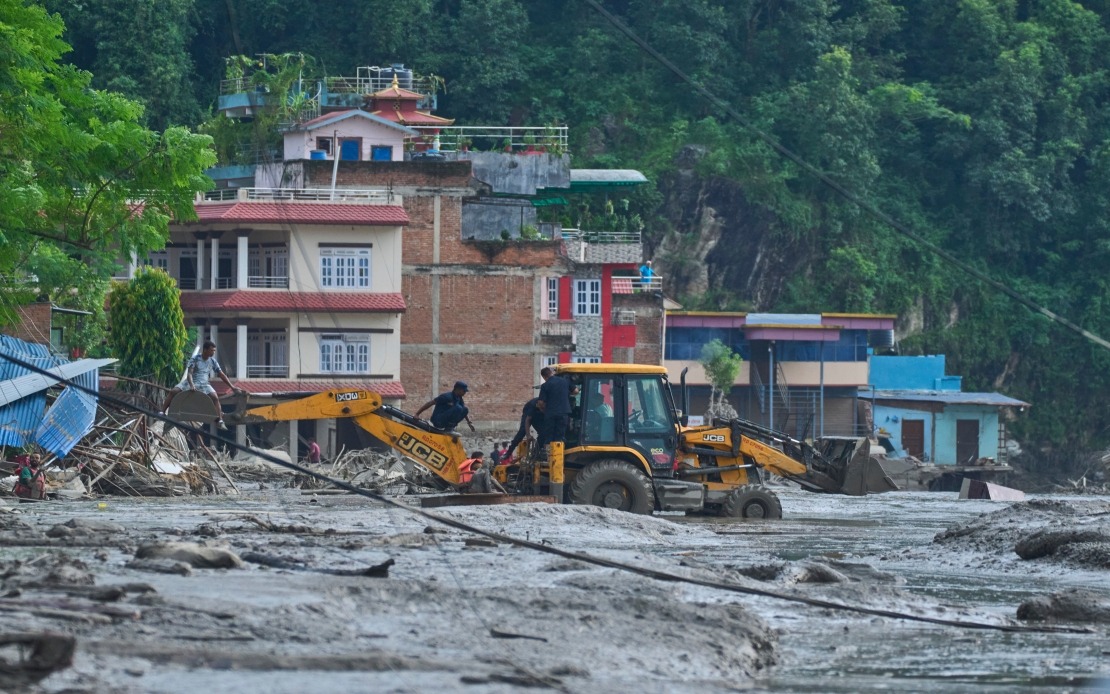
South Korea is mobilizing diplomatic and emergency resources following a catastrophic flooding event in Nepal that has left nine of its nationals unaccounted for. The missing workers comprise six employees from the industrial conglomerate Doosan Enerbility Co. and three staff members from Korea South-East Power Co., the state-owned power generation enterprise. All were engaged in hydropower plant construction in Rasuwa district when the deluge struck on Wednesday, forcing a massive evacuation of foreign workers from the site.
The scale of the disaster extends well beyond the South Korean contingent. The flooding, which occurred near the Nepal-Tibet border, has claimed more than 160 lives and left hundreds of others unaccounted for, with foreign nationals comprising a substantial portion of those missing. The incident underscores the vulnerability of international construction projects in Nepal's mountainous terrain, where geological instability and climate-related hazards pose persistent risks to workers and infrastructure development.
Seoul's response has been swift and coordinated. President Lee Jae Myung has directed all government agencies to prioritize the search and rescue operation, deploying every available resource to locate the missing workers. Foreign Minister Cho Hyun chaired an emergency response meeting on Wednesday, during which the government committed to establishing a comprehensive support framework for affected families and remaining South Koreans in the affected region. The diplomatic messaging emphasized the urgency of the situation while signalling Seoul's determination to work through official channels with Nepalese authorities.
A joint rapid response team comprising officials from South Korea's foreign ministry alongside police and fire rescue specialists is scheduled to arrive in Kathmandu on Thursday to coordinate on-ground assistance. This deployment reflects a standard protocol for Seoul when nationals face distress abroad, particularly in disaster scenarios requiring specialized search and rescue expertise. The team's arrival will enable direct liaison with Nepalese government and local authorities, potentially accelerating the identification and recovery of missing personnel.
Among the broader group affected by the emergency, ten other Doosan Enerbility employees who had been stranded in the area have since been accounted for and confirmed safe. However, these individuals remain awaiting evacuation from the flood-affected zone. Approximately 200 foreign workers were engaged in the hydropower construction project at the time of the flooding, and the majority have successfully evacuated, though logistical challenges persist in removing personnel from the disaster area.
Both Doosan Enerbility and Korea South-East Power have established their own emergency response mechanisms to complement government efforts. The companies are organizing field response teams to deploy to the accident site, combining corporate resources with official government coordination. This multi-layered approach reflects the private sector's stake in ensuring worker safety and managing the reputational implications of industrial accidents abroad.
For Malaysian and Southeast Asian observers, this incident carries several implications. The region experiences similar hydropower development initiatives, particularly in Laos and Myanmar, where foreign construction crews operate in comparable geological and climatic conditions. The Nepal flooding demonstrates how rapidly environmental hazards can overwhelm even well-established industrial operations, raising questions about safety protocols and emergency preparedness across cross-border infrastructure projects in Asia.
The diplomatic dimension also merits attention. South Korea's swift government mobilization and Foreign Minister Cho's explicit commitment to coordinating with Nepal's government reflects how developed nations typically manage consular emergencies abroad. For regional governments and investors, including Malaysian entities with overseas operations, the episode illustrates the importance of maintaining robust diplomatic channels and pre-established emergency response frameworks.
Climate and environmental factors underpin these recurring disasters. The Nepal-Tibet border region experiences intense monsoon precipitation and geological volatility, creating compounding hazards for construction activities. As Southeast Asian nations intensify hydropower development to meet energy demands, similar risks will likely recur unless safety standards, early warning systems, and evacuation protocols are substantially strengthened.
The broader geopolitical context involves China's proximity to the disaster zone and the multi-national character of hydropower projects in the Himalayan region. South Korea's response strategy, emphasizing cooperation with Nepal's government rather than unilateral action, reflects diplomatic norms in a region where major power interests converge. This approach may serve as a model for how other nations coordinate rescue efforts in contested or sensitive geographical areas.
Corporate accountability mechanisms also emerge as a relevant consideration. Both Doosan Enerbility and Korea South-East Power will face scrutiny regarding their safety management practices, insurance coverage, and worker protection protocols. For Malaysian companies operating hydropower projects or similar infrastructure ventures in neighboring countries, this incident provides cautionary context regarding corporate governance standards and liability exposure.
The humanitarian dimension remains paramount. Families of the nine missing workers face an agonizing wait as search efforts proceed in challenging terrain. The Nepalese government's capacity to conduct rescue operations in remote mountainous areas will significantly influence outcomes. International cooperation, including technical support from countries with advanced search and rescue capabilities, may prove decisive in locating survivors.

