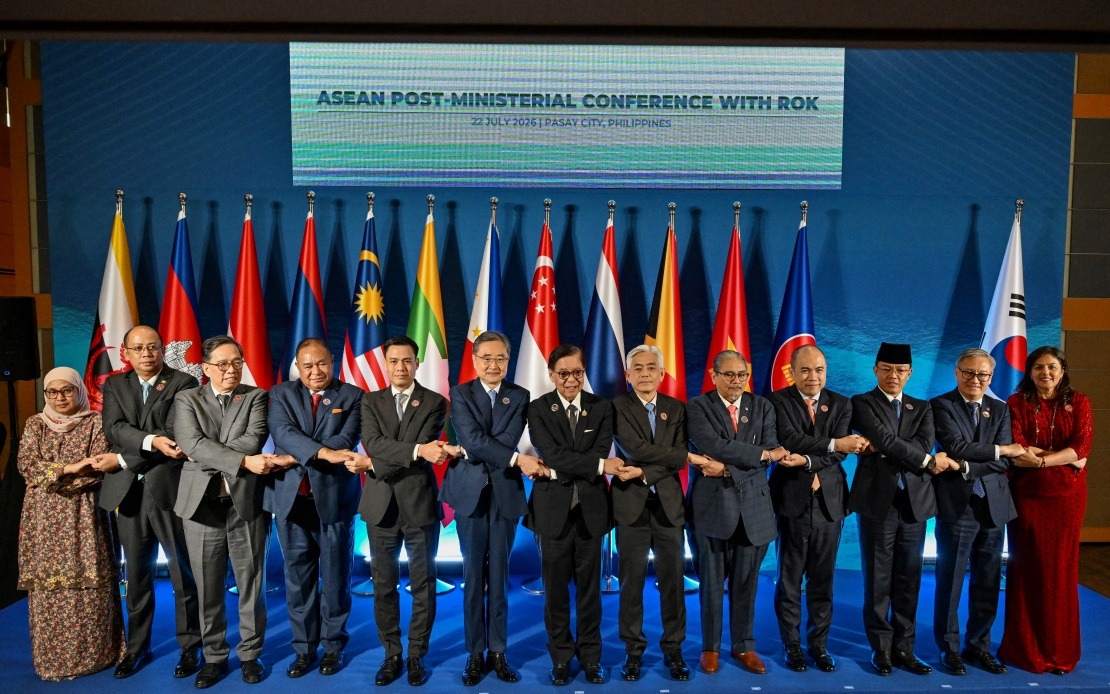
South Korea's Foreign Minister Cho Hyun and his Thai counterpart jointly chaired discussions in Manila this week to advance the Seoul-ASEAN partnership, introducing a suite of fresh initiatives designed to deepen engagement across technology, commerce and cultural sectors. The meetings, convened alongside broader ASEAN ministerial gatherings, reflected both parties' determination to navigate an increasingly complex regional landscape characterised by supply chain reorganisation and rapid innovation cycles.
The partnership vision, originally presented by President Lee Jae Myung at the preceding year's summit, rests on three foundational pillars: initiatives centred on people, economic growth coupled with innovation, and regional peace alongside stability. This framework underpins Seoul's strategic approach to binding the ten-nation bloc more tightly through coordinated action across multiple domains. South Korea has positioned itself as offering complementary capabilities that address ASEAN's development priorities, particularly in sectors reshaping the regional economy.
Central to the expanded agenda is the newly unveiled Korea-ASEAN AI Partnership Initiative, which leverages Seoul's comprehensive artificial intelligence ecosystem to facilitate technology transfer and capacity building throughout the region. The programme encompasses three interconnected elements: establishing robust AI development environments across member nations, cultivating research excellence and developing skilled workforces through training and educational partnerships, and ensuring AI deployment occurs within frameworks prioritising safety and responsible innovation. This initiative responds directly to ASEAN governments' recognition that mastering AI technologies is essential for economic competitiveness and social progress.
Beyond technology, Seoul introduced parallel commitments addressing cultural and creative industries—sectors increasingly vital to Southeast Asian economies seeking diversification beyond traditional manufacturing. South Korea's own success transforming cultural exports into a major economic driver provides a tested model that ASEAN nations can adapt. The initiatives also encompass cooperation combating online financial crimes, reflecting growing concern about transnational fraud networks exploiting digital channels, and establishing a joint maritime safety academy to strengthen regional capacity in protecting strategic waterways critical to global commerce.
Trade deepening featured prominently in discussions, particularly regarding the bilateral free trade agreement that has governed commerce since 2006, when goods provisions took effect. Subsequent agreements covering services and investment rounds emerged in 2007 and 2009 respectively. Last month marked a significant milestone when both parties commenced formal negotiations to modernise this framework, explicitly targeting expansion into digital economy sectors, critical mineral supplies and other emerging technology areas. This upgrade reflects recognition that the original accord, whilst foundational, requires updating to accommodate twenty-first century trade patterns.
The economic dimensions prove substantial for Malaysian and regional observers. South Korea ranks as ASEAN's third-most significant trading partner, with Seoul supplying approximately US$122.5 billion in goods annually to the ten member states. This figure underscores how deeply integrated the economies have become, with Korean enterprises investing extensively across manufacturing, semiconductors, automotive production and consumer electronics throughout Southeast Asia. Strengthening the trade architecture promises reciprocal benefits, as Korean companies seek stable, predictable market access whilst ASEAN nations gain reliable sources of advanced technology and capital.
ASEAN delegations welcomed Seoul's vision expansively, pledging their backing and participation in proposed cooperative frameworks. This receptiveness reflects calculations that partnering with South Korea—a prosperous, technologically sophisticated democracy—serves members' national interests. For smaller ASEAN economies particularly, such partnerships distribute risks across larger blocs rather than concentrating dependency on single powers. The commitment also signals alignment with Seoul's broader strategic positioning within Southeast Asia as tensions on the Korean Peninsula persist.
Foreign Minister Cho utilised the Manila platform to advocate for international support regarding his government's Korean Peninsula policy, framing peaceful coexistence with North Korea as essential for Seoul's own stability and regional prosperity more broadly. ASEAN member states reciprocated this emphasis, reaffirming their stance that peninsular peace directly affects regional security architecture and economic stability. This mutual reinforcement—Seoul acknowledging ASEAN's centrality whilst ASEAN recognises Korean security concerns—exemplifies how bilateral relationships increasingly intertwine with regional calculations among Southeast Asian nations.
The timing of these announcements carries particular significance given geopolitical currents reshaping the Indo-Pacific. ASEAN governments, practicing strategic autonomy, seek partnerships diversifying their engagement portfolio beyond traditional alignments. South Korea offers advantages distinct from other major partners: economic dynamism without the historical baggage complicating some relationships; technological prowess in sectors defining future competitiveness; and demonstrated commitment to multilateral institutions. The Korea-ASEAN partnership thus represents neither hedging nor abandonment of other relationships, but rather pragmatic engagement with an increasingly important player.
Beyond formal statements, the joint emphasis on supply chain resilience addresses practical concerns preoccupying policymakers regionally. Recent global disruptions—pandemic-related closures, geopolitical tensions affecting semiconductors and rare earths, climate-induced shocks—demonstrated vulnerabilities in concentrated supply networks. By cooperating on supply chain architecture, Seoul and ASEAN can develop redundancies and diversification strategies protecting economic interests. This cooperation extends naturally to critical minerals, where ASEAN members control significant reserves whilst South Korea requires reliable supplies for battery manufacturing, electronics and green energy industries.
The cultural and creative dimensions merit particular attention from Malaysian stakeholders. Southeast Asia increasingly competes with East Asian neighbours to establish regional soft power prominence. Korean entertainment, fashion and design have achieved commercial and cultural dominance globally—a phenomenon termed the Korean Wave. ASEAN nations possess rich cultural heritages and emerging creative sectors but often lack the integrated industrial infrastructure maximising commercial potential. Technology transfer and knowledge-sharing partnerships with Seoul could accelerate capacity development, helping ASEAN creators compete globally whilst strengthening intra-regional cultural circulation.
Moving forward, successful implementation hinges on translating political commitments into sustained institutional cooperation. The proposed joint maritime safety academy exemplifies how concrete institutions embed partnerships within operational frameworks generating tangible outputs. Similarly, the AI initiative requires establishing mechanisms for research collaboration, talent mobility and knowledge dissemination. For Malaysian enterprises and policymakers, monitoring progress on these fronts indicates whether rhetorical partnership statements translate into substantive benefits justifying participation costs.

