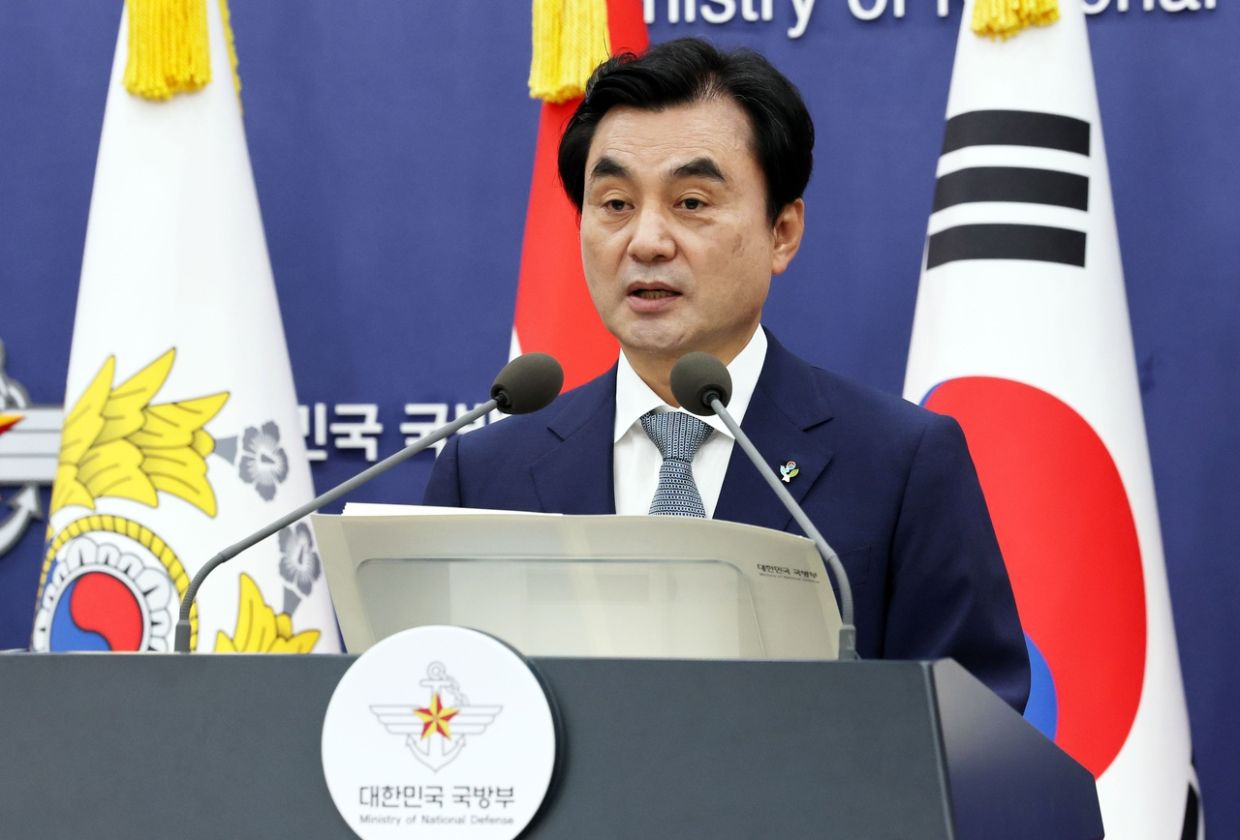
South Korea's Defence Ministry has announced an ambitious restructuring of its unmanned aerial capabilities, committing to procure more than 20,000 low-cost drones and accelerate the deployment of domestically developed long-range loitering munitions known as K-Lucas. Defence Minister Ahn Gyu-back unveiled the comprehensive drone and counter-drone strategy on Friday, June 26, as the South Korean military moves to address fundamental shifts in modern battlefield dynamics driven by affordable drone technology and autonomous systems.
The strategic pivot reflects mounting pressure on Seoul to adapt its military doctrine in light of two major geopolitical developments: Russia's extensive deployment of budget drones throughout its invasion of Ukraine, and escalating unmanned aerial activities in the Middle East involving the United States and Iran. These conflicts have demonstrated that high-volume, expendable drone operations can overwhelm traditional air defence systems and reshape tactical outcomes in ways that conventional military planning had not fully anticipated. For South Korea, the implications are particularly acute given North Korea's concurrent expansion of its drone arsenal and the proximity of the demilitarised zone.
Ahn emphasised that the proliferation of inexpensive unmanned systems represents nothing less than a fundamental transformation of warfare itself. He noted that North Korea's expanding inventory of uncrewed aerial vehicles poses escalating dangers not only to military installations but also to critical civilian infrastructure, including power grids, communications networks, and populated areas. This dual threat — military and civilian — underscores why Seoul's acquisition strategy encompasses reconnaissance drones, small loitering munitions, and interceptor systems rather than focusing exclusively on high-end platforms.
The K-Lucas system stands at the centre of Seoul's long-range strike capabilities under this new framework. Described as a Korean-style loitering munition capable of executing strategic strikes during future conflicts, the accelerated deployment of K-Lucas reflects confidence in domestic engineering while providing operational flexibility that imported systems might not offer. The system's development represents South Korea's determination to reduce dependence on foreign drone technologies and maintain technological sovereignty in a domain increasingly central to national defence.
Beyond immediate procurement, the Defence Ministry's roadmap extends to 2030 and incorporates several technological frontiers. Planners intend to field directed-energy weapons including laser systems and high-power microwave arrays capable of neutralising drone swarms without conventional ammunition. Simultaneously, Seoul will deploy counterdrone systems and small unmanned aircraft defence mechanisms throughout forward-deployed positions near the inter-Korean border beginning next year. These layered defences acknowledge that no single technology can address the diverse threat spectrum posed by different drone classes operating at varying altitudes and ranges.
A particularly ambitious element involves developing artificial intelligence-powered drone swarms, reflecting recognition that future conflicts may involve autonomous systems operating with minimal human intervention. This technological leap moves beyond current remote-piloted platforms toward networked, decision-making machines capable of coordinating complex operations across wide areas. The implications extend far beyond the peninsula, as AI-enabled drone swarms represent an emerging military capability that could reshape regional security dynamics across East and Southeast Asia.
Central to operationalising this vision is a fundamental reorganisation of South Korea's drone command structure. The Drone Operations Command will transform into the National Defence Drone Headquarters, shifting from operational command to a policy-focused entity responsible for capability development, procurement, and military-industrial coordination. Operational authority will devolve to the Army, Navy, Air Force, and Marine Corps, enabling each service branch to develop drone tactics and operational concepts aligned with their specific missions. This decentralisation balances the need for coordinated drone strategy with service-specific flexibility.
The reorganisation arrives amid considerable controversy surrounding the original Drone Operations Command. Investigations have examined allegations that the command conducted drone incursions into Pyongyang in October 2024 at the direction of then-President Yoon Suk Yeol and former Defence Minister Kim Yong-hyun, potentially as part of a strategy to justify the martial law declaration that followed in December 2024. Personnel have faced accusations of destroying evidence including flight logs and disposing of equipment following martial law's imposition. Despite these difficulties, Defence Ministry officials argued that the growing strategic importance of drones, robotics, and artificial intelligence necessitates maintaining a centralised policy organisation overseeing these domains.
An additional strategic dimension involves human capital development. The military aims to train 500,000 "drone warriors" across all service branches, transforming drones into what military planners describe as a "second personal weapon" available to every soldier. This concept represents a democratisation of advanced military technology — envisioning ordinary service members operating unmanned systems as routinely as they handle rifles or communication equipment. Such widespread drone literacy could substantially increase operational flexibility while distributing intelligence-gathering capacity throughout front-line units.
Implementing this ambitious agenda requires legislative reform. Deputy Minister Kim Hong-cheol acknowledged that traditional defence procurement cycles move too slowly to accommodate rapid technological advancement in drone systems. The ministry plans to pursue legislation that permits commercially available drone technologies to undergo testing under military conditions and achieve rapid fielding through streamlined certification processes. This approach mirrors commercial technology adoption in civilian sectors, potentially enabling South Korea to leverage innovations from its robust private drone industry more effectively than rigid military procurement protocols would allow.
The modernisation strategy encompasses simultaneous investment in military capability development and domestic industry strengthening. Officials recognise that sustaining technological edge in unmanned systems requires robust private-sector participation and investment in research and development. By creating regulatory frameworks favouring rapid military-industrial cooperation, Seoul hopes to establish itself as a regional leader in drone technology while ensuring that South Korean industry captures commercial opportunities emerging from the global drone marketplace expansion.
For Malaysia and other Southeast Asian nations, South Korea's strategic shift carries important implications. The region faces its own emerging drone threats from both state and non-state actors, while also hosting significant commercial drone industries. Seoul's approach to balancing rapid capability acquisition with industrial development, combined with its emphasis on counter-drone systems and air defence innovation, provides a potential model for regional security planning. Additionally, the urgency evident in South Korean military planning signals that autonomous systems and drone warfare represent permanent features of contemporary security environments rather than temporary phenomena.
President Lee Jae Myung's scheduled meeting on fostering future security innovation companies signals broader governmental commitment to this transformation. By integrating defence drone development with space industry strengthening and emerging security technologies, South Korea positions itself to address evolving threats while capitalising on technological opportunities that could extend influence across multiple domains.

