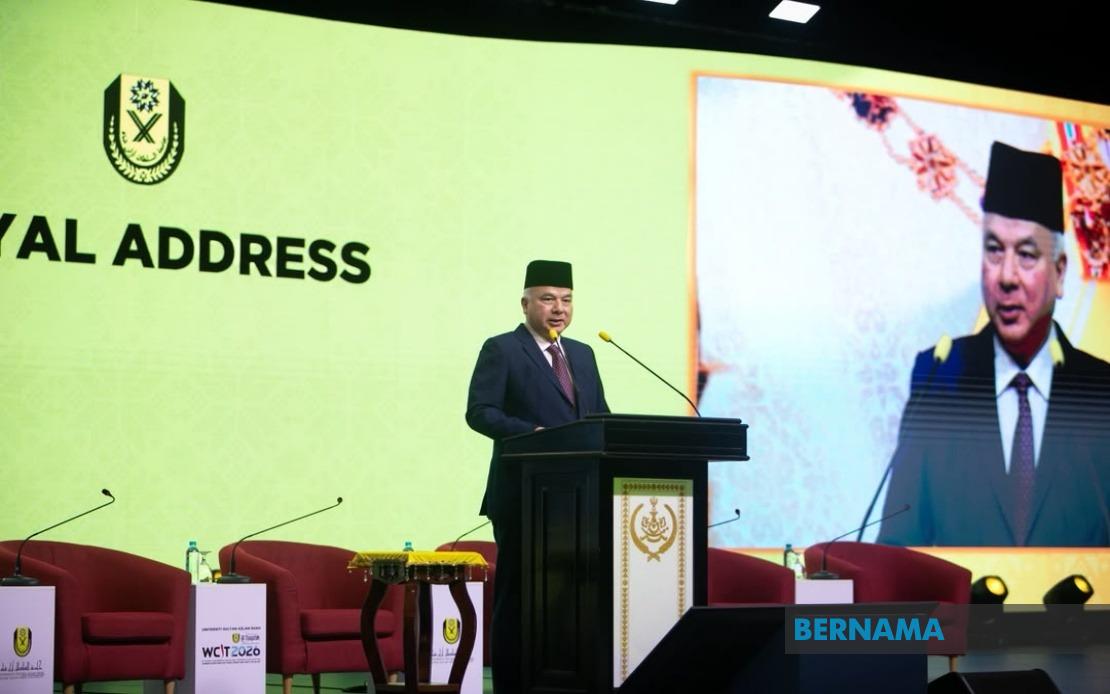
Sultan Nazrin Shah, the Sultan of Perak, has articulated a vision of national security that extends far beyond conventional military and technological defences. Speaking at the 8th World Conference on Islamic Thought and Civilisation in Ipoh on July 21, the royal leader contended that the most enduring form of security stems from social cohesion—the bonds that unite a diverse population around shared values and collective purpose. While acknowledging that border protection and countering cyber threats remain necessary components of any nation's defensive strategy, Sultan Nazrin positioned these measures as insufficient without the deeper foundation of internal unity and mutual belonging.
For Malaysia in particular, which has long grappled with balancing religious identity within a multicommunal democracy, the Sultan's remarks carry significant weight. He identified a specific vulnerability that many nations across the Muslim world have confronted: the weaponisation of religious sentiment to advance narrow factional interests at the expense of national cohesion. This pattern—where faith becomes a tool for division rather than a bridge for understanding—represents a corrosive threat that no security apparatus can effectively counter. The manipulation of belief systems to justify exclusion fundamentally undermines the inclusive vision that underpins sustainable nationhood.
Sultan Nazrin articulated a fundamental principle that challenges conventional thinking about statecraft and sovereignty. True national integrity cannot be decoupled from security; a nation that fortifies its borders while suffering from internal corruption, systemic injustice, and eroding institutional trust has achieved only a superficial and temporary advantage. Such a state has not solved its security dilemma but merely deferred the inevitable consequences of internal decay. The correlation between integrity and security suggests that investments in rule of law, transparent governance, and equitable economic opportunity are not competing priorities with defence spending but essential complements.
Central to the Sultan's thesis is the concept of belonging—the psychological and material sense that all citizens, regardless of ethnic or religious background, possess a genuine stake in their nation's trajectory and prosperity. When this sentiment exists, it generates powerful internal cohesion that external threats struggle to fracture. Conversely, when significant portions of the population feel excluded from economic opportunity, political voice, or fair representation in key institutions, no security apparatus proves robust enough to compensate. The presence or absence of this shared sense of belonging fundamentally determines a nation's resilience during times of crisis.
The Sultan emphasised that national integrity cannot be manufactured through enforced uniformity or the suppression of dissenting voices. Instead, it requires deliberate institutional design ensuring that diverse communities see themselves reflected equitably across the legal system, economic structures, educational institutions, and leadership hierarchies. This approach recognises that genuine unity emerges not from enforced conformity but from voluntary commitment rooted in perceived fairness and mutual respect. When citizens across different backgrounds witness laws applied consistently, economic opportunity distributed broadly, and leadership representative of the broader population, they develop organic commitment to the national project.
A critical distinction the Sultan drew involves the comparative durability of different types of unity. Cohesion maintained through coercion—whether through surveillance, repression, or fear—remains brittle and susceptible to sudden collapse when pressure eases or legitimacy erodes. By contrast, unity constructed on genuine shared belonging and reciprocal investment in collective welfare possesses inherent resilience. Citizens unified by coercion await the moment to resist; citizens unified by genuine belonging actively defend their shared institutions against destabilising forces. This distinction has profound implications for understanding why some nations weather crises successfully while others fracture under stress.
Turning to education as a foundation for long-term security and prosperity, Sultan Nazrin outlined a vision of comprehensive human capital development suited to contemporary and emerging challenges. He stressed that the traditional model—building physical infrastructure in the form of schools and universities—represents only a starting point. The substance of education requires careful calibration to develop the capacities that artificial intelligence and automation cannot replicate. While foundational knowledge in sciences and mathematics remains essential, the Sultan argued that education systems must equally emphasise humanities, arts, and ethics—disciplines that cultivate the reflective capacities distinguishing human cognition from algorithmic processing.
The Sultan's educational framework explicitly rejects an artificial hierarchy between academic and vocational pathways, a distinction that has long plagued educational systems across Southeast Asia. By advocating that technical and vocational training receive equivalent institutional prestige and investment as university education, he addressed a practical reality: modern economies require skilled tradespeople as much as they require doctors and engineers. This inclusive approach to educational dignity expands opportunities for social mobility and ensures that communities historically steered away from academic routes can access respected and economically viable careers.
In the context of artificial intelligence's accelerating advancement, Sultan Nazrin identified a fundamental transformation required in how education conceptualises knowledge and learning. The pedagogical methods optimised for industrial economies—rote memorisation, standardised testing, and uniform curricula—serve poorly in an environment where information retrieval is instantaneous and nearly costless. The genuine scarcity now consists of the distinctly human capacities: critical thinking that questions prevailing assumptions, ethical reasoning that navigates competing values, creativity that generates novel solutions, and adaptability that responds to unforeseen circumstances. These are precisely the intellectual capacities that properly conceived Islamic education, grounded in both revealed knowledge and rational inquiry, has historically cultivated.
The Sultan's remarks about Islamic education merit particular emphasis given their relevance to Malaysia's own educational debates. He suggested that the tradition of Islamic scholarship, characterised by rigorous intellectual engagement with texts and principles rather than passive reception of doctrine, offers a template for developing the human capacities required in knowledge-based economies. This framework provides religious communities and Islamic educational institutions a pathway to embrace technological change and contemporary intellectual challenges without perceiving them as threats to theological integrity. The potential synthesis of traditional Islamic epistemology with contemporary pedagogical requirements offers a compelling alternative to the false choice between modernisation and religious authenticity.
The Sultan's address, delivered in the presence of Deputy Prime Minister Datuk Seri Fadillah Yusof, Perak Menteri Besar Datuk Seri Saarani Mohamad, and Higher Education Minister Datuk Seri Dr Zambry Abd Kadir, signals high-level engagement with these questions of national security, social cohesion, and educational transformation. The gathering of such senior political figures at an Islamic thought conference underscores how governments across the region are confronting the intersection of religious identity, national security, and economic competitiveness. For Malaysia specifically, a nation constantly negotiating the relationship between Islamic values and multicommunal governance, these themes address enduring tensions that shape policy debates from education to economic development to social harmony.

