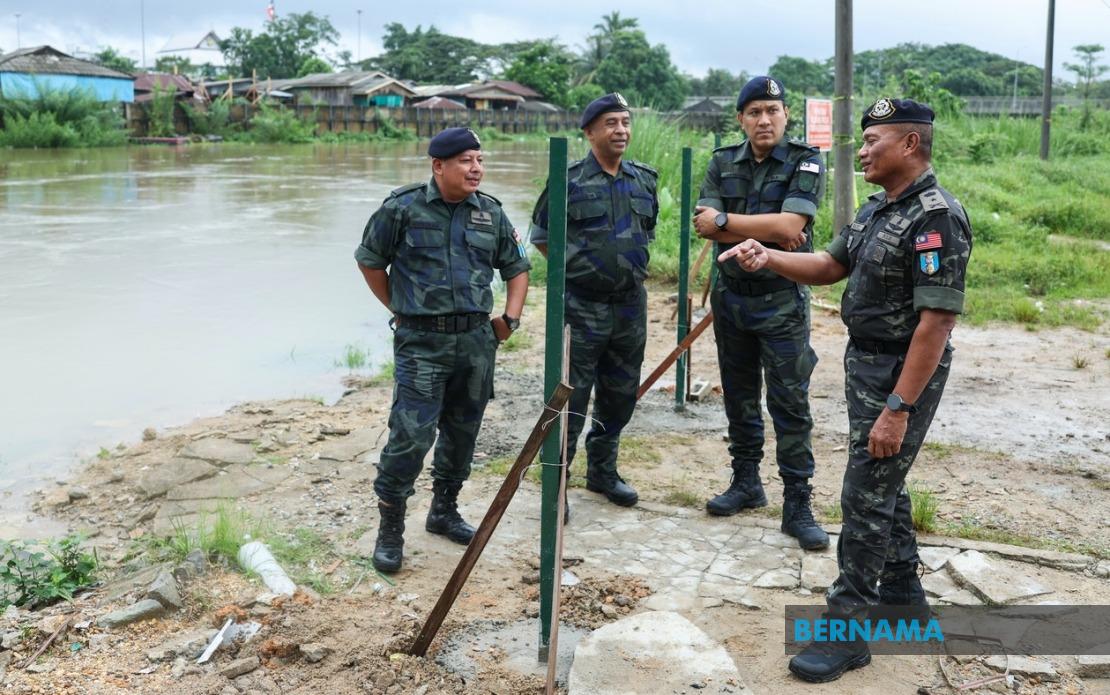
Security forces in Kelantan have uncovered a significant shift in how human smuggling operations function within Malaysia, with criminal syndicates now fragmenting migrant movements into smaller clusters to circumvent law enforcement detection. The General Operations Force's Southeast Brigade intercepted 13 Myanmar nationals—five women and eight men—following separate raids in Kampung Banggol Kemian, Pasir Mas, in an operation that exposed the evolving sophistication of trafficking networks operating across the Thai-Malaysian border.
The arrests came during Operasi Taring Wawasan Kelantan, a coordinated enforcement action undertaken jointly by GOF's 8th Battalion and the Criminal Investigation Division from Pasir Mas district police headquarters. According to Southeast Brigade GOF commander SAC Ahmad Radzi Hussain, the operation commenced at approximately 3.30 am following intelligence work that prompted personnel to investigate a Proton Exora displaying suspicious behaviour in the locality. When the vehicle's driver detected the GOF presence, he abandoned the car and fled into dense forest, ultimately evading capture.
Inspection of the abandoned vehicle yielded the first batch of detainees: four Myanmar nationals occupying the rear seats who possessed no legitimate travel documentation. A systematic search of the surrounding forest perimeter approximately an hour later resulted in the apprehension of nine additional undocumented migrants who had recently crossed into Malaysian territory through unauthorised entry points. The coordinated nature of these separate discoveries illustrates the deliberate operational design employed by trafficking organisers to reduce visibility and minimise the probability of mass detection during transportation.
The detainees, ranging in age from twenty to thirty-seven years, subsequently revealed critical details about their journey and intended destinations. All individuals reported having been ferried across the Golok River from Thailand by two unidentified handlers, then strategically deposited at intervals throughout the forest rather than transported collectively in a single vehicle movement. This segmented approach directly addresses the vulnerability that large-group transits present to enforcement operations. The migrants were ultimately bound for employment opportunities in the Kuala Lumpur metropolitan area, consistent with broader patterns of regional labour migration that drive undocumented movement across Southeast Asia.
The evolution toward smaller-group transportation represents an adaptive response by smuggling syndicates to increasingly sophisticated border security measures across Malaysia. Rather than operating consolidated convoys that present obvious targets for checkpoint screening and aerial surveillance, networks now distribute migrants across multiple routes and timetables, thereby reducing the likelihood that any single interception will yield substantial numbers. This tactical adjustment complicates enforcement coordination and stretches already-thin monitoring resources deployed along porous forest borders shared with Thailand.
Beyond the human apprehensions, authorities also secured a Proton Exora valued at approximately RM30,000, which had served as the primary transportation asset for the smuggling operation. The seizure of vehicles represents an important disruption to syndicate infrastructure, as reliable transport assets constitute critical operational requirements for repeated trafficking runs. Each confiscated vehicle increases operational costs and reduces the bandwidth available for subsequent smuggling attempts, though the relatively modest vehicle value suggests that replacement costs present only marginal deterrence to well-resourced criminal networks.
The investigation has been transferred to Pasir Mas district police CID for prosecution under Section 6(1)(c) of the Immigration Act 1959/63, which addresses the transportation and harboring of undocumented non-citizens. This statutory framework provides the legal foundation for proceeding against both the apprehended migrants and, potentially, the identified and unidentified handlers involved in orchestrating the cross-border movement. The two unidentified ferry operators remain fugitives and represent active investigation priorities.
For Malaysian policymakers, this operation underscores the dynamic nature of migrant trafficking and the continuous tactical modifications employed by organised networks. The shift toward smaller-group dispersals presents enforcement challenges that cannot be addressed through checkpoint-centric strategies alone, requiring instead enhanced intelligence collection, cross-border cooperation with Thai authorities, and community-based reporting mechanisms in vulnerable frontier zones. The Golok River crossing points, while geographically challenging to seal entirely, remain focal areas requiring sustained operational attention.
The incident also reflects broader Southeast Asian labour dynamics, wherein economic disparities between Myanmar and Malaysia maintain powerful incentives for undocumented migration despite enforcement risks. The migrants' intended destination in Kuala Lumpur suggests employment in lower-wage sectors—construction, manufacturing, domestic work, and hospitality—where undocumented labour remains economically accessible to employers despite legal prohibitions. Addressing the supply side of human smuggling therefore requires engagement with labour market conditions and employer compliance mechanisms, not solely border interdiction.
Regionally, the sophistication demonstrated by this particular network—coordinated ferry operations, vehicle acquisition, forest navigation, and distributed delivery logistics—indicates that human trafficking along the Thailand-Malaysia corridor remains organised and well-resourced. The apparent professionalism of operations stands in contrast to the desperate circumstances of migrants themselves, highlighting the profit extraction inherent in trafficking systems. Each migrant transported likely generates substantial returns for organisers while exposing individual migrants to exploitation, debt bondage, and workplace abuse.
For Southeast Asian governments collectively, such operations signal the necessity for harmonised enforcement standards and intelligence-sharing protocols that transcend bilateral limitations. Thai-Malaysian cooperation on identifying and disrupting smuggling hubs in cross-border areas remains underdeveloped relative to the scale of smuggling activity. Enhanced judicial cooperation concerning human trafficking prosecutions, combined with intelligence exchange regarding syndicate structures and operational methods, could significantly amplify enforcement effectiveness across the region.

