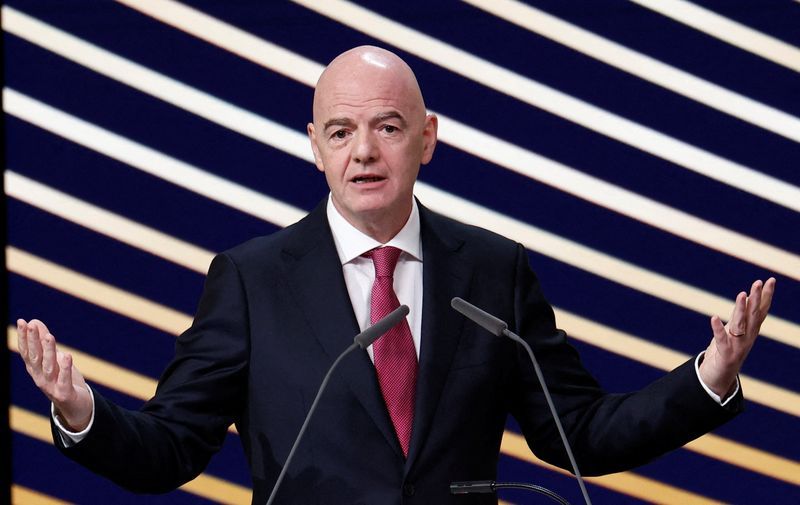
Gianni Infantino's bid to secure a fourth term as FIFA president faces an unprecedented challenge, with two of the world's most powerful football confederations now openly questioning his leadership. Yet his path back to power may depend less on reconciliation with Europe's elite soccer nations than on maintaining the backing of smaller, developing countries that have become reliant on FIFA's financial support mechanisms.
The Swiss administrator confirmed in May that he intends to contest next year's Congress election, but the timeline may accelerate before then. UEFA and CONCACAF, representing 55 and 41 member nations respectively, declared no confidence following Infantino's proposal to inject private equity capital into the World Cup—a scheme that triggered immediate resistance across the football establishment. Wales became the first national federation to formally withdraw its support, and UEFA indicated it was preparing legal challenges against the FIFA president over the initiative.
The governance structure of FIFA creates unusual dynamics that could shield an incumbent facing such hostility. Although all 211 member associations possess equal voting power irrespective of their footballing prestige or economic might, removing a sitting president requires significant procedural hurdles. An Extraordinary Congress to challenge Infantino's leadership must be convened if 20 percent of member associations formally request one in writing. Even then, an Extraordinary Congress would need to occur within three months, potentially allowing Infantino and rival candidates to mobilise support across dispersed continents and time zones.
Europe possesses sufficient unity to force such a vote alone—UEFA's 55 members voting unanimously could trigger the process immediately. However, securing the majority vote needed to actually unseat Infantino at an Extraordinary Congress represents a fundamentally different calculation. This dynamic creates a striking asymmetry: European confederations can relatively easily force a confrontation, but translating that confrontation into Infantino's removal requires assembling support from across Africa, Asia, South America, Oceania and the Caribbean. Many of these regions view Infantino's tenure through a radically different lens than European federations.
Under Infantino's leadership, FIFA has substantially expanded financial transfers to smaller nations. The 2023–26 World Cup cycle allocation permits member associations to claim up to $3 million for soccer development programmes, representing a $1 million increase from the previous cycle. For wealthy nations with established professional leagues and domestic revenue streams, such sums constitute rounding errors in football budgets. For nations like Bhutan, Vanuatu, Mauritius or Samoa—countries that have never qualified for a World Cup and rely almost entirely on international competition revenue and FIFA assistance—these grants constitute the lifeblood of national football operations.
Vanuatu exemplifies how Infantino's patronage has transformed institutional power for smaller footballing nations. The South Pacific island nation, with a population of approximately 340,000, received a $4.15 million FIFA development grant that enabled construction of a 6,500-seat stadium in the capital Port Vila, completed in 2022. Critically, Vanuatu's football association president Lambert Maltock obtained a seat on FIFA's Executive Council as one of eight vice-presidents—a position that offers substantial international prestige and institutional influence to a nation whose football federation might otherwise exercise minimal voice in global football governance. For Brian Kaltak, Vanuatu's first professional player now based in Australia, Infantino's approach has represented genuine opportunity. The Perth Glory defender acknowledged that FIFA leadership opened doors previously closed to developing nations, simultaneously providing direct financial support for infrastructure and competitive opportunity.
This funding architecture operates consistently across Africa, Asia, the Caribbean and the Pacific. FIFA grants have financed training facilities, gymnasium equipment, coaching development programmes and tournament participation costs that national associations would struggle to afford through domestic resources. Kenya, Fiji, Sierra Leone, Afghanistan and dozens of others have benefited from similar development transfers. Such investments are not incidental to FIFA operations but constitute core elements of Infantino's broader vision for globalising football participation.
The political implications cut deeply. By expanding FIFA's financial reach into smaller nations whilst simultaneously concentrating institutional power through enlarged Executive Councils and development council positions, Infantino has created a constituency with tangible interests in his continued leadership. These nations did not resist the private equity proposal with the same intensity as European confederations because such equity injection might ultimately enhance the resources flowing to smaller federations. This structural dependency renders mobilising anti-Infantino sentiment among smaller nations considerably more difficult than assembling European opposition.
Critics contend that this funding model fundamentally compromises FIFA governance by creating a political ecosystem where financial patronage translates directly into voting loyalty. The system arguably perpetuates an international football hierarchy where the world governing body trades material resources for political compliance, making incumbent presidents exceptionally difficult to unseat once they establish strong relationships with developing football nations. An Infantino opponent seeking to build a coalition sufficient to remove him at an Extraordinary Congress would need to persuade dozens of smaller nations to vote against the president who has materially improved their footballing infrastructure and international standing.
The arithmetic of FIFA's membership structure thus reverses traditional assumptions about power in international sport governance. UEFA's 55 nations represent advanced football economies with sophisticated administrative systems and European political coordination mechanisms. Yet these advantages prove insufficient without broader support. Infantino's greatest vulnerability emanates not from Europe's established football powers but from his ability to sustain backing among the 156 member associations outside Europe. Winning back major nations like France, Spain and England would provide political legitimacy but would not guarantee survival. Conversely, maintaining support across Africa's 54 nations, Asia's 47 nations and other confederations provides the numerical foundation for withstanding European pressure.
The developing crisis reveals FIFA's fundamental governing paradox. The organisation legitimises itself through universal membership and democratic voting procedures, yet this universalism creates voting patterns disconnected from global football's actual power distribution. An incumbent president opposed by Europe's footballing elite may survive by retaining support from smaller nations whose football development depends upon that president's patronage priorities. Whether Infantino chooses to force an extraordinary congress confrontation or attempts negotiated settlement with UEFA and CONCACAF will partly depend on his confidence in maintaining this coalition of smaller nations that have benefited substantially from his tenure.

