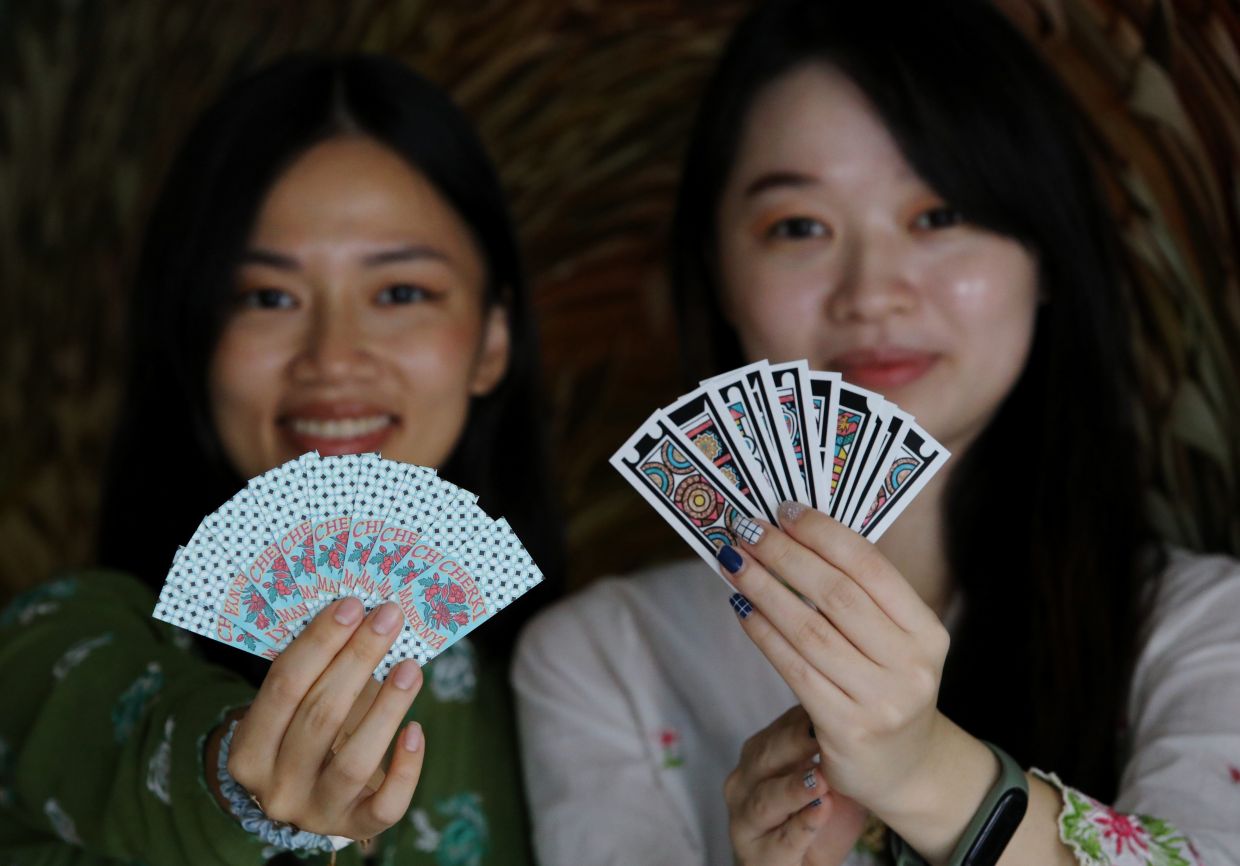
Two Peranakan sisters from Melaka are attempting to rescue a centuries-old card game from cultural obscurity. Lee Swee Lin, 32, and Lee Swee May, 31, have redesigned Cherki – a traditional game once played in households across the Baba Nyonya community – introducing vibrant colours and modern illustrations while preserving its fundamental structure and symbolic elements. What began as a personal mission to honour their late grandmother has evolved into a broader effort to bridge the widening gap between younger Peranakans and their ancestral traditions in an era dominated by digital entertainment and competing priorities.
Cherki, also known as Ceki, Chi Kee or Koa in different regions, represents a significant but increasingly forgotten dimension of Peranakan heritage. Played across Singapore, Malaysia, Indonesia and Thailand, the game shares structural similarities with mahjong, utilising two decks of 60 cards depicting 30 distinct patterns. Traditional versions featured simple black-and-white designs divided into three suits – coins, strings and myriads – with numerical values from one to nine, supplemented by three special cards representing symbolic concepts. Historical records suggest card games originated during China's Tang Dynasty in the 9th century, later spreading westward through trade routes to reach Europe by the 14th century. The Malay adaptation of these cards, called "daun ceki" (daun meaning leaf), became deeply embedded in Peranakan culture, though knowledge of the game has deteriorated significantly among contemporary generations.
The sisters' decision to revitalise Cherki stems partly from personal loss and reflection. Their paternal grandmother, Deo Yeok Kim, profoundly shaped their understanding of Peranakan traditions through daily example – from cooking practices to language preservation to the meticulous beadwork that now sustains their family business. After her recent passing, both sisters recognised how extensively their cultural knowledge derived from her lived example rather than formal instruction. This realisation catalysed their determination to prevent similar knowledge loss among younger Peranakans who lack equivalent intergenerational transmission. For Lee Swee Lin, the project addresses a critical vulnerability: many people in her generation, and even in her mother's era, no longer possess the skills to play Cherki, let alone teach it to others.
The Melaka-born entrepreneurs, who operate a Kuala Lumpur business specialising in Peranakan beaded footwear and decorative objects, found themselves naturally positioned to undertake this cultural reclamation. Their existing work already involved learning traditional techniques from their mother and grandmother – knowledge laden with cultural significance and practical artistry. Extending this preservation impulse toward Cherki represented a logical evolution of their commitment to maintaining tangible connections to Peranakan identity. Beginning their research and development phase in 2024, they collaborated with a small design team to digitally reimagine the cards using contemporary tools including Procreate and Adobe Illustrator. Critically, they prioritised aesthetic modernisation without sacrificing cultural authenticity.
Their adapted version maintains the essential 30-pattern structure but increases repetition from twice to four times per deck, introducing visual vibrancy while streamlining gameplay comprehension. The redesigned cards prominently feature culturally resonant Peranakan symbols: the kantan, a fragrant flower integral to Nyonya cuisine; chupu, traditional porcelain serving vessels; kerongsang, ornamental clasps fastening the kebaya; and gelang, bracelets worn by Nyonya women. Special cards have been reimagined, replacing the original white flower, red flower and old thousand with butterfly, dragon and phoenix – symbols carrying deeper cultural meaning within Peranakan cosmology. Simultaneously, they created substantially clearer instructional materials, recognising that game accessibility represents a precondition for cultural transmission. As Lee Swee May explains, their underlying philosophy sought equilibrium: contemporary visual appeal and intuitive mechanics serving as vessels for heritage, enabling younger players to engage meaningfully with their ancestry without requiring prior cultural immersion.
This revival initiative intersects with broader demographic challenges confronting the Peranakan community. Persatuan Peranakan Baba Nyonya Malaysia (PPBNM) deputy president Lee Yuen Thien estimates the national Peranakan population at 10,000-15,000 individuals, with the association currently maintaining 3,000 members. Among younger cohorts, accelerating cultural disconnection reflects not apathy but structural transformation. Career preoccupation, geographic dispersion, and competing entertainment options have fundamentally altered how contemporary Peranakans allocate cultural attention. A 2022 academic study examining "Comparative of Cultural Material Study Between Baba Nyonya Original Descendants and Baba Nyonya New Descendants in Malacca" documented how younger generations increasingly encounter external cultural influences – particularly global pop culture – whilst experiencing diminished exposure to traditional practices. The research underscored educational necessity, advocating for systematic awareness-raising regarding Baba Nyonya material culture.
Migration patterns and demographic evolution have particularly impacted cultural transmission mechanisms. Many Peranakans now live outside ancestral strongholds in Melaka and Penang, where historical family networks traditionally facilitated knowledge passing. Mixed marriages, lifestyle modernisation, and professional migration have fundamentally restructured community cohesion. Lee Yuen Thien acknowledges that contemporary life trajectories – characterised by demanding career commitments and competing priorities – leave minimal temporal and psychological space for cultural engagement, which many view as peripheral to pressing practical concerns. This generational fracture extends beyond individual families into institutional memory. Traditional household practices where grandmothers taught card games or cooking techniques during leisure hours have largely dissolved, replaced by atomised family units where such transmission becomes episodic rather than continuous.
Cultural preservation advocates, however, resist pessimistic inevitability narratives. Tan, manager of the Baba & Nyonya Heritage Museum Melaka, contends that cultural evolution and continuity need not remain antagonistic. Rather, encouraging heritage awareness among younger Peranakans can catalyse renewed interest and sustain cultural transmission. Lee Swee Lin similarly frames Cherki revitalisation as essential to preventing complete forgetting of a game intrinsically connected to Peranakan identity, storytelling traditions and community bonds. Without deliberate preservation efforts, she warns, Cherki risks becoming purely historical, divorced from living practice. This perspective aligns with contemporary heritage scholarship recognising that traditions survive not through static preservation but through dynamic adaptation maintaining continuity with ancestral practices whilst remaining relevant to contemporary contexts.
The sisters' approach deliberately embraces this adaptive philosophy. Their modernised cards represent neither nostalgic reproduction nor complete reimagining but rather thoughtful translation – rendering traditional game mechanics and symbolic vocabularies accessible to players lacking prior exposure. The visual transformation serves pedagogical purposes, signalling that heritage need not feel temporally remote or aesthetically alienating. By making Cherki visually compelling and mechanically transparent, they remove practical barriers to engagement. Simultaneously, embedded Peranakan symbolism ensures that gameplay itself becomes a vehicle for cultural transmission, each card interaction reinforcing familiarity with ancestral aesthetics and values. Players learning Cherki implicitly absorb knowledge about Nyonya jewellery, cooking traditions and dress practices through contextualised, pleasurable engagement rather than formal instruction.
The project's broader significance extends beyond individual card game revival toward exemplifying how smaller communities within diverse Malaysia can sustain heritage in modernising conditions. Peranakan culture, having survived centuries of intercultural contact and colonial administration, faces contemporary challenges less tangible than historical threats – not suppression but indifference, not prohibition but obsolescence through disengagement. The Lee sisters' initiative demonstrates that preservation need not require abandonment of modernity or rejection of contemporary design sensibilities. Instead, it demands intentional curation of cultural transmission mechanisms adapted to contemporary social conditions. Their work also illustrates how diaspora communities activate heritage through entrepreneurship and creative adaptation, transforming cultural preservation from antiquarian concern into dynamic contemporary practice.
Looking forward, the sisters' Cherki project occupies uncertain terrain. Whether modernised card games can substantially reverse intergenerational cultural disconnection remains contingent on broader ecosystem factors – family engagement, community institutional support, and sustained visibility within Peranakan networks. However, their initiative establishes a proof-of-concept demonstrating that heritage transmission requires neither resignation to loss nor nostalgic stasis. Instead, creative professionals from within heritage communities can generate contemporary expressions honouring ancestral practices whilst meeting contemporary aesthetic and mechanical expectations. For younger Peranakans contemplating their cultural identity, modernised Cherki offers tangible entry points, suggesting that heritage remains living, evolving and directly relevant to present experience rather than strictly historical.

