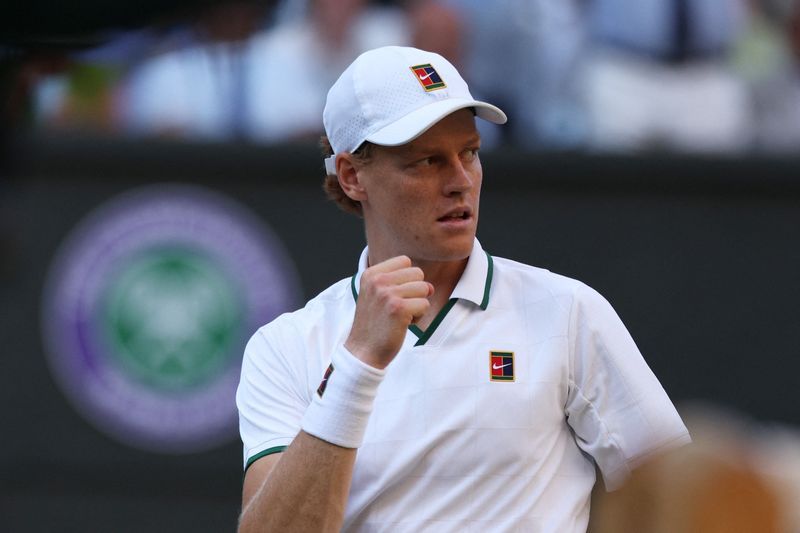
Jannik Sinner reinforced his status as one of professional tennis's elite performers by successfully defending his Wimbledon crown on Sunday, overcoming a stern challenge from Germany's Alexander Zverev in a four-set final at the All England Club. The 24-year-old Italian triumphed 6-7(7) 7-6(2) 6-3 6-4 in a match that showcased both technical mastery and mental resilience under the pressure of defending one of tennis's most prestigious titles.
With this victory, Sinner has now captured his fifth Grand Slam championship and joined an exclusive group of only ten players in the professional era to successfully defend a Wimbledon title. The achievement carries particular significance given the competition he faces from rivals, most notably Carlos Alcaraz, who currently leads with seven Grand Slam titles. Sinner's continued ascent narrows that gap and positions him as a genuine threat in the race to accumulate multiple major championships throughout his career.
The dominance Sinner has established over Zverev is equally remarkable. This victory extended his unbeaten run against the German to ten consecutive matches, a streak that demonstrates the psychological advantage the Italian has developed. Zverev, despite being seeded second and reaching his fourth Grand Slam final, could not find the answers needed to break through against an opponent who seems to understand the nuances of their matchup better with each encounter.
The final itself proved to be a compelling examination of two different approaches to tennis at the highest level. The opening set was a gruelling affair, with both players engaged in an extended battle that stretched to twelve games before the tiebreak decider. Zverev's aggressive approach yielded immediate dividends when he showcased his powerful forehand to secure the opening set, with the German celebrating emphatically at Centre Court after outlasting his opponent in a tense tiebreak.
However, Sinner's response demonstrated the characteristic composure that has defined his rise to prominence. Despite Zverev's continued attacking play in the second set, Sinner gradually asserted control and converted the second set tiebreak with greater precision, levelling the match and indicating that the momentum was beginning to shift. The Italian's increased animation and engagement with the crowd suggested he was settling into the rhythm of the encounter.
A pivotal moment arrived in the third set when Zverev brought up a break point after more than two and a half hours of intense rallying. However, a miscalculation by the German proved decisive. After being deceived by one of Sinner's characteristic drop shots, Zverev slipped and fell awkwardly onto the Centre Court grass, landing heavily on his right knee. The visible distress and the dramatic nature of the fall momentarily shifted the emotional tenor of the match, with the crowd audibly concerned for the player's wellbeing.
Although Zverev continued playing after tending to his injury, the incident appeared to disrupt his momentum. Sinner capitalised immediately, breaking serve in the following game to move to a 5-3 advantage. Zverev's frustration became evident as he smashed his racket to the court, a sign that the psychological weight of the situation was weighing upon him. By the conclusion of the third set, after nearly three hours of gruelling tennis, Sinner had moved into a commanding two-sets-to-one lead.
The fourth and final set saw Sinner maintain his ascendancy with another break of serve that provided a 4-3 advantage. From this position, the Italian proved capable of withstanding whatever Zverev could muster, holding his service games with increasing confidence as the finish line approached. The closing stages of the match became a formality, with Sinner clinching the title after nearly four hours of compelling tennis. His collapse onto the grass in celebration reflected the emotional intensity and physical toll of defending a Grand Slam title.
For Zverev, the loss marked his fourth defeat in a Grand Slam final, a statistic that underscores the difficulty of converting opportunities at the sport's most prestigious tournaments. Nevertheless, the German conducted himself with grace in defeat, offering generous congratulations to his opponent and acknowledging the honour of competing on Centre Court during the final weekend. His aside to Sinner about being unable to count his consecutive losses suggested a player who, despite disappointment, could appreciate the competitive reality before him.
Sinner's victory carries implications beyond Wimbledon's manicured grass courts. His continued progression in the Grand Slam count, combined with his consistency across different surfaces and tournament formats, suggests that the tennis landscape is evolving. The Italian's blend of aggressive baseline play, exceptional athleticism, and mental fortitude represents a template that may define the sport's next era of dominance.
For Southeast Asian tennis enthusiasts and observers, Sinner's emergence as a perennial contender at the sport's highest level reflects the globalisation of professional tennis. The Italian's success, alongside other emerging players from diverse backgrounds, demonstrates that the sport's traditional power bases continue to shift. His ability to perform under immense pressure at tennis's most traditional and revered venue adds another dimension to his credentials as a generational talent poised to shape the sport's trajectory for years to come.

