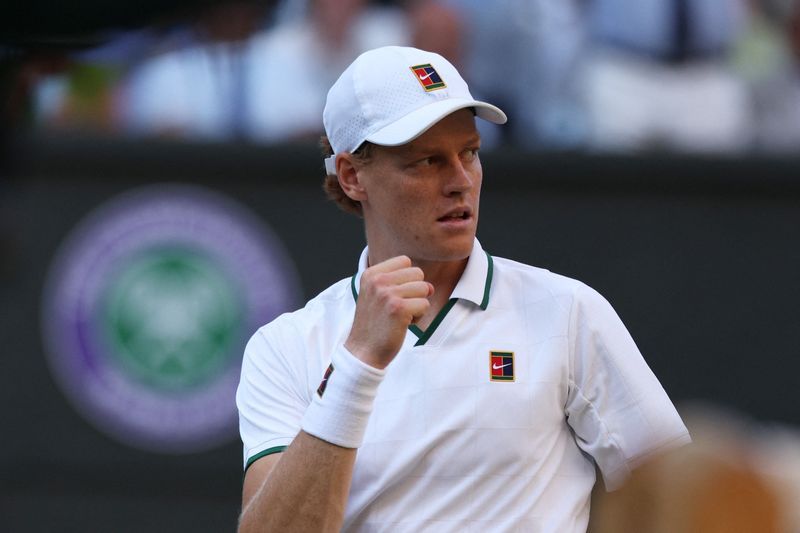
Jannik Sinner has cemented his status as one of tennis's most formidable champions by successfully defending his Wimbledon title in a gruelling final that showcased the sport at its most compelling. The Italian top seed overcame a determined challenge from Alexander Zverev, the second seed, in what proved to be a marathon three hours and 46 minutes of intense, power-laden tennis. The scoreline of 6-7(7) 7-6(2) 6-3 6-4 reflects a contest that remained delicately balanced for much of its duration before Sinner's superior depth and consistency ultimately prevailed on Centre Court.
The victory represents far more than another trophy for Sinner. At 24 years old, he has now accumulated five Grand Slam titles and accomplished the rare feat of defending a Wimbledon crown, joining just ten men in the professional era to successfully repeat as champion at the All England Club. His achievement last year, when he first won Wimbledon by defeating Carlos Alcaraz, made him the first Italian to capture the singles title at tennis's oldest major championship. This year's successful defence underscores that breakthrough as no mere one-off success but rather the foundation of something more substantial and enduring.
Zverev arrived at this final as a German player riding an emotional high. Fresh from winning the French Open at his 41st Grand Slam attempt, he was bidding to become the first German man to win Wimbledon since Michael Stich in 1991. The 29-year-old pushed Sinner relentlessly throughout, particularly in a breathtaking opening set that consumed 65 minutes of high-quality tennis. Both competitors produced heavy-hitting forehands and commanding serves, with Zverev dropping only eight points on his own delivery in that opener. The German's performance served notice that Sinner would face one of the sternest examinations of his season.
The opening set exemplified the razor-thin margins separating victory from defeat at the sport's pinnacle. Only one break point materialized during the first twelve games, and Sinner squandered that opportunity at 4-3 when he inexplicably framed a forehand wide—an uncharacteristic lapse from a player who had been performing immaculately. The subsequent tiebreak became a microcosm of the entire final's intensity. Zverev earned set point first but could not convert, then saved one with an ace before finally converting his second opportunity with a clinical forehand winner. That victory ended Sinner's remarkable streak of winning fourteen consecutive sets against the German, a significant psychological breakthrough for Zverev.
Sinner regrouped through sheer force of will. The frustration visible on his face during the second set, when Zverev's serve proved nearly impenetrable, soon gave way to renewed intensity. In the match's second tiebreak, Sinner elevated his game decisively, taking control of the rallies and levelling the match to force a decisive third set. The quality of rallies in the second set was exceptional, with both men uncorking forehands that thundered across the grass, yet Sinner's willingness to shift gears and dictate play eventually proved decisive in that critical moment.
The turning point arrived just past the two-hour-and-42-minute mark. As the third set reached 3-3, Zverev finally earned his first break point of the match, having reached a point where Sinner's defences appeared momentarily vulnerable. Yet at that crucial juncture, fortune intervened in Sinner's favour. When the Italian produced a delicate drop shot, Zverev slipped badly while attempting to change direction near the baseline, falling awkwardly on the grass. The incident was a pivotal moment that psychologically shifted momentum, even though Zverev indicated he was physically okay to continue.
What followed was a masterclass in capitalizing on an opponent's distress. Sinner held serve to preserve his situation, then broke Zverev's serve for the first time in the match as the German visibly moved more gingerly thereafter. Zverev's frustration boiled over, his racket flying across the turf in exasperation. The injury clearly affected his mobility and confidence, allowing Sinner to establish control that he never relinquished. In the fourth set, though Zverev momentarily recovered his composure and poise, Sinner executed another crucial break for 4-3 and never looked back, serving out the title with two remarkable rallies that epitomized the calibre of tennis both men had produced.
Sinner's path to this triumph had not been entirely smooth. He suffered a shocking second-round exit at the French Open just weeks earlier and came perilously close to an early exit at Wimbledon against Miomir Kecmanovic in the opening round. Yet when it mattered most, the Italian summoned his best form, particularly in the closing stages. Most impressively, he did not drop a single service game in either the semi-final or the final, a statistical indicator of dominance that masked the genuine quality of opposition he faced.
For Malaysian and Southeast Asian tennis followers, Sinner's continued excellence represents the emergence of a generational talent who prioritizes Grand Slam success above all else. Unlike some contemporaries who chase rankings and Masters titles, Sinner has built his identity around winning the sport's most prestigious events. His Italian heritage also connects to Southeast Asia through the sport's increasingly global nature, with players from all corners competing on equal footing at Wimbledon's hallowed grounds.
Zverev's journey to the final, despite the disappointment of losing, cannot be diminished. The German's French Open triumph proved he belongs among the sport's elite, and his Wimbledon appearance signals that his game, once thought to plateau, has evolved. Making a first Wimbledon final at 29 and pushing the defending champion to the absolute limit demonstrates that Zverev's career renaissance is genuine. His post-match reflection that he truly believed for the first time at his age that he could win Wimbledon suggests the German will return with renewed ambition.
Sinner's comments in victory reflected both humility and awareness of his privileged position. Standing with the pineapple-topped Challenge Cup, he acknowledged never taking opportunities for granted and recognizing that Sunday mornings at Wimbledon bring unique pressures and emotions. His recognition that two players had given everything and that both had played exceptional tennis demonstrated the sportsman's perspective of a true champion. The victory positions him among the sport's immortals, and at just 24 years old, his list of accomplishments seems far from complete as he continues to reshape the landscape of professional tennis.

