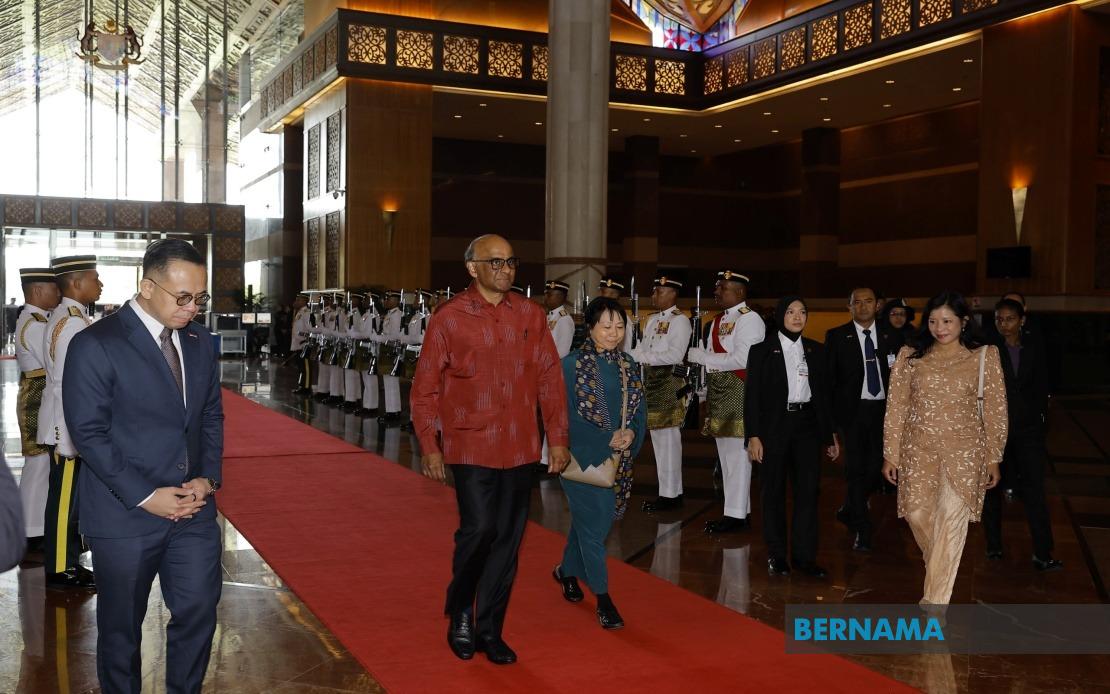
Singapore President Tharman Shanmugaratnam brought his three-day state visit to Malaysia to a close on Sunday, departing from Kuala Lumpur International Airport at 2.20 pm alongside his wife Jane Ittogi and their accompanying delegation. The presidential party, travelling on a commercial flight back to Singapore, represented the culmination of a carefully choreographed diplomatic engagement that underscored the enduring partnership between the two Southeast Asian neighbours.
The departure ceremony at KLIA Terminal 1's Bunga Raya Complex reflected the ceremonial weight accorded to the visit. A static Guard of Honour comprising two officers and 26 personnel from the First Battalion of the Royal Ranger Regiment, under the command of Capt Muhammad Hanafi Ja'afar, lined the departure route. Minister of Entrepreneur and Cooperatives Development Steven Sim represented the Malaysian government in bidding farewell to the departing dignitary, an official gesture that signalled the importance both nations place on maintaining their relationship.
Tharman's visit, which commenced on Sunday at the formal invitation of His Majesty Sultan Ibrahim, King of Malaysia, represented more than ceremonial protocol. The timing and structure of the engagement served a strategic diplomatic purpose, functioning as a reciprocal visit following Sultan Ibrahim's own sojourn to Singapore on May 6 and 7, 2024. This back-and-forth exchange of high-level visits illustrates how Malaysia and Singapore, despite occasional tensions and disagreements, maintain institutional mechanisms for reinforcing their interconnected futures.
Particularly significant was the fact that this constituted Tharman's inaugural state visit to Malaysia since he assumed the presidency of Singapore on September 14, 2023. The deliberate scheduling demonstrated Malaysia's commitment to formally acknowledging the leadership transition in the neighbouring city-state and establishing a working relationship with the ninth president. For Tharman, the visit provided an opportunity to establish his diplomatic credentials on the regional stage and signal Singapore's continued commitment to cordial relations with its largest neighbour.
The substantive components of the visit illustrated the multilayered nature of Malaysia-Singapore engagement. On Monday, Tharman received the full ceremonial treatment accorded to visiting heads of state, including a formal welcoming ceremony followed by an audience with Sultan Ibrahim at the Istana Negara, the seat of Malaysia's federal monarchy. These formal protocols served not merely as etiquette but as symbolic affirmations of mutual recognition and respect between the two nations' leadership structures.
Beyond palace protocols, the visit encompassed substantive government-to-government interaction. Prime Minister Datuk Seri Anwar Ibrahim extended a courtesy call to the Singapore President, an engagement that brought together key figures from Malaysia's diplomatic and economic portfolios. Foreign Minister Datuk Seri Mohamad Hasan, Investment, Trade and Industry Minister Datuk Seri Johari Abdul Ghani, and Entrepreneur and Cooperatives Development Minister Steven Sim all participated in the meeting, indicating that discussions likely touched on trade, investment, and economic cooperation between the nations—issues of paramount importance given their deeply integrated economies and substantial trade volumes.
The visit also encompassed engagement with Malaysia's state-level leadership, reflecting the federal structure's role in bilateral affairs. The Sultan of Selangor, Sultan Sharafuddin Idris Shah, granted an audience to Tharman at Istana Alam Shah, demonstrating that Malaysian state rulers actively participate in receiving international dignitaries. Such engagements are particularly relevant given Selangor's economic significance as Malaysia's most developed and industrialised state, with substantial commercial links to Singapore.
For Malaysian observers, the visit represents a reaffirmation of neighbourhood diplomacy at a time when both countries face regional and global challenges requiring coordinated responses. The regular exchange of high-level visits between Malaysia and Singapore, despite historical complexities and occasional friction points—ranging from maritime boundary disputes to water supply agreements—demonstrates a mature commitment to managing bilateral relations through established diplomatic channels. These visits function as pressure-release valves and relationship-maintenance mechanisms that prevent disagreements from escalating into broader confrontations.
The significance of such state visits extends beyond the immediate bilateral relationship. Malaysia and Singapore together function as anchors of regional stability in Southeast Asia, their economic clout and strategic locations making them influential actors in forums such as ASEAN and the East Asia Summit. When their leadership maintains strong working relationships, it generates positive spillover effects for the broader region, facilitating cooperation on transnational issues including maritime security, counterterrorism, and environmental protection.
For Tharman specifically, the Malaysia visit allowed him to establish his role as a regional diplomat advancing Singapore's interests while navigating the complexities of balancing relationships with multiple Southeast Asian partners. His presidency comes at a time when regional geopolitics are in flux, with great power competition and shifting alliances creating new challenges for small nations seeking to maintain strategic autonomy while deepening beneficial partnerships.

