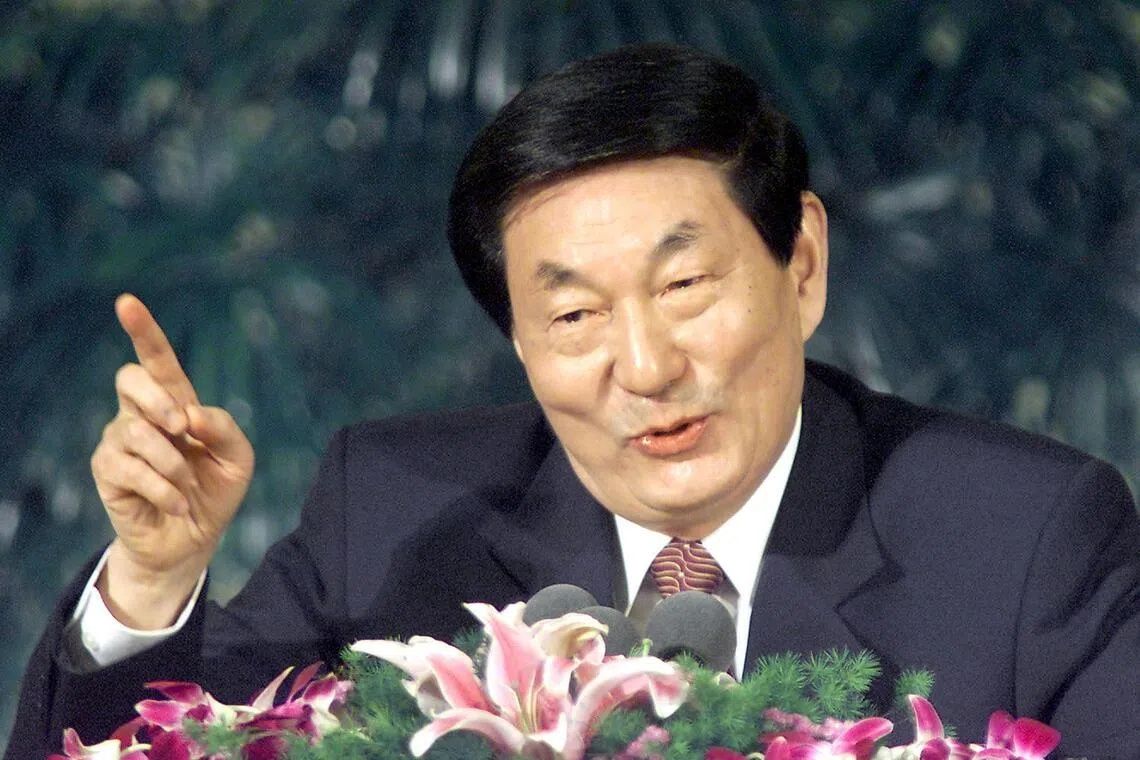
Singapore's Prime Minister Lawrence Wong has conveyed condolences to Chinese Premier Li Qiang following the passing of former premier Zhu Rongji in Beijing on Wednesday, August 12, just weeks before what would have been his 98th birthday. The death marks the end of an era for one of China's most transformative economic leaders, whose tenure fundamentally reshaped the nation's position in the global marketplace and influenced regional development strategies across East and Southeast Asia.
In a formal letter dated August 13, PM Wong acknowledged Zhu's exceptional career spanning decades of public service, during which he demonstrated visionary leadership in steering China through its most ambitious economic restructuring. The tribute specifically highlighted Zhu's pivotal role in orchestrating China's integration into the World Trade Organization in 2001—a landmark achievement that opened unprecedented trade pathways and established the foundation for China's emergence as a global economic powerhouse. This accession fundamentally altered regional and international trade dynamics, enabling Chinese enterprises to access global markets while facilitating foreign investment into the country at unprecedented scale.
PM Wong characterised Zhu as an enduring friend of Singapore, underscoring the personal relationships he cultivated with Singapore's foundational leaders. The former Chinese premier maintained close working relationships with Lee Kuan Yew and Goh Chok Tong across multiple formal and informal engagements, fostering a bilateral rapport that transcended typical diplomatic protocol. These connections proved instrumental in building institutional trust between the two nations and creating channels for substantive dialogue on matters of regional interest during a transformative period in Asia-Pacific relations.
A watershed moment in Singapore-China engagement occurred in 1999 when Zhu became the inaugural speaker at the prestigious Singapore Lecture, an influential forum organised by the ISEAS – Yusof Ishak Institute that attracts prominent global policymakers and intellectuals. His address articulated a compelling vision of how China's economic ascendancy would generate prosperity not merely for Beijing but ripple across Asia and the broader global economy. This prescient assessment proved remarkably accurate, as subsequent decades validated his thesis that Chinese growth would elevate living standards and create opportunity throughout the region.
During that lecture, Zhu introduced a conceptually significant proposal: the establishment of a free trade area linking the Association of Southeast Asian Nations with China. This initiative represented more than commercial opportunism; it embodied a strategic understanding that economic interdependence could become a stabilising force in regional relations. PM Wong observed that this vision has since materialised, with China now functioning as one of Singapore's most consequential economic partners while maintaining similarly vital trade and investment relationships across the ASEAN community.
Beyond grand strategic pronouncements, Zhu's legacy encompasses concrete bilateral projects that have shaped Singapore-China cooperation. He championed the China-Singapore Suzhou Industrial Park, Singapore's inaugural government-to-government venture in mainland China, which became a flagship model for economic collaboration and demonstrated the viability of joint ventures between the island nation and the mainland. This project generated employment, transferred technological expertise, and established replicable templates for regional industrial cooperation that influenced subsequent initiatives throughout East Asia.
When serving as Shanghai's mayor, Zhu actively promoted official and professional exchanges between Singapore and Shanghai, recognising that sustained dialogue between administrative and business communities would deepen mutual understanding and create lasting institutional relationships. These facilitated interactions enabled knowledge transfer, professional networking, and the establishment of personal relationships among officials who would influence policy trajectories in subsequent years. Such investments in people-to-people connections often prove as consequential as formal diplomatic agreements, generating goodwill and shared interests that persist across political transitions.
The foundations that Zhu's initiatives established have matured into the sophisticated bilateral relationship Singapore and China enjoy today. The infrastructure for dialogue, commercial networks, and institutional partnerships created during his tenure continue functioning as essential conduits for cooperation. PM Wong's tribute emphasised that contemporary Singapore-China relations—encompassing extensive official exchanges, substantial investment flows, and collaborative efforts across multiple sectors—rest fundamentally upon groundwork laid during Zhu's most influential years.
For Malaysian and broader Southeast Asian observers, Zhu's trajectory illuminates the consequential role individual visionary leaders play in shaping regional trajectories. His conception of ASEAN-China economic integration anticipated the contemporary ASEAN-China Free Trade Area and remains relevant as ASEAN nations navigate strategic positioning between major powers. His belief that economic ties could bind nations together reflects a philosophy increasingly tested by geopolitical tensions, yet his legacy testifies to the enduring capacity of commerce and institutional cooperation to maintain stable international relations during uncertain periods.

