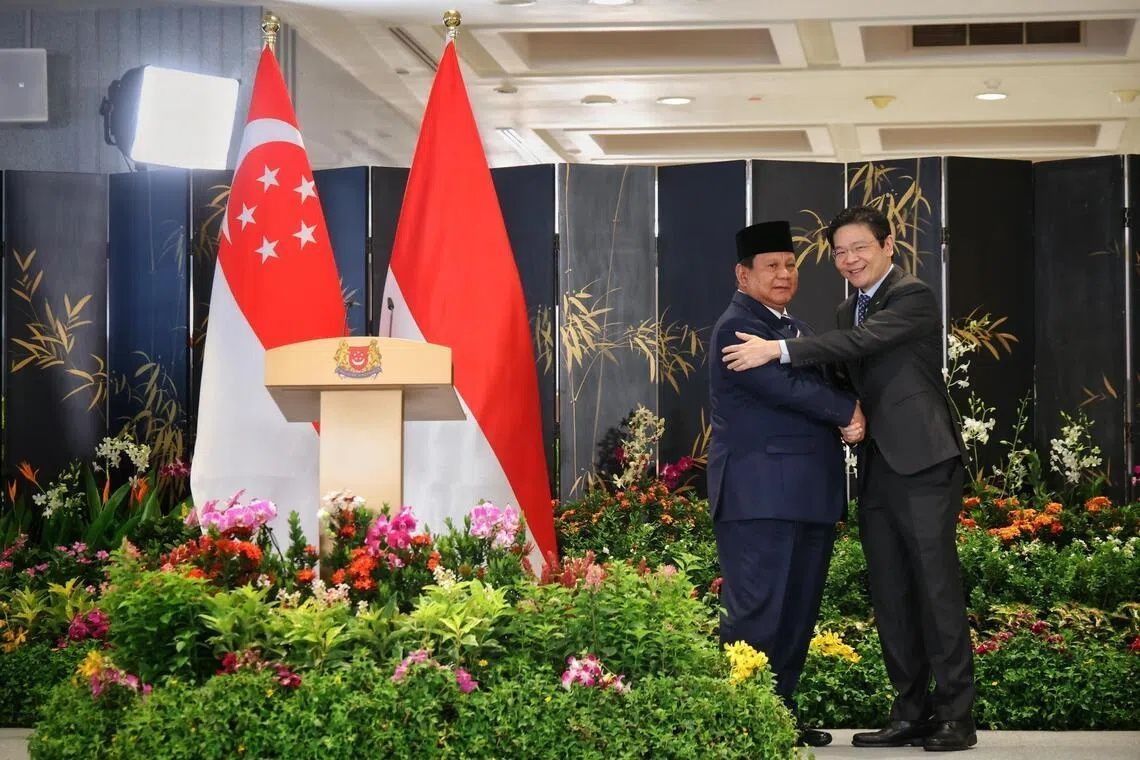
Prime Minister Lawrence Wong is set to travel to Jakarta on Monday, July 6, for the Singapore-Indonesia Leaders' Retreat, a marquee diplomatic engagement that underscores the strategic importance both nations place on their relationship. The retreat will bring together Wong and President Prabowo Subianto for substantive discussions on strengthening bilateral cooperation and addressing issues of mutual concern. Hosted by President Prabowo, the gathering represents the second such retreat under the current leadership of both countries and reflects the institutionalised nature of high-level engagement between Singapore and Indonesia.
The annual retreat serves as the apex forum for bilateral relations, convening not only the two leaders but also senior government ministers across multiple portfolios. According to Singapore's Prime Minister's Office, the platform allows both nations to reaffirm their commitment to deepening cooperation and to review progress across numerous sectors. The previous retreat was held in Singapore in June 2025, while the last meeting hosted by Indonesia occurred in April 2024 at the Bogor Presidential Palace, when then Prime Minister Lee Hsien Loong met then President Joko Widodo. At that time, Wong served as deputy prime minister and finance minister, while Prabowo was president-elect, making this July gathering his first as the sitting president.
During the retreat, the two leaders will receive comprehensive updates on bilateral projects that have progressed since their last meeting. Beyond ceremonial reaffirmations, substantive exchanges on regional and global developments are anticipated, allowing both countries to align perspectives on matters affecting Southeast Asia and the broader international order. The Prime Minister's Office emphasised that the retreat provides an opportunity to explore new avenues for collaboration while consolidating existing partnerships, reflecting the dynamism of the Singapore-Indonesia relationship.
The bilateral relationship has evolved significantly, expanding well beyond traditional pillars such as trade, investment, and defence cooperation. Emerging priority areas now include the green economy, reflecting both nations' commitment to sustainability and climate action. Cross-border electricity trade has taken on new relevance as the region seeks to optimise energy resources and transition toward cleaner power sources. Carbon capture and storage technologies represent another frontier, with both countries positioning themselves at the intersection of environmental responsibility and technological innovation. Artificial intelligence and digital connectivity round out the expanded agenda, addressing the imperatives of digital transformation and technological competitiveness in an increasingly knowledge-driven global economy.
Indonesia's economic significance to Singapore remains pronounced. In 2025, Singapore maintained its position as Indonesia's leading source of foreign direct investment, channelling US$17.4 billion into the Indonesian economy. This substantial capital flow underscores the depth of commercial ties and reflects the confidence Singaporean investors place in Indonesia's market fundamentals and growth trajectory. Such investment figures carry implications for the broader Southeast Asian region, signalling the continued importance of intra-regional economic integration and the role Singapore plays as an investment hub and gateway for capital flows within ASEAN.
Wong's delegation will be notably substantial, reflecting the breadth of cooperation between the two nations. Deputy Prime Minister and Minister for Trade and Industry Gan Kim Yong will accompany the prime minister, underlining the economic dimension of the talks. Coordinating Minister for Public Services and Minister for Defence Chan Chun Sing's presence signals the continued salience of security and defence cooperation in the bilateral relationship. Foreign Minister Vivian Balakrishnan will lead diplomatic efforts, while Minister for Social and Family Development Masagos Zulkifli and Minister for Manpower and Minister-in-charge of Energy and Science and Technology Tan See Leng round out the delegation, each bringing portfolio-specific expertise to discussions.
The composition of Singapore's delegation reveals the multifaceted nature of modern bilateral relations, extending far beyond traditional diplomatic channels. The inclusion of energy and science and technology portfolios underscores the importance both nations place on innovation-driven cooperation and sustainable development. Defence and public services coordination reflect ongoing cooperation in security matters and administrative efficiency, areas where Singapore's expertise has long been sought by neighbours across Southeast Asia. The breadth of ministerial participation suggests that discussions will span economic cooperation, infrastructure development, people-to-people exchanges, and strategic alignment on regional issues.
During Wong's absence from Singapore, Coordinating Minister for National Security and Minister for Home Affairs K. Shanmugam will assume the role of acting prime minister, ensuring continuity in governance and decision-making. This arrangement highlights Singapore's institutional maturity and the clear succession protocols that govern the leadership structure during periods when the prime minister is travelling internationally on state business.
The timing of this retreat comes against a backdrop of shifting geopolitical dynamics in Southeast Asia and the Indo-Pacific region. Both Singapore and Indonesia, as major ASEAN players, carry responsibility for navigating regional complexities and maintaining stability. Their bilateral relationship often serves as a bellwether for broader ASEAN cohesion and the region's capacity for collaborative problem-solving. The July 6 retreat thus carries implications extending beyond the two countries themselves, with outcomes potentially influencing regional responses to challenges ranging from economic integration to maritime security and climate action.
For Malaysian observers, the Singapore-Indonesia partnership warrants close attention, given the intricate web of economic, security, and diplomatic relationships that bind ASEAN member states. Singapore's continuing investment in Indonesia, combined with both nations' emphasis on emerging technologies and the green economy, sets benchmarks for regional development priorities. The retreat's focus on cross-border collaboration, whether in electricity trade or digital connectivity, offers relevant lessons for Malaysia's own regional engagement strategy and opportunities for triangular or multilateral cooperation frameworks.

