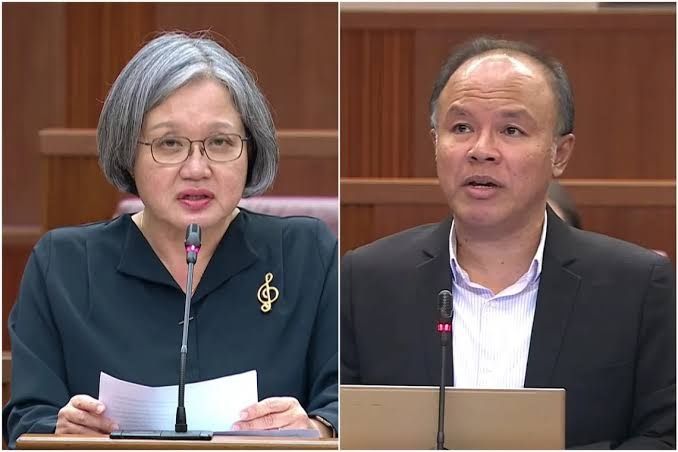
Singapore's Parliament has formally concluded its pursuit of disciplinary action against Workers' Party leaders Sylvia Lim and Faisal Manap for giving false testimony to a parliamentary committee, with Leader of the House Indranee Rajah announcing on July 7 that legal time constraints now prevent any penalties from being imposed. The declaration effectively terminates a protracted institutional dispute that has occupied Parliament's attention since allegations of dishonesty emerged during investigations into former MP Raeesah Khan's fabricated parliamentary anecdote in 2021.
The closure comes despite confirmation that Lim and Faisal did indeed mislead Parliament's Committee of Privileges, findings now corroborated by the High Court's December 2025 judgment upholding party leader Pritam Singh's conviction for the same conduct. Indranee acknowledged the frustration inherent in this outcome, stating that "had the timelines been different, I would have proposed a different course of action." Her statement revealed how procedural constraints embedded in the Parliament (Privileges, Immunities and Powers) Act have created an unanticipated barrier to accountability, even as the factual foundation for misconduct has been legally established.
The central issue traces to August 2021, when Raeesah Khan, then representing Sengkang GRC, recounted a fabricated encounter with police during parliamentary debate. Pritam Singh, leading the Workers' Party, allegedly instructed Khan to conceal the lie permanently, while Lim and Faisal—both representing Aljunied GRC at the time—attended the relevant meeting but denied discussing the matter when questioned by the Committee of Privileges. All three initially faced investigation, but Parliament's response diverged significantly based on the degree of culpability assigned to each individual.
Pritam received the harshest institutional judgment, referred directly to criminal prosecutors for independent investigation and prosecution with full legal representation. Lim and Faisal, classified as having played "subsidiary" roles while showing "limited helpfulness" to the investigating committee, were treated more leniently. Parliament deliberately delayed action against the pair pending completion of Pritam's criminal proceedings, a strategic choice intended to ensure fairness but which ultimately produced an ironic result: by the time Pritam's appeals concluded in December 2025, the statutory window for parliamentary discipline had shut.
The technical impediment lies in Section 22 of the Parliament (Privileges, Immunities and Powers) Act, which constrains the House's enforcement authority to offences committed either during the current parliamentary session or during the final session of the immediately preceding Parliament. The original lying occurred in the first session of the 14th Parliament. Following the 2025 general election and commencement of the 15th Parliament in September, the temporal scope contracted precisely because sufficient parliamentary terms had elapsed. Indranee's explanation to members emphasized that "the law, in this case the time bar provisions of PPIPA, must be observed," signaling Parliament's commitment to procedural legitimacy even when the substantive result proves unsatisfying.
This technical resolution carries particular significance for Malaysian observers monitoring parliamentary governance across the region. Singapore's experience demonstrates how statutory time limitations, ostensibly designed to prevent indefinite institutional harassment and protect finality, can inadvertently shield individuals from consequences through procedural accident rather than substantive exoneration. The mechanism prioritizes administrative closure over accountability, a trade-off that reflects broader tensions between parliamentary effectiveness and the rule of law within Westminster-derived systems operating in contemporary Southeast Asia.
Parliament retained one residual avenue for expressing institutional disapproval: passing a motion to formally register disapproval of lying to Parliament or its committees. However, Indranee noted that Parliament had already registered such disapproval collectively when it declared Pritam Singh unsuitable as Leader of the Opposition in January 2025. This earlier motion, she argued, sufficiently communicated Parliament's unequivocal stance against dishonesty in parliamentary proceedings, rendering a fresh motion redundant. The reasoning transforms a setback into a face-saving formulation, suggesting that Parliament's values had been adequately vindicated through alternative procedural means.
The Workers' Party itself had already moved decisively beyond this controversy internally. During party elections on June 28, members voted to retain Pritam Singh as leader despite his criminal conviction, demonstrating that the party viewed the episode as concluded and Pritam's position sufficiently secure to warrant continued confidence. This internal decision preceded Parliament's formal closure by one week, effectively removing partisan political pressure from the parliamentary process and allowing the announcement to proceed as a technical legal clarification rather than a contested institutional judgment.
Sylvia Lim's brief response, confirming that she would not object to Indranee's statement and reiterating her prior January explanation, underscored the muted conclusion to a dispute that had occupied significant parliamentary attention. Lim emphasized that references to her conduct in court documents reflected prosecution evidence presented during Pritam's trial, and that she had lacked opportunity to present a defense given she was never called as a witness in criminal proceedings. Her clarification highlighted an asymmetry in how the dispute had been resolved: while Pritam faced criminal prosecution enabling full legal advocacy, Lim and Faisal effectively endured institutional censure based on findings made in an administrative committee inquiry.
For regional political observers, Singapore's handling of this affair illustrates the vulnerability of parliamentary disciplinary mechanisms to unintended temporal constraints. Unlike criminal law, which typically permits prosecution within defined limitation periods that operate prospectively, parliamentary privilege law in this instance created a retroactive deadline that expired while investigations were still ongoing. The outcome suggests that future parliaments operating under similar statutory frameworks might require legislative amendment to prevent circumstantial foreclosure of accountability when institutional processes themselves generate temporal delays.
The Workers' Party emerges from this episode with its internal structure and leadership intact, though the broader institutional reputation damage—both individual and collective—remains unquantified. Pritam Singh's conviction stands as a permanent criminal record, while Lim and Faisal's misleading testimony exists in parliamentary records and judicial findings without formal parliamentary disciplinary consequence. This stratified outcome, where substantive misconduct is judicially confirmed but institutional punishment becomes legally impossible, represents an unsatisfying but legally defensible conclusion to prolonged parliamentary controversy.

