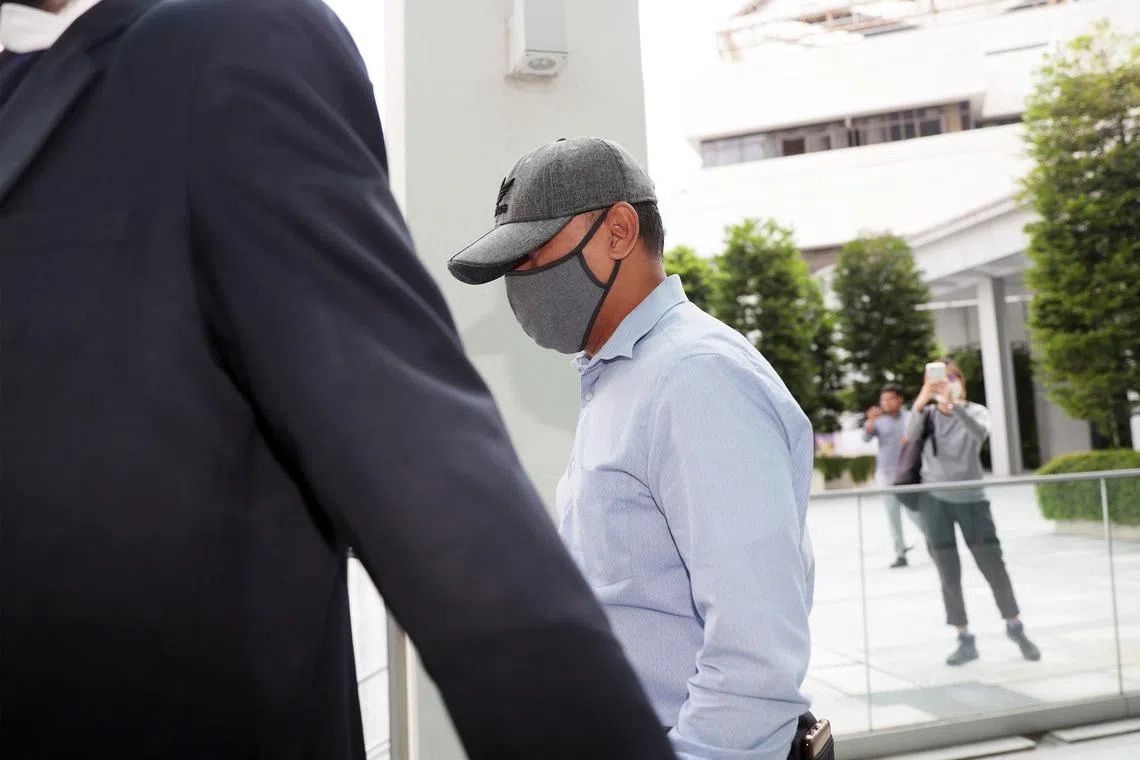
A senior administrator at two prominent Singapore mosques has been handed a 14-month jail term for exploiting his official position to steer construction work to a personal associate, marking a significant corruption case within the city-state's Islamic institutional framework. Abdul Rahim Mawasi, 59, served as executive chairman of both Darul Aman Mosque along Jalan Eunos and Sallim Mattar Mosque in MacPherson, while simultaneously holding a senior officer position at the Islamic Religious Council of Singapore (MUIS), to which he had been seconded. His conviction in April followed a trial that revealed how he had corruptly furnished price guidance to enable his longtime associate to secure renovation and construction contracts totalling S$223,000 across the two religious institutions.
The scheme centred on an arrangement between Abdul Rahim and Mohd Mustaqim Kam, also known as Kam Hock Beng, who was then 66 years old and served as director at construction firm Zeal-Con Engineering. According to court proceedings, the two men had known each other for over a decade when Abdul Rahim proposed in July 2018 that they jointly establish a pilgrimage travel company. Kam consented to the venture on terms that significantly favoured Abdul Rahim: he would contribute no capital to launch the business, but instead would leverage his institutional access to secure construction contracts for Zeal-Con, with profits then funnelled into the travel enterprise as equity investment. This arrangement effectively turned public mosque assets and procurement processes into a vehicle for private enrichment.
The prosecution demonstrated how Abdul Rahim manipulated the bidding process at Darul Aman Mosque when the institution sought vendors for yard construction work in 2018. Zeal-Con initially submitted a quote of S$128,600 in August, but after Abdul Rahim conducted "extensive discussions" with Kam regarding bidding strategy and supplied critical pricing intelligence, the company submitted a revised quote of S$118,000 in September. This lowered bid undercut the nearest competitor's S$125,500 offer, positioning Zeal-Con as the most economical choice. Crucially, the mosque's management board remained entirely unaware that Abdul Rahim had actively counselled Kam on price positioning rather than maintaining the impartial stance expected of a fiduciary. Zeal-Con was awarded the contract on September 26, 2018, for the reduced amount.
A similar pattern emerged at Sallim Mattar Mosque, where Abdul Rahim again weaponised confidential information to advantage his partner's firm. In September 2018, Zeal-Con quoted S$115,700 for structural work encompassing roof repairs and reception area renovation. Months later, in July 2019, Kam submitted a substantially lower quotation of S$105,000 for identical scope. Deputy Public Prosecutor Bryan Wong established that Abdul Rahim had directly advised Kam to reduce the company's bid to improve its competitiveness and secure selection. The following month, Sallim Mattar Mosque formalised contract awards to Zeal-Con aligned with the reduced pricing, enabling the scheme to generate additional revenue for the emerging travel venture.
To disguise the illicit partnership and shield his enrichment from institutional scrutiny, Abdul Rahim orchestrated an elaborate concealment strategy involving his family. In November 2019, Kam converted a shell company into Amal Travel and Tour (ATT), capitalising it with S$100,000 and issuing 100,000 shares valued at S$1 each. He then allocated 25,000 shares to Abdul Rahim's son, circumventing direct ownership records that would have exposed the corruption scheme to MUIS compliance oversight. During trial testimony, Abdul Rahim vehemently denied any involvement with ATT, claiming he held no shares whatsoever in the entity—a legally accurate but morally hollow distinction that masked his instrumental role in structuring the arrangement and deriving financial benefit through his family member's shareholding.
Abdul Rahim's professional standing and institutional tenure lent particular gravity to the offence. He had joined MUIS in 2005, accumulating 13 years of service in a trust-based organisation where adherents contribute zakat and other religious donations expecting rigorous stewardship. His secondment to the mosque management boards positioned him as custodian of congregational assets and institutional integrity. The corruption fundamentally betrayed that fiduciary duty, transforming his administrative authority into an instrument for personal gain and undermining the community confidence essential to effective Islamic institutional functioning in Singapore's pluralistic society.
The case carries sobering implications for Southeast Asian religious organisations navigating accountability frameworks. While the Straits Times and court documents confirm that Zeal-Con satisfactorily completed the physical construction works—meaning the mosques received serviceable outcomes despite the compromised procurement—the absence of direct financial loss does not mitigate Abdul Rahim's culpability. Prosecutors emphasised that he had committed a "serious public sector corruption offence for financial gain," emphasising that institutional harm extends beyond monetary loss to encompass governance erosion and breach of public trust. The principle that corruption corrodes institutional legitimacy regardless of whether tangible damages materialise remains fundamental to Singapore's anti-corruption enforcement philosophy.
Abdul Rahim's co-conspirator Mohd Mustaqim Kam received a comparatively lenient six-month sentence in February 2025, reflecting his lesser institutional position. While Kam actively directed the construction firm and benefited directly from contract awards, Abdul Rahim possessed superior positional authority and knowledge of procurement protocols, rendering his breach more egregious. The sentencing differential underscores how courts calibrate penalties based on the unique betrayal inherent to abuse of official position—a principle increasingly relevant across Southeast Asia as religious and community organisations strengthen governance structures against internal corruption.
Abdul Rahim maintained that his defence counsel Satwant Singh Sarban Singh had urged leniency, requesting no more than six months imprisonment and highlighting his previously unblemished record. However, the court determined that a 14-month custodial term more appropriately reflected the seriousness of deliberate, calculated misconduct spanning multiple contract cycles and encompassing family-based asset concealment. He posted S$30,000 bail pending commencement of his sentence on July 10, affording limited opportunity for appeal or further legal manoeuvre. His case stands as a cautionary chronicle for administrators across religious institutions in the region, demonstrating that positional trust, once weaponised for private enrichment, triggers consequences proportionate to the betrayal involved and the institutional damage inflicted.

