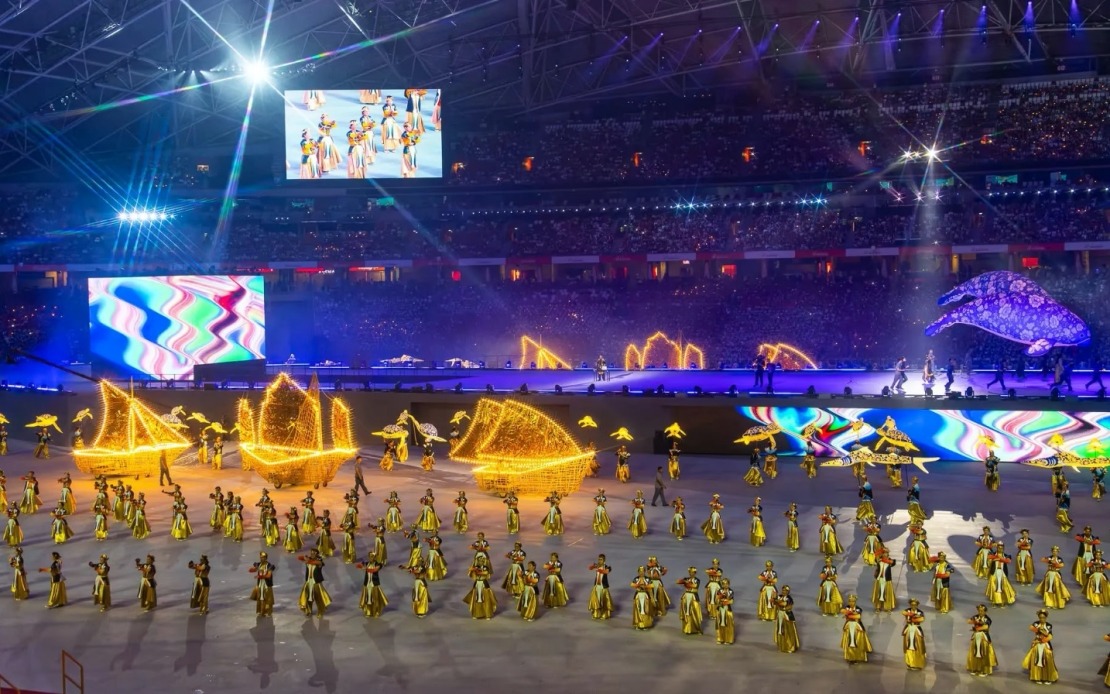
Singapore's 61st National Day celebrations on Sunday marked a significant milestone as the iconic National Day Parade made its long-awaited return to the National Stadium after remaining absent for the past decade. The event, anchored by the theme "Majulah Singapura, Go Beyond!", brought together President Tharman Shanmugaratnam, Prime Minister Lawrence Wong, and Cabinet ministers alongside Members of Parliament in a ceremony that drew approximately 42,000 members of the public to the stadium, dressed in the traditional national colours of red and white.
The parade's homecoming to the National Stadium represented more than a symbolic gesture of continuity. The venue change reflected a deliberate effort to reinvigorate the nation's principal civic celebration, bringing the spectacle back to a location deeply embedded in Singapore's identity while modernising how the parade engages with citizens across a broader geographical area. The decision to return to Kallang underscores Singapore's commitment to maintaining traditions whilst adapting them to contemporary circumstances.
A particularly innovative aspect of this year's celebrations involved extending the parade experience beyond the National Stadium itself. For the first time in Singapore's six decades of independence, both the Presidential Gun Salute and the State Flag Flypast took place at Kallang Basin, creating an expanded celebration that reached thousands of additional spectators positioned throughout the wider Kallang precinct. This geographical expansion transformed what had traditionally been a stadium-centric event into a neighbourhood-scale celebration, democratising access to key ceremonial moments.
The Presidential Gun Salute achieved this expanded reach through a novel approach: four 25-pounder Howitzer guns, mounted on Mobility 3rd Generation rafts, sailed across the basin rather than remaining stationary at a single vantage point. This mobile configuration brought the traditional 21-gun salute, comprising 151 participants drawn from the 23rd Battalion of the Singapore Artillery and the 35th Battalion of Singapore Combat Engineers, into proximity with citizens positioned throughout the precinct. The integration of water-based logistics into what is typically a land-focused ceremony added a distinctive character to the proceedings.
The parade and ceremony segment, commencing at approximately 6 pm, centred on the sub-theme "Go Beyond Self" and involved 32 contingents mobilising more than 2,000 participants. This ceremonial phase drew together six Guard of Honour contingents, ten contingents representing uniformed youth organisations, and sixteen supporting contingents, alongside the Singapore Armed Forces Colours Party. The Guard of Honour contingents, comprising 72 personnel drawn from the Singapore Army, Republic of Singapore Navy, Republic of Singapore Air Force, newly minted Digital and Intelligence Service, Singapore Police Force, and Singapore Civil Defence Force, escorted the SAF Colours Party through the stadium.
The show segment that followed the formal ceremony introduced a markedly different register, featuring 36 artistes and exceeding 2,600 performers in total. This entertainment-focused component, organised around the overarching national theme, aimed to present Singapore's development narrative through an integrated package of authentic storytelling, cutting-edge technological presentation, and an emotionally resonant musical score. The production design attempted to weave together threads representing different aspects of Singaporean society and achievement.
A notably significant dimension of this year's show segment involved the deliberate inclusion of performers from diverse ability backgrounds, reflecting broader societal conversations about inclusion and representation. Seven dancers of varying backgrounds participated, including performers with autism and Down syndrome. This choreographic choice carried explicit messaging: the performance affirmed the principle that all Singaporeans, irrespective of background or physical ability, possess capacity to contribute meaningfully toward constructing the nation's shared future. Such symbolic gestures, embedded within mass public spectacle, communicate values beyond the immediate entertainment context.
For Malaysian observers, Singapore's National Day celebrations warrant attention for several reasons. First, the return of a major civic parade to a fixed venue after a decade-long hiatus suggests how contemporary city-states manage public space, civic ritual, and the relationship between government and citizenry. Second, the technological and logistical innovations—particularly the water-based gun salute and the expanded geographical footprint—demonstrate how traditional ceremonial forms adapt to modern urban constraints and opportunities. Third, the explicit programming of inclusive representation signals how Southeast Asian governments are articulating social values through public ceremony at a moment when questions of cohesion and belonging carry particular weight across the region.
The scale and ambition of Singapore's National Day celebrations also contextualise Singapore's position within Southeast Asia. As a densely urbanised city-state with significant regional influence, Singapore's civic choreography often anticipates broader regional trends. The emphasis on innovation, inclusivity, and the integration of digital and technological elements within traditional ceremony reflects how developed Southeast Asian societies are navigating the intersection of continuity and change, heritage and modernity. The careful construction of narratives around "going beyond" oneself and current capacities speaks to competitive anxieties and aspirational frameworks that increasingly characterise the region's political discourse.
The 42,000-strong attendance at the National Stadium, filling the venue in national colours, represents tangible public participation in state ritual at a moment when such participation cannot be assumed. The voluntary gathering of citizens to witness and celebrate national identity, facilitated by the stadium's return, provides the government with visible evidence of civic engagement and national cohesion. In the contemporary context, where governments across Southeast Asia grapple with fragmenting publics and competing narratives, the successful execution of a large-scale national celebration carries weight beyond ceremonial significance.
As Singapore enters its seventh decade as an independent nation, the National Day Parade's return to the National Stadium and its expansion across Kallang Basin demonstrates how a mature city-state continues investing in the architecture of national identity and public belonging. The careful layering of military precision, inclusive representation, technological innovation, and emotional resonance creates a multivalent message directed toward different audiences. For Malaysians observing from across the Strait, Singapore's approach to civic celebration offers comparative perspective on how different Southeast Asian societies choreograph national identity and manage the relationship between state, tradition, and contemporary aspirations in an increasingly complex regional environment.

