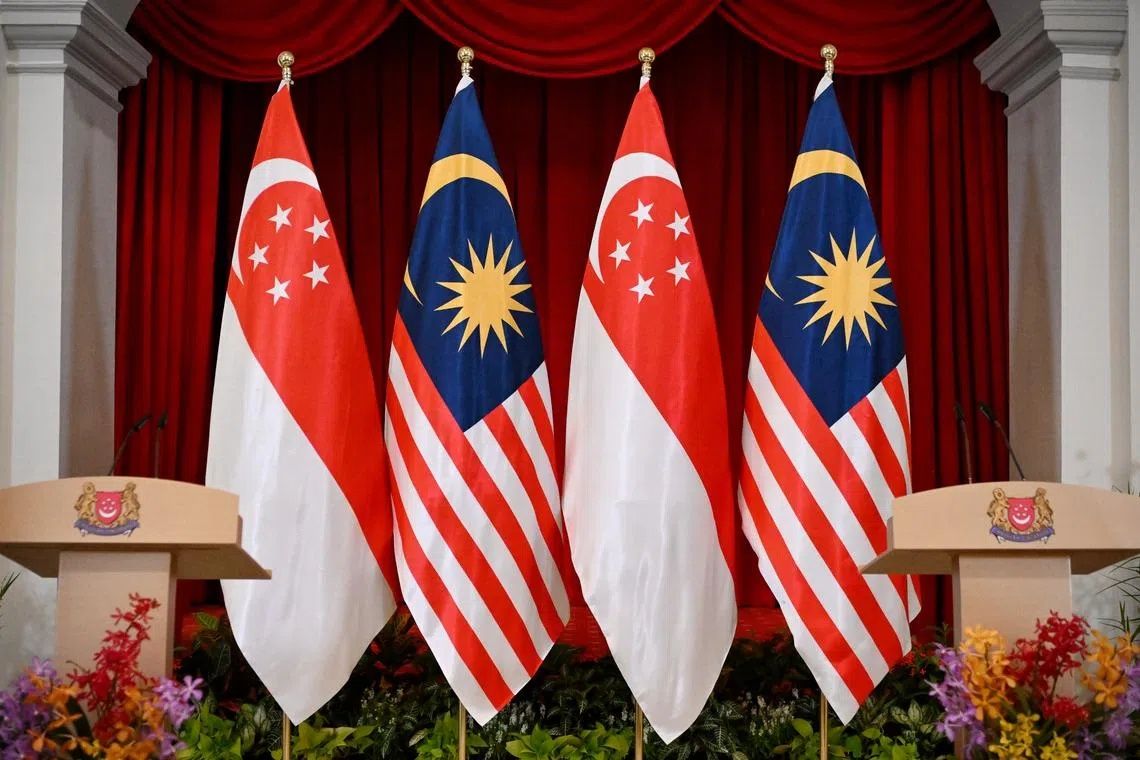
As President Tharman Shanmugaratnam embarks on a four-day state visit to Malaysia at the invitation of King Sultan Ibrahim Sultan Iskandar, he has underscored a fundamental truth about the relationship between Singapore and its closest neighbour: occasional disagreements need not derail deeper cooperation. Speaking to Malaysian news agency Bernama ahead of the visit, the President articulated a vision of partnership grounded not in convenience or short-term calculation, but in the accumulated trust and goodwill forged over six decades of coexistence.
The Singapore-Malaysia relationship has long been marked by its complexity. The two nations share geographical proximity, a partially intertwined history, and millions of citizens with cross-border ties, yet they have also navigated sensitive and occasionally contentious issues that test their commitment to peaceful coexistence. President Tharman's remarks reflect a mature understanding that such disputes are neither unusual nor necessarily destructive between neighbouring countries with deep historical connections. What distinguishes this partnership is not the absence of friction, but rather the consistent choice by successive governments on both sides to address disagreements squarely, anchored in mutual respect and adherence to international law, rather than allowing them to fester or dominate the bilateral agenda.
This approach has proven its worth repeatedly over the decades. Rather than becoming mired in disputes, both nations have cultivated the discipline to manage them responsibly through dialogue and the high levels of trust cultivated between leaders, officials, and peoples on both sides. President Tharman noted that this capacity for restraint and reasoned engagement extends beyond the bilateral sphere; it serves as an important model for the Association of Southeast Asian Nations and the broader region, particularly in an era of intensifying great power competition and fracturing multilateral systems. The example of Singapore-Malaysia demonstrates that countries need not sacrifice sovereignty or principles to engage cooperatively with neighbours, provided they maintain commitment to rules-based conduct and genuine respect for each other's interests.
Central to strengthening these ties is the recognition that engagement must occur at multiple levels and on a sustained basis. President Tharman emphasised that regular interaction among leaders, politicians, officials, business communities, and ordinary citizens is not merely desirable but essential. Whereas such exchanges came naturally to earlier generations with stronger cross-border integration, deliberate effort is now required to maintain and expand these connections. Bilateral exchange programmes, youth leadership forums, and community projects represent practical mechanisms through which both nations can nurture the personal relationships and mutual familiarity that serve as shock absorbers during periods of tension.
Beyond maintaining existing goodwill, President Tharman outlined an expansive vision for deepening cooperation across multiple domains. Economic integration stands as a natural starting point, given the complementary strengths of both economies and the integrated supply chains already linking them. More ambitiously, both nations can collaborate on renewable energy development and carbon credit schemes, positioning themselves as leaders in the region's transition towards sustainable energy. These initiatives are not altruistic; they reflect genuine mutual interest in building economies resilient to climate change and insulated against supply chain disruptions that could undermine prosperity on both sides of the Causeway.
The President highlighted existing joint projects as demonstrations of this win-win logic in action. The Johor-Singapore Special Economic Zone and the RTS Link represent precisely the kind of ambitious cooperation that harnesses each nation's comparative advantages for collective benefit. These initiatives create employment, enhance connectivity, and deepen economic interdependence in ways that reinforce political incentives for continued peaceful coexistence. For Malaysian readers and policymakers, such projects offer tangible evidence that cooperation with Singapore need not involve sacrificing autonomy or advantage; rather, it multiplies opportunities for development that neither nation could realise independently.
Regional architecture and ASEAN's future featured prominently in President Tharman's vision. He commended Malaysia's successful 2025 ASEAN chairmanship, particularly the historic admission of Timor-Leste as the grouping's eleventh member. By working in concert, Singapore and Malaysia can help preserve ASEAN's vitality as a coherent, reliable, and trustworthy regional actor at a moment when the international system faces unprecedented stress. This shared commitment to institutional strength and regional rules extends naturally to Singapore's forthcoming 2027 chairmanship, suggesting a continuity of constructive engagement that will serve all member states. For Southeast Asia more broadly, the willingness of its two most developed nations to anchor their partnership to regional institutions rather than pursuing narrow bilateral advantage sends a powerful signal about the grouping's enduring relevance.
President Tharman's invocation of the Malay saying "jiran sepakat membawa berkat" — neighbours in agreement bring blessings — carries symbolic weight beyond mere rhetoric. It signals appreciation for Malaysian cultural concepts and a conviction that the Singapore-Malaysia partnership represents not an arrangement of mere convenience but a genuine meeting of two peoples with shared destiny. The phrase captures the essence of his broader argument: that decades of mutual investment in understanding and respect have created something more durable and valuable than any temporary transaction could provide.
Fundamentally, President Tharman presented Singapore-Malaysia relations as a model for how nations might navigate an increasingly fractious world. In an era of rising protectionism, strategic competition among great powers, and pressure on multilateral institutions, the capacity of two small neighbouring countries to maintain partnership while addressing sensitive differences offers a valuable counterexample. This is not naivete about conflict; it is instead a sophisticated recognition that discipline, mutual respect, and commitment to dialogue represent practical strategies for managing inevitable tensions. For Malaysia and Singapore alike, the stakes of this partnership extend beyond bilateral convenience to include the stability and prosperity of Southeast Asia itself.

