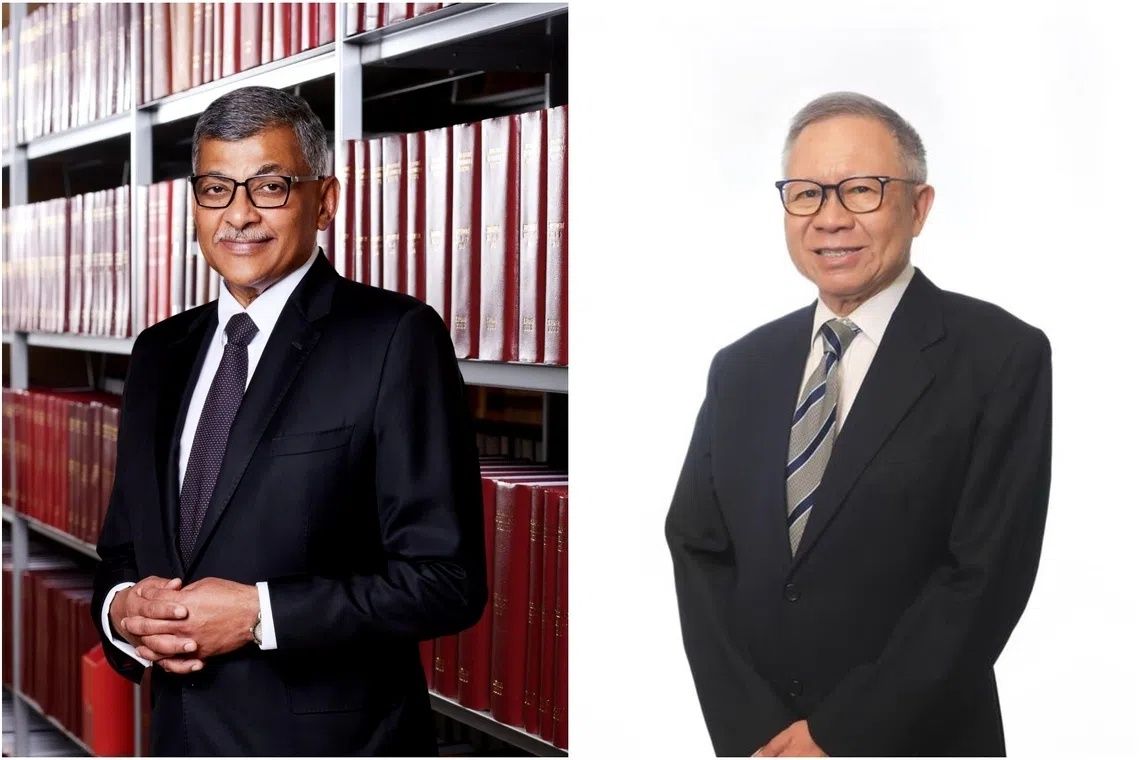
Singapore's Chief Justice Sundaresh Menon and former chairman of the Council of Presidential Advisers (CPA) Eddie Teo have been honoured with the Order of Temasek (With Distinction) at the 2026 National Day Awards, marking recognition of their extensive contributions to the city-state's governance and institutional development. Both men, aged 62 and 79 respectively, represent generations of leadership that have shaped Singapore's evolution as a modern nation. Their conferment places them among the republic's most decorated public servants and underscores the government's commitment to acknowledging those who have fundamentally strengthened key institutions.
Menon's judicial tenure spanning 14 years since November 2012 has fundamentally reshaped how Singapore administers justice. Beyond the symbolic role of Chief Justice, his leadership introduced sweeping modernisation initiatives that positioned the judiciary at the forefront of legal innovation in Asia. The establishment of the Singapore International Commercial Court, in particular, transformed Singapore into a regional hub for dispute resolution, attracting international arbitration cases and legal expertise that have bolstered the nation's standing as a financial and commercial centre. His retirement in February 2027 marks the conclusion of a transformative period for Singapore's legal architecture.
The judicial reforms implemented during Menon's watch extended beyond courtroom administration into the social fabric of justice delivery. The therapeutic justice approach introduced in the Family Justice Courts and Youth Courts represented a philosophical shift toward rehabilitation and healing rather than purely punitive outcomes. This model has become increasingly relevant for Malaysia and other Southeast Asian nations wrestling with similar criminal justice reform challenges. The creation of the Singapore Judicial College similarly signalled that judicial excellence requires continuous learning and professional development, a lesson particularly pertinent for developing legal systems in the region.
Digitalisation of court processes under Menon's stewardship proved prescient when the COVID-19 pandemic forced courts worldwide to adapt rapidly. Singapore's courts, already equipped with robust digital infrastructure, maintained continuity and access to justice when others struggled. This investment in legal technology has positioned Singapore's judiciary as a model for other Commonwealth nations and emerging economies contemplating similar digital transformation initiatives. The establishment of the Appellate Division of the High Court enhanced judicial capacity and created clearer pathways for complex cases requiring specialist attention.
Menon's recognition arrives during what he himself characterised as a bicentennial year for Singapore's legal and judicial system, adding historical resonance to the honour. His acknowledgment that the legal system's development represents collective effort rather than individual achievement reflects the collaborative ethos essential for institutional success. As Malaysian legal professionals observe Singapore's judicial evolution, Menon's emphasis on sustaining public confidence in the administration of justice offers valuable perspective, particularly relevant to ongoing discussions about institutional independence and transparency in the region.
Teo's nearly 56 years in public service represent an exceptional arc spanning from the pioneering era through contemporary governance challenges. His early career under the mentorship of founding figures including Lee Kuan Yew and Goh Keng Swee connected him directly to Singapore's nation-building narrative. Such intergenerational knowledge transfer, though less visible than formal institutions, constitutes a crucial element of administrative continuity that developing countries often struggle to maintain. His progression from the Security and Intelligence Division directorship to permanent secretary roles in multiple portfolios demonstrates the breadth of capability required for senior civil service positions.
Teo's tenure as Public Service Commission chairman from 2008 to 2018 deliberately broadened recruitment and advancement pathways by incorporating professionals from academia, law and social work into commission membership. This diversification of the commission's composition signalled that merit and excellence could be recognised across sectors beyond traditional administrative backgrounds. For Malaysian policymakers and civil service reformers, such structural changes to recruitment bodies can influence broader institutional culture and the quality of talent pipeline development.
The Council of Presidential Advisers role that occupied Teo from 2018 to June 2026 placed him at the centre of Singapore's most consequential recent fiscal decision. The withdrawal of approximately S$40 billion from past reserves during the COVID-19 pandemic represented unprecedented reliance on accumulated reserves, requiring deliberate institutional review and approval. That President Halimah Yacob and the CPA conducted thorough discussions before endorsement demonstrates the constitutional safeguards embedded within Singapore's governance framework. The outcome—economic stabilisation without excessive public debt—offers instructive lessons for nations balancing emergency response with long-term fiscal prudence, a tension particularly acute in Southeast Asia during and after the pandemic.
Teo's emphasis on the integrity, meritocracy and excellence embedded within Singapore's public service speaks to persistent concerns across Southeast Asia about institutional capacity and anti-corruption standards. His reflection that five decades of service to government remains meaningful and worthwhile, despite lower remuneration than private sector alternatives, addresses a fundamental challenge confronting developing bureaucracies. The brain drain toward private employment and overseas opportunities has weakened administrative capacity throughout the region, making Teo's implicit endorsement of public service as a noble calling potentially influential for younger professionals.
The broader 2026 National Day honours recognising 7,491 individuals across varying levels of contribution underscore Singapore's systematic approach to acknowledging service across society. This scaling of recognition from highest honours to community-level acknowledgment creates incentive structures and social narratives that emphasise collective effort in nation-building. For regional observers, such holistic approaches to recognising service, rather than concentrating recognition among political elites, may offer alternative models for fostering institutional loyalty and public engagement.
Among the Distinguished Service Order recipients, Land Transport Authority chairman Alan Chan's recognition highlights infrastructure development's centrality to modern governance. His stewardship of improvements from 393,000 to two million mean kilometres between rail failures demonstrates that administrative excellence translates into tangible quality-of-life improvements for citizens. Similarly, former Civil Aviation Authority of Singapore chairman Edmund Cheng's honour spanning aviation, rehabilitation and the arts reflects Singapore's integration of economic dynamism with social responsibility. These recognitions validate that bureaucratic effectiveness and social conscience remain compatible objectives within effective governance frameworks.

