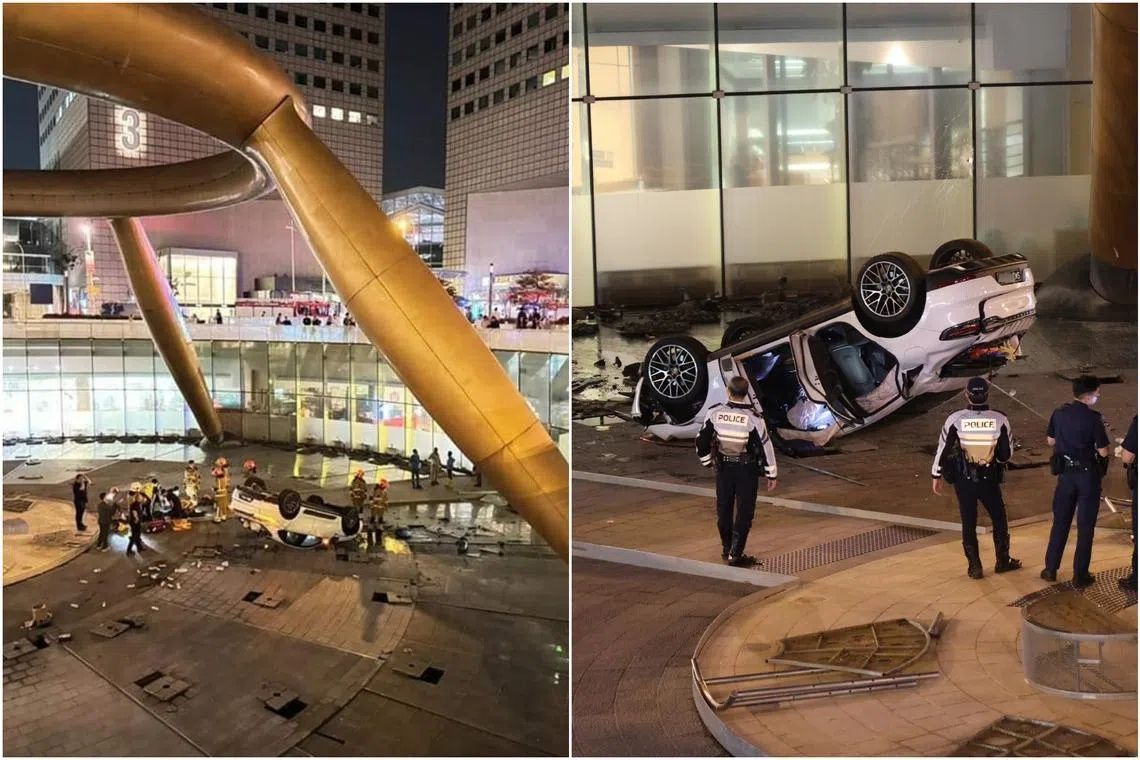
A Singapore court has handed down a five-week prison sentence to a 58-year-old man who drove his car into the iconic Fountain of Wealth at Suntec City after consuming approximately one litre of beer, marking another cautionary tale in the ongoing battle against drink-driving offences in the city-state. The incident, which occurred on July 13, 2024, saw the vehicle plough through a protective barricade and crash into the fountain's basement, narrowly missing construction workers who were present at the scene. The district court's decision to impose custodial punishment, combined with a 2½-year driving disqualification, underscores the judiciary's commitment to deterring what judges describe as highly irresponsible behaviour that endangers public safety.
The circumstances surrounding the incident reveal a troubling sequence of events that unfolded over several hours. The accused, identified as Then Shing Chong, left his residence around 5 p.m. on July 12 before heading to Suntec City shopping mall to socialise with a friend. Upon arrival at approximately 6 p.m., he parked his vehicle in the basement and proceeded to a bar within the complex. Between 6:15 p.m. and midnight, he consumed the substantial quantity of beer before deciding to drive himself home, a decision that would have severe consequences.
Witnesses reported that as Then attempted to exit the carpark, his vehicle came to a brief halt for roughly ten seconds after a gantry barrier raised to allow passage. However, what followed demonstrated a critical lapse in driving attention and vehicle control. Travelling along Temasek Boulevard, Then failed to maintain focus on the road and missed directional signage that required him to turn left into a roundabout. Instead of following the proper traffic route, he continued driving straight through three separate lanes before breaching the protective barricade surrounding the Fountain of Wealth.
The collision occurred with sufficient force to send the vehicle crashing into the basement area of the fountain, where three construction workers happened to be engaged in maintenance activities at that exact moment. Fortunately, the workers reacted swiftly and evacuated the area without sustaining injuries, preventing what authorities acknowledged could have resulted in far more catastrophic consequences. A heavy lorry crane was subsequently deployed to extract the damaged vehicle from the fountain before it was towed away for disposal. The incident caused approximately S$64,600 in property damage to the fountain, a cost that the defendant has since fully repaid.
Medical assessments conducted after the accident revealed additional complications that would later feature prominently in the legal proceedings. Then was transported to the emergency department of Tan Tock Seng Hospital following the collision, where he was treated for injuries including a lacerated scalp. Notably, formal blood and breath alcohol tests were not conducted immediately after the accident, as the injured man required urgent medical attention. Subsequently, during psychological evaluation at the Institute of Mental Health, Then disclosed that he had consumed either an antihistamine or a sleeping pill prior to the drinking session, a disclosure that his legal representatives would later argue contributed to his impaired state.
When the case reached District Judge Koo Zhi Xuan on July 14, Then pleaded guilty to driving in a dangerous manner, accepting responsibility for his actions without contesting the charges. The Deputy Public Prosecutor, Gladys Lim, presented the facts methodically to the court, emphasising the severity of the situation and the fortune that prevented loss of life. She particularly highlighted the proximity of the construction workers to the crash site, arguing that had they been positioned directly beneath the falling vehicle, the outcome would have been catastrophic rather than merely damaging.
The prosecution successfully argued for a custodial sentence, stressing the necessity for deterrence in drink-driving cases. Ms Lim contended that the court needed to send a clear message about the dangers of operating a vehicle whilst under the influence of alcohol, particularly in urban environments where innocent bystanders face elevated risk. The argument resonated with the judiciary, which has consistently treated drink-driving as a serious traffic offence warranting imprisonment rather than merely financial penalties.
The defence team, comprising Josephus Tan, Cory Wong and Devlin Mohyong of Invictus Law Corporation, mounted a more nuanced argument centred on Then's mental health status. They presented a report from the Institute of Mental Health indicating that their client was suffering from major depressive disorder at the time of the incident and argued for a mandatory treatment order, which would have allowed Then to undergo psychiatric treatment instead of serving jail time. The defence suggested a causal link between his diagnosed mental condition and the commission of the offence, essentially requesting the court to consider treatment-based rehabilitation rather than purely punitive measures.
However, the prosecution objected to this approach, contending that the seriousness of drink-driving offences necessitated deterrent sentencing regardless of concurrent mental health conditions. The court sided with the state's position, with Judge Koo emphasising that drink-driving represented fundamentally irresponsible behaviour that courts could not excuse or mitigate significantly through alternative sentencing frameworks. The judge noted that Then's actions had generated substantial property damage and had created genuine risk of serious injury or death to multiple individuals present at the scene.
The 2½-year driving disqualification imposed alongside the jail sentence represents a standard ancillary penalty in Singapore for serious traffic violations. This extended period of licence suspension effectively removes the offender from Singapore's roads for a considerable duration and serves both as additional punishment and as a practical safety measure. The court's reasoning reflected a philosophy that individuals who demonstrate such grave lapses in judgment whilst operating motor vehicles require extended periods away from the road before being permitted to reapply for driving privileges.
For Malaysian observers and regional transport safety advocates, this case illustrates how developed legal systems in the region handle the intersection between mental health and criminal responsibility. While Singapore's courts acknowledge psychiatric factors, they do not permit them to override the paramount concern of public safety when serious traffic violations occur. The decision reflects a broader regional consensus that drink-driving represents an unacceptable risk that demands firm judicial response. The case also underscores how fortunate outcomes in traffic accidents—such as workers escaping injury—influence judicial reasoning about potential versus actual harm, even when courts ultimately prioritise deterrence over mitigation.
The financial restitution aspect of Then's case, whereby he fully compensated the S$64,600 in damages, demonstrates a trend in contemporary sentencing towards requiring offenders to make monetary amends for harm caused. This approach, common across Southeast Asian jurisdictions including Malaysia, seeks to ensure that victims of negligence are not left bearing financial burdens whilst courts simultaneously protect public interests through custodial sentences. The combination of imprisonment, disqualification, and restitution creates a multi-layered consequence structure that addresses retribution, deterrence, rehabilitation, and victim compensation simultaneously.

