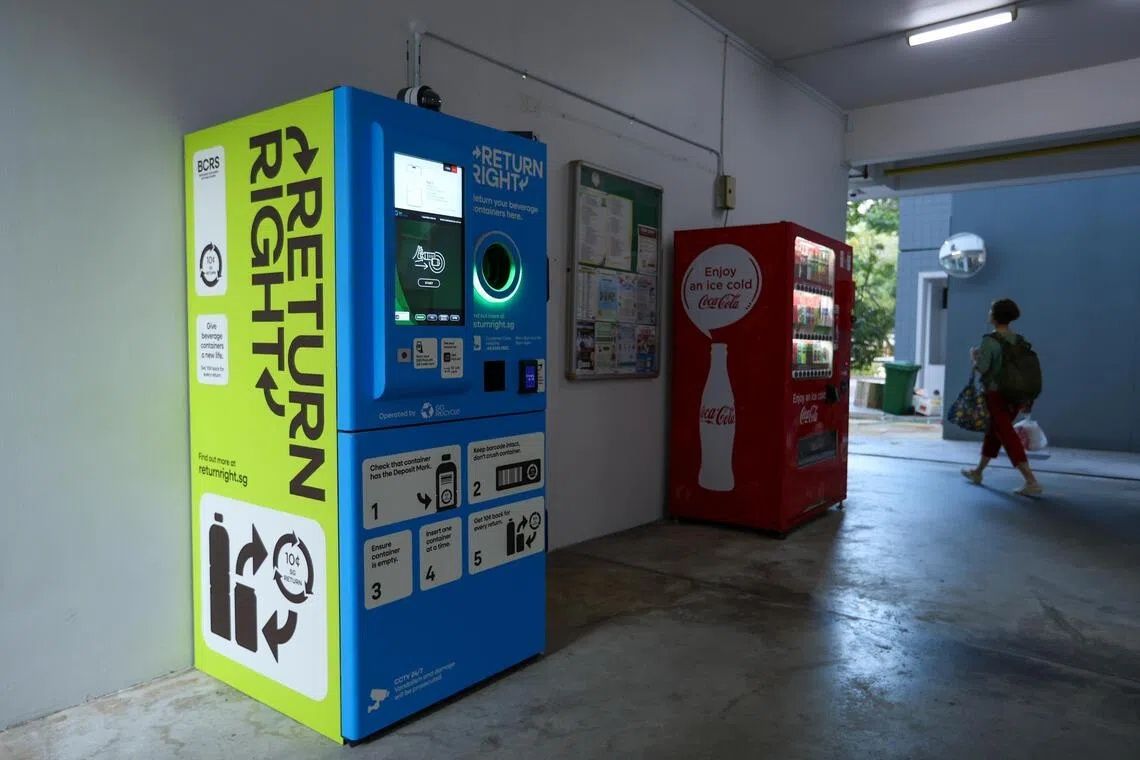
Singapore's National Environment Agency moved swiftly on August 15 to address mounting public concern about the integrity of its Beverage Container Return Scheme, flatly rejecting claims of financial impropriety that had gained traction in online discussions. The agency characterised the accusations as fundamentally misguided, attributing the controversy to a widespread misreading of official statements made in Parliament earlier that month. The denial represents an important moment for the scheme, which launched barely four months earlier and has become an unexpected flashpoint for transparency questions in Singapore's environmental policy.
The confusion appears to have originated from comments made by Senior Minister of State for Sustainability and the Environment Janil Puthucheary on August 5, when he informed Parliament that between April and July, the scheme had processed over one million successful refund transactions for 5.5 million containers returned through reverse vending machines. Some online commentators interpreted this to mean that refunds had only been issued for approximately one million of the 5.5 million containers deposited, suggesting that the remainder of the deposits had disappeared or been misappropriated. This interpretation gained sufficient currency to prompt the NEA's unusual public intervention.
The core of the misunderstanding hinges on what constitutes a refund "transaction." The NEA's clarification reveals that the scheme's architecture permits multiple containers to be processed during a single customer interaction with a machine. Rather than a one-to-one correlation between transactions and refunded containers, the agency noted that consumers deposited an average of 5.5 containers per transaction. This operational detail, while seemingly technical, carries significant implications for public understanding of how the scheme functions at ground level and why official statistics might appear counterintuitive without proper explanation.
The financial dimensions of the scheme help contextualise the scale of the operation. Each beverage container attracts a 10-cent deposit, recoverable when the empty container is returned to a reverse vending machine. Across the 5.5 million containers returned in the scheme's first four months, approximately S$550,000 (US$429,822) in deposits has been refunded to consumers. The modest per-item value underscores the administrative complexity of managing millions of micro-transactions, a challenge that may have contributed to both the scheme's operational hiccups and the public misinterpretations that followed.
The Beverage Container Return Scheme itself represents a significant policy shift in Singapore's environmental governance. Launched on April 1, the mandatory deposit system aims to incentivise beverage container recycling and reduce litter. By imposing a financial consequence on consumers who choose not to recycle, the scheme leverages economic behaviour modification rather than relying solely on voluntary compliance or regulatory enforcement. For Malaysian observers, the Singaporean approach offers a potential model as regional governments consider their own extended producer responsibility frameworks and circular economy initiatives.
Yet the scheme's debut has not been entirely smooth. During its first weeks of operation, numerous users reported frustration with mechanical failures and processing errors at the reverse vending machines. Some customers complained that expected refunds did not materialise immediately, forcing them to pursue compensation through separate channels. Others encountered rejection messages from machines that should have accepted their containers, adding friction to what was meant to be a frictionless customer experience. These technical teething problems are relatively common for newly deployed infrastructure, but they occurred within the scheme's critical initial impression phase when public confidence and user adoption rates remain particularly malleable.
Janil's parliamentary statement on August 5 attempted to characterise these difficulties as isolated rather than systemic. He asserted that the overwhelming majority of transactions and returns at the machines had functioned as intended, with only a "handful" of issues requiring intervention. The scheme operator BCRS, he noted, had responded promptly to reported problems, working alongside machine operators to diagnose and remediate faults. This framing positioned the scheme as fundamentally sound despite surface-level operational friction, a narrative now bolstered by the NEA's clarification regarding the financial accounting.
The governance structure underpinning the scheme includes built-in accountability mechanisms designed to prevent exactly the kinds of concerns that surfaced online. BCRS, the scheme operator, is required to submit comprehensive annual reports to the NEA, including full financial documentation. This regulatory oversight framework theoretically creates multiple checkpoints where irregularities could be detected and corrected. Yet the controversy demonstrates that technical compliance with reporting requirements does not automatically translate into public understanding or confidence, particularly when scheme participants encounter difficulties and statistical summaries in parliamentary discourse prove susceptible to misinterpretation.
For the broader region, the Singapore case study carries several instructive lessons. Southeast Asian nations increasingly implementing beverage container deposit schemes or considering similar mechanisms must grapple with the tension between operational complexity and public communication. Complex systems often require technical explanations that can confuse lay audiences, yet inadequate communication risks generating exactly the kind of suspicion that confronted Singapore's NEA. Building genuine public confidence in environmental schemes requires not just robust governance but also proactive, clear, and sustained explanation of how systems actually function.
The scheme's evolution over coming months will likely determine whether this initial controversy becomes a defining challenge or merely a minor early-stage friction point. If the reverse vending machine network becomes more reliable and user-friendly, public confidence should gradually recover. Conversely, if technical problems persist or expand, the existing scepticism could crystallise into more entrenched resistance to the deposit system. For Singapore's environmental ambitions, the Beverage Container Return Scheme represents an important test of whether economic incentives combined with technological infrastructure can effectively reshape consumer behaviour toward sustainability.

