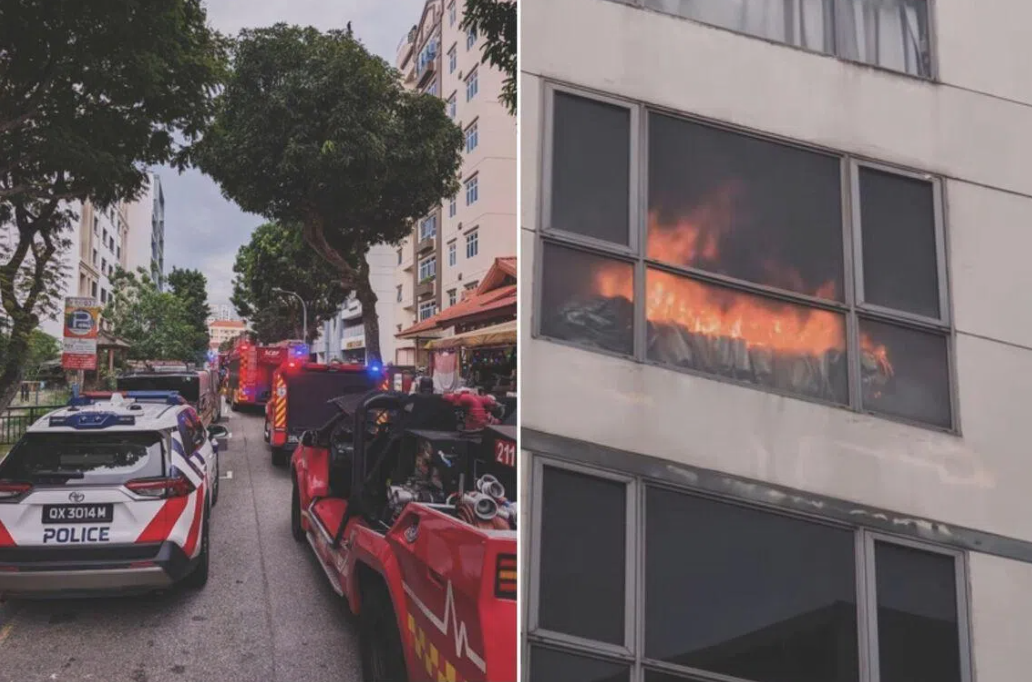
A residential fire triggered by an unattended, charging power-assisted bicycle has renewed safety concerns across the region about the hazards posed by increasingly popular active mobility devices. The incident occurred on Sunday, June 21, in a seventh-floor unit at Casa Aerata condominium in Geylang, prompting the Singapore Civil Defence Force to evacuate five neighbouring residents as a precautionary measure. Although no injuries resulted from the blaze, the episode underscores the dangers of poor battery management practices that extend well beyond Singapore's boundaries, affecting users across Southeast Asia who are adopting e-bikes and personal mobility devices at a rapid pace.
Emergency responders arrived at 9 Lorong 26 Geylang at 5.35pm after being alerted to the fire. The SCDF contained the blaze using conventional firefighting equipment, deploying a hosereel and a compressed air foam backpack to suppress the flames emanating from the battery that had been left charging in the unit's living room. The swift response prevented the fire from spreading to adjacent units, though the intensity of the heat damaged the seventh-floor window sufficiently to cause it to shatter. Local Member of Parliament Cai Yinzhou from Bishan-Toa Payoh GRC arrived at the scene after spotting smoke and hearing emergency sirens, and immediately helped clear the area beneath the burning unit in anticipation of falling debris from the compromised window.
Initial investigations determined that the fire originated from electrical failure within the power-assisted bicycle battery itself. The device had been charging unattended, a practice that significantly increases fire risk as no one was present to intervene if the battery began malfunctioning. This detail carries particular importance for Malaysian users, many of whom rely on PABs for daily commuting through densely populated urban areas and residential neighbourhoods similar to those in Singapore's East region. The confined environment of a condominium unit—where residents live in close proximity to one another—transforms what might otherwise be a contained incident into a collective safety emergency requiring coordinated evacuation procedures.
The Singapore Civil Defence Force has responded to this incident by reissuing critical safety guidance to the public regarding the use and charging of active mobility devices. The agency explicitly cautioned against purchasing or using non-original batteries, a widespread problem in the region where counterfeit and substandard battery packs are commonly available at significantly lower prices than genuine alternatives. These unauthorised batteries often lack proper safety mechanisms, thermal management systems, and quality control standards that manufacturers implement in original products. The SCDF also stressed that PAB and PMD batteries should never be charged for extended periods or left charging overnight, practices that compound the risk of thermal runaway—a cascading failure that can lead to rapid combustion.
The statistical context provided by Singapore's fire service reveals a troubling trend in the broader region. During the first half of 2025, the SCDF responded to 304 electrical fires at residential premises, with 34 cases specifically involving active mobility devices. This represents approximately eleven percent of all residential electrical fires, a proportion that would be concerning even in isolation. However, the breakdown of device types shows a particularly acute problem with personal mobility devices: PMD fires increased significantly from 25 incidents in 2024 to 31 in the comparable period of 2025. This forty-four percent increase in PMD-related incidents suggests that users may be becoming less cautious about charging practices, or that device quality and battery standards continue to deteriorate as the market expands rapidly without corresponding regulatory oversight.
Interestingly, overall AMD fires declined from 67 cases in 2024 to 49 in the first half of 2025, suggesting that some safety awareness campaigns or enforcement measures may be having a positive effect. Yet the rising proportion of PMD incidents within this declining total indicates that messaging around power-assisted bicycle safety may be more effective than guidance targeting stand-on scooter users. For Malaysian authorities and safety advocates, this data suggests that targeted public education campaigns should differentiate between device types, recognizing that PMD users may require more intensive outreach and stricter regulations.
The incident also highlights infrastructure and policy gaps relevant to Southeast Asian cities. In Malaysia, where e-bikes and PMDs are increasingly common in urban centres such as Kuala Lumpur, Penang, and Johor Bahru, there is limited standardized guidance regarding safe charging practices in residential buildings. Unlike Singapore, where the SCDF can issue coordinated warnings, Malaysia's fragmented regulatory landscape—with responsibilities split between local councils, the Road Transport Department, and the Malaysian Communications and Multimedia Authority—creates confusion about who bears responsibility for setting and enforcing safety standards.
The residential condominium setting carries particular significance for both Singapore and Malaysia, where such developments house rapidly growing populations in compact spaces. In these environments, a single battery fire can pose simultaneous risks to dozens of neighbouring units, and evacuation procedures must be executed swiftly to prevent casualties. The fact that this incident resulted in zero injuries reflects well on emergency response coordination, but should not create complacency. Each such event consumes firefighting resources and creates community anxiety that could be prevented through better user practices.
Manufacturers and retailers across Southeast Asia bear responsibility for ensuring that only quality batteries reach consumers. The proliferation of non-original battery packs, particularly through online marketplaces and informal retail channels, represents a systemic challenge that individual users cannot fully address through personal diligence alone. Malaysian and Singaporean consumer protection agencies should consider implementing stricter product certification requirements and enforcement mechanisms against sellers of counterfeit batteries, similar to steps taken in markets such as South Korea and Australia.
For users in Malaysia and across the region, the Geylang incident serves as a practical reminder that active mobility devices are not entirely risk-free. While PABs and PMDs offer genuine benefits for urban commuting and reducing congestion, responsible ownership requires adherence to manufacturer guidelines regarding charging. This means using only original batteries, avoiding overnight or extended charging sessions, and maintaining devices according to specifications. Residential building management should also consider developing policies regarding where and how active mobility devices may be charged, balancing resident convenience against collective safety.
The broader safety infrastructure challenge extends to charging stations and public facilities. As demand for active mobility devices grows across Malaysia and Southeast Asia, cities should invest in dedicated, properly monitored charging facilities in public spaces rather than relying on residents to manage batteries in home environments. Such infrastructure would reduce fire risks while also normalizing safe charging practices across the user population. Singapore's development of AMDhubs—dedicated areas for parking and charging these devices—offers a model that other regional cities should study and potentially adapt.
Moving forward, both Singapore and Malaysia should recognize that safety regarding active mobility devices requires coordination across multiple stakeholders: manufacturers must prioritize quality and safety, regulatory bodies must establish and enforce standards, retailers must resist selling counterfeit products, and users must adopt responsible practices. The Geylang fire, while contained and resulting in no casualties, demonstrates that complacency in any of these areas carries real consequences. For residents across Southeast Asian cities, the incident underscores that the convenience and environmental benefits of e-bikes and PMDs come with responsibilities that should not be overlooked.