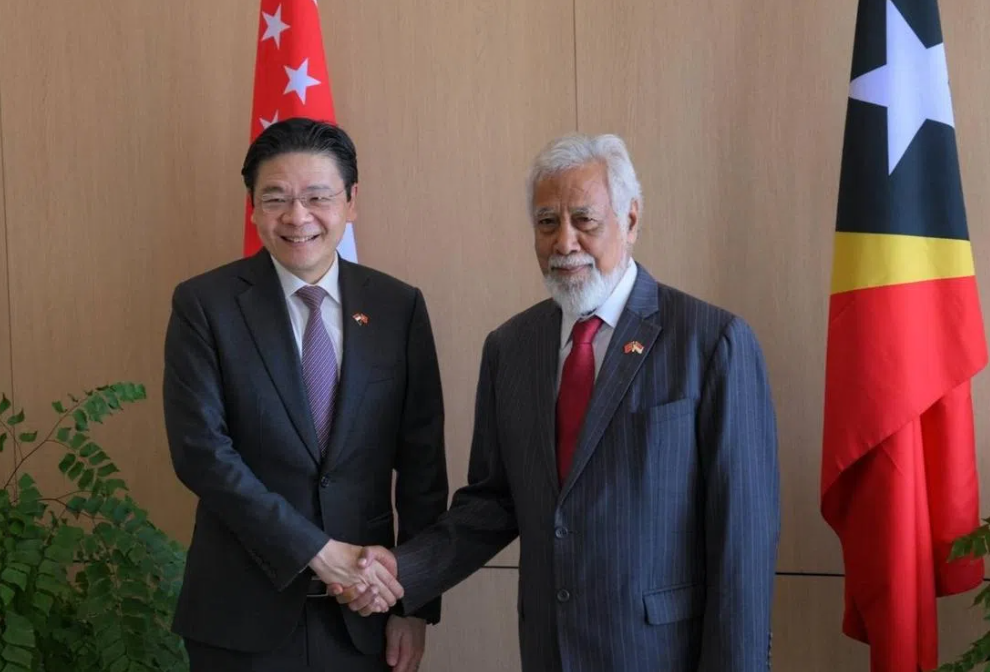
Prime Minister Lawrence Wong's landmark visit to Dili has cemented Singapore's commitment to Timor-Leste's development trajectory, with both nations formalising a sweeping bilateral cooperation pact that extends across investment, labour markets, and institutional capacity building. The agreement, signed on July 3 at the Government Palace in the presence of Timor-Leste Prime Minister Xanana Gusmao, establishes a structured diplomatic framework designed to deepen collaboration across multiple sectors and coordinate responses to regional strategic challenges. Wong's visit marks the first occasion a Singapore prime minister has travelled to the Southeast Asian nation, underscoring the diplomatic significance both governments attach to the relationship at a time when Timor-Leste consolidates its position as Asean's newest member state.
At the heart of the new pact lies a regularised consultation mechanism between the foreign ministries of both countries, creating institutional channels through which officials can deliberate not merely on bilateral matters but on the broader regional and international landscape. This structured dialogue platform represents a strategic shift toward systematic engagement, moving beyond ad-hoc interactions to embed regular review cycles that assess existing cooperative endeavours and identify emerging domains where mutual benefit can be realised. By embedding consultation into the diplomatic architecture, both governments signal their intention to treat the relationship as foundational rather than peripheral to their respective foreign policy portfolios.
The economic dimension of the partnership illuminates Singapore's deepening investment presence in Timor-Leste, where companies have already positioned themselves as among the country's largest foreign investors. These enterprises are diversifying their engagement across wholesale trade, renewable energy, and other growth sectors, reflective of growing confidence in the nation's economic prospects. PM Wong framed this investment activity not as extractive engagement but as part of a mutual value-creation agenda, where Singapore's commercial expansion becomes a vehicle for supporting Timor-Leste's economic diversification and generating prosperity that extends to both populations.
A particularly significant development announced during the visit concerns labour mobility. From the second half of 2027, Singapore will open designated sectors and occupations to Timorese workers, expanding the existing pool from which businesses can recruit permit holders. This initiative will encompass construction, marine shipyard operations, and other labour-intensive domains where Singapore firms have identified manpower constraints. The Singapore Ministry of Manpower noted early interest from construction sector companies in accessing this workforce, suggesting the policy addresses genuine sectoral demand rather than representing symbolic gesture-making. For Timor-Leste, this opening provides employment pathways for its citizens and creates remittance flows that contribute to family incomes and broader economic circulation.
The healthcare collaboration signals Singapore's intention to build institutional capacity within Timor-Leste's health system through sustained technical partnerships. The National University Hospital and Timor-Leste's Ministry of Health are moving toward formalising a five-year framework targeting health workforce development, training infrastructure, public health capability enhancement, and systemic strengthening. Rather than offering transactional aid, this approach channels Singapore's institutional expertise into domains Timor-Leste has identified as priorities—emergency medicine, paediatrics, obstetrics, ophthalmology, and supporting care services. Such capacity building addresses the structural health system deficits that newly independent or developing nations typically face, where institutional knowledge and technical systems require reinforcement to deliver population-wide health security.
Educational cooperation constitutes a second pillar of institutional development, with Singapore committing support to Timor-Leste's teacher training institute and educational professional development systems. The focus on nurturing school leaders reflects understanding that sustainable education transformation depends on strengthening the pedagogical leadership pipeline rather than importing foreign curriculum or personnel. This approach respects Timorese institutional ownership while leveraging Singapore's experience in educator development and school management systems. The investment in human capital formation through education creates long-term returns by reshaping the capabilities of professionals who will guide the country's development over decades.
PM Wong's conferment of the Order of Timor-Leste (Grand Collar) by President Jose Ramos-Horta acknowledged Singapore's sustained institutional commitment to the nation's post-independence consolidation and Asean integration process. In accepting the honour, Wong redirected recognition toward the Singaporean professionals, trainers, and technical specialists who have served in-country, emphasising that Singapore's contribution has been fundamentally relational and capacity-focused rather than hierarchical. This framing reinforces the partnership narrative as mutual nation-building rather than conventional donor-recipient dynamics.
Timor-Leste's integration into Asean, formalised on October 26, 2025, created the strategic context for intensifying bilateral engagement with Singapore. The nation now confronts the complex challenge of participating effectively in Asean mechanisms while preparing for its designated chairmanship in 2029. Singapore has expanded the Stars (Singapore-Timor-Leste Asean Readiness Support) package, initially launched in December 2022, to provide officials with training in Asean meeting protocols, procedures, and policy frameworks. The expansion includes tailored workshops addressing chairmanship responsibilities and facilitation of attachments to Singapore's own Asean chairmanship teams in 2027, enabling Timorese officials to acquire practical experience within functioning chairmanship structures.
This approach to Asean capacity building reflects recognition that formal membership requires more than ceremonial attendance at regional forums. Timor-Leste must develop institutional capability to navigate complex multilateral negotiations, coordinate ministerial positions across domestic agencies, and eventually manage Asean's rotating leadership role. By embedding knowledge transfer within Singapore's own chairmanship cycle, the package converts institutional experience into transferable learning that Timorese officials can apply when their nation assumes the chair. This sequenced approach—building foundational capabilities now, creating observational learning opportunities in 2027, and positioning Timor-Leste for independent leadership in 2029—demonstrates strategic thinking about phased capacity development.
The bilateral framework also resonates within the broader Southeast Asian regional architecture, where Timor-Leste's Asean membership represents both achievement and potential instability vector. The nation's integration into the regional organisation creates opportunities for coordinated approaches to maritime security, transnational challenges, and economic integration while simultaneously expanding the complexity of consensus-based decision-making. Singapore's commitment to supporting Timor-Leste's institutional capacity therefore carries external benefits, stabilising the newest member's contribution to regional stability and effectiveness. As both nations formalise cooperation mechanisms, they are simultaneously strengthening Asean's institutional coherence and demonstrating that membership integration requires deliberate, sustained partnership building rather than assumption that formal accession automatically confers effective participation capability.

