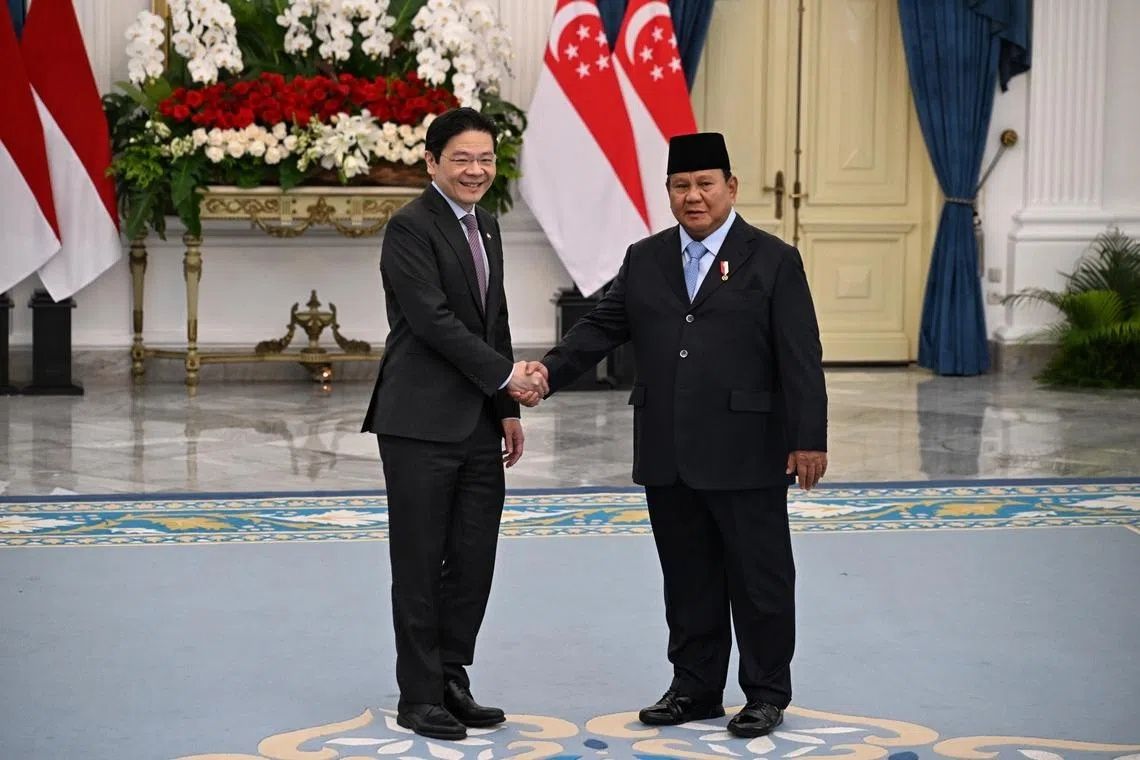
Singapore and Indonesia have jointly committed to preserving the Strait of Malacca as an open, secure maritime corridor accessible to all nations, marking a strategic realignment of their bilateral relationship centred on regional stability and shared economic prosperity. The pledge came during discussions between Prime Minister Lawrence Wong and President Prabowo Subianto at their annual Leaders' Retreat on July 6, elevating maritime security and freedom of navigation to the core of their partnership at a time of intensifying geopolitical volatility.
The Strait of Malacca represents one of the world's most vital shipping arteries, funnelling enormous volumes of international commerce and energy resources between the Indian Ocean and South China Sea. Through this narrow corridor flows a substantial portion of global trade, including critical petroleum supplies destined for Asia-Pacific markets. Its strategic importance cannot be overstated: any disruption to transit through the waterway would reverberate across global supply chains and energy markets, making its security a matter of concern far beyond Southeast Asia. For Malaysia, watching from its vantage point as a major littoral state, the joint stance by its two closest neighbours carries particular significance for regional navigation frameworks.
President Prabowo emphasised that Indonesia and Singapore, as countries with direct borders along the strait, maintain aligned interests in ensuring unimpeded passage for all maritime users. He articulated a comprehensive vision of strait security extending beyond mere freedom of navigation to encompass environmental protection, accident prevention, and suppression of piracy and maritime robbery. Indonesia intends to continue coordinating with Malaysia and Thailand to ensure compliance with international maritime law, particularly the United Nations Convention on the Law of the Sea, guaranteeing that the waterway remains consistently available to legitimate users globally.
Prime Minister Wong connected the maritime commitment to broader international developments, specifically referencing recent Middle Eastern instability that has disrupted traffic through the Strait of Hormuz and created ripple effects across global trade networks and oil supply chains. This comparison underscores why Singapore and Indonesia view maintaining Malacca's stability as essential not merely for regional prosperity but for worldwide economic continuity. By explicitly framing their partnership as strategically aligned on navigational freedoms and open sea lines of communication, both leaders signalled resolve against any potential future restrictions on maritime passage.
The bilateral relationship is undergoing significant expansion beyond conventional trade and investment frameworks. Both nations have identified renewable energy and cross-border electricity commerce as cornerstone initiatives for future cooperation, reflecting recognition that regional energy security demands integrated approaches transcending national boundaries. Indonesia's sovereign investment fund Danantara has assumed a leadership position in implementing electricity trade arrangements, collaborating with Singapore firms including Keppel Electric, Sembcorp Industries and Singapore Energy Interconnections. These partnerships represent concrete steps toward establishing commercial frameworks that could eventually facilitate broader regional power grid integration across ASEAN.
Prime Minister Wong characterised the cross-border electricity initiative as a mutually beneficial undertaking and a foundational element for constructing a more expansive ASEAN Power Grid capable of enhancing collective regional energy security. Such interconnected infrastructure would reduce individual nations' dependency on singular supply sources and create redundancy mechanisms protecting against supply disruptions. The electricity trade framework also demonstrates how Singapore and Indonesia view their relationship evolving toward deeper structural integration, moving beyond arm's-length commercial transactions toward genuine infrastructure partnerships.
Beyond energy cooperation, the two countries have identified supply chain resilience, digital infrastructure, and cybersecurity as priority collaboration areas. President Prabowo reported that discussions on digital ecosystems and cybersecurity had yielded concrete operational outcomes, suggesting movement beyond preliminary consultations toward implementable protocols. These sectors carry particular relevance for Malaysian observers, as strengthened Singapore-Indonesia supply chain coordination and digital infrastructure development will inevitably influence broader regional supply networks and digital governance frameworks that Malaysian enterprises must navigate.
Singapore's demonstrated confidence in Indonesia's economic trajectory featured prominently throughout the discussions, with Prime Minister Wong repeatedly emphasising that Singapore views Indonesia's prosperity as intrinsically linked to regional stability and its own long-term interests. This positioning carries implications for investment flows and business confidence throughout Southeast Asia. Wong highlighted Singapore's capital contributions extending beyond simple financial transfers to encompassing technology transfer, downstream industrial development, and employment creation across Indonesia. Specific examples include ongoing activities in the Batam, Bintan and Karimun economic zones, alongside the Kendal Industrial Park in central Java, which achieves full operational capacity by 2026 and plans to expand by an additional 1,000 hectares.
The industrial park expansion epitomises how Singapore-Indonesia cooperation functions as a practical mechanism for driving regional development. The additional 1,000 hectares of industrial capacity will attract further foreign and regional investment, generate additional employment opportunities, and reinforce Indonesia's positioning as a manufacturing destination within Southeast Asia's integrated supply chains. For Malaysian policymakers and business leaders, this expansion represents both competitive pressure and potential partnership opportunities, as Malaysian manufacturers may increasingly view Kendal and similar Indonesian facilities as either competitors or complementary production nodes within regional supply networks.
The bilateral discussions implicitly laid groundwork for marking six decades of diplomatic relations in 2027, positioning both countries to build upon historical ties through modernised strategic partnerships addressing contemporary regional challenges. The emphasis on maritime security, renewable energy, and digital infrastructure reflects recognition that 21st-century strategic alignment requires addressing transnational challenges transcending conventional military and political domains. By jointly articulating commitment to Malacca's openness and simultaneously advancing cooperation in energy and digital spheres, Singapore and Indonesia have projected a vision of Southeast Asian regionalism based on institutional deepening and shared prosperity rather than zero-sum competition.
For Malaysia as a fellow littoral state on the Strait of Malacca, the Singapore-Indonesia alignment on maritime security creates both opportunity and obligation. The joint commitment to coordination with Malaysia on strait security suggests incorporation of Malaysian interests into maritime governance frameworks, yet simultaneously raises questions about Malaysia's own strategic priorities and whether its policies align sufficiently with neighbours' positions. The emphasis on cross-border electricity and supply chain integration likewise positions Malaysia at a decision point regarding participation in broader regional infrastructure projects that could reshape economic geography and competitive positioning within Southeast Asia for decades ahead.

