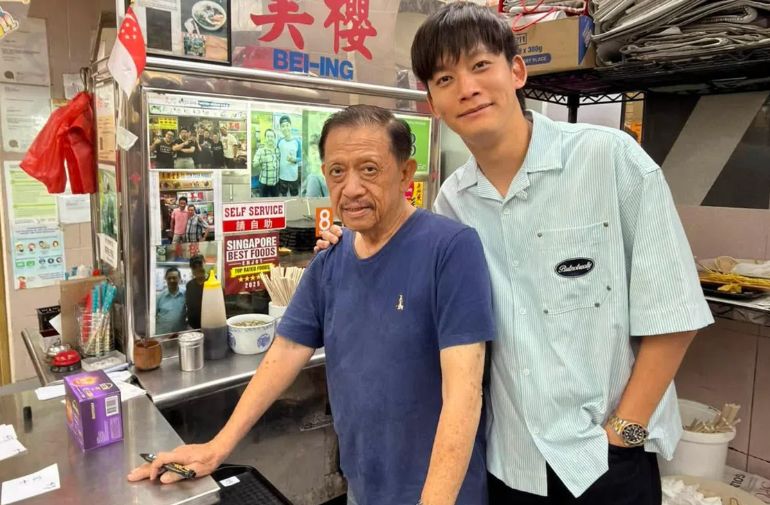
Singaporean actor Noah Yap has pushed back forcefully against social media critics who alleged he capitalised on an elderly hawker's misfortune to boost his public profile. The backlash emerged after Yap visited Bei-Ing Wanton Noodle owner Yeo at Roxy Square following a violent altercation, with detractors claiming the actor staged the encounter for media attention. Yap's pointed response underscores the complexity of celebrity activism in the age of social media, where even genuine gestures of concern risk being interpreted through a cynical lens.
The controversy centres on an incident that unfolded at a Roxy Square coffee shop when Yeo, an elderly hawker, was caught in a confrontation with a young man after the stall owner attempted to pat a child on the head in what he perceived as a friendly gesture. Video footage that circulated online on August 15 appeared to show the younger man forcibly restraining and pushing Yeo to the ground, leaving the elderly vendor injured. Police have confirmed receiving a report and are investigating the matter, though the full circumstances surrounding the dispute remain subject to official inquiry.
Yap visited Yeo the following afternoon on August 16 to check on his condition and offer support. The actor discovered the hawker in relatively good spirits despite initial reluctance to seek medical attention for his injuries. What began as a personal gesture of concern took on a broader dimension when Yap shared details of his visit on social media, intending to draw attention to the incident itself rather than to himself. His stated motivation was to raise public awareness about the altercation and its implications for community safety and civility.
The veteran actor's relationship with Bei-Ing Wanton Noodle extends far deeper than casual patronage. Yap has been a regular customer for more than two decades, maintaining the connection since his primary school days. This long-standing personal tie lends considerable weight to his account of the visit. According to Yap's account, Yeo and his family have consistently shown genuine interest in his wellbeing and have enquired after him during his visits over the years. The hawker apparently played a meaningful role in Yap's formative years, a detail that transforms the nature of his response from external concern to familial responsibility.
Yap's sharp riposte to his critics—"Get a life la. I'm not as free as you think"—reflects a broader frustration with the assumption that every action undertaken by public figures must be motivated by self-interest or image management. The comment suggests that the online accusers themselves may harbour unrealistic expectations about celebrity behaviour or may project their own assumptions about personal motivation onto others without adequate evidence. This aspect of the controversy highlights how difficult it has become for public personalities to navigate the space between genuine community engagement and the perpetual suspicion of performative activism.
The hawker incident itself raises significant questions about community standards and interpersonal conduct in Singapore's densely packed urban environment. The alleged assault on an elderly man for what appears to have been an innocent gesture reveals underlying tensions about personal boundaries, cultural differences in physical affection, and the appropriate responses to perceived transgressions. That such an incident could escalate into violence illustrates how quickly misunderstandings can turn dangerous, particularly when younger, stronger individuals confront elderly vendors who may be perceived as vulnerable.
Yap's response emphasised broader messages about non-violence and social responsibility rather than seeking to capitalise on the situation for personal gain. In his social media statement, he stressed that violence can never be justified as a response to disagreement or discomfort, and called for greater kindness and understanding within communities. These messages align with efforts by public figures throughout Southeast Asia to promote social cohesion and peaceful conflict resolution, particularly in contexts where rapid urbanisation and demographic change have sometimes strained traditional community bonds.
The timing and nature of Yap's intervention also merit consideration. Rather than remaining silent or distancing himself from the controversy, he actively engaged with the situation by visiting Yeo in person, a gesture that required genuine effort and carried personal risk given the online environment. His decision to publicise the visit, rather than keeping it private, reflects a calculation that raising awareness about the incident served a public interest that outweighed concerns about personal optics. For Malaysian observers, this represents a model of how celebrities in the region might engage with community issues while acknowledging legitimate concerns about authenticity and motivation.
The episode also touches on broader anxieties about social media culture and the rapid amplification of accusations without contextual investigation. The critics who alleged that Yap sought limelight made their judgments based on incomplete information and without apparent knowledge of his pre-existing relationship with the hawker. This reflects a troubling tendency in online discourse where cynicism becomes the default interpretive frame, making it increasingly difficult for individuals—celebrity or otherwise—to engage in straightforward acts of kindness without facing suspicion.
For Malaysian and Southeast Asian readers, the Yap controversy offers instructive lessons about the intersection of celebrity responsibility and community welfare. As social media increasingly shapes how public figures engage with social issues, the pressure to perform activism risks overwhelming genuine community concern. Yet the alternative—silence and withdrawal from public participation—also carries costs for communities that might benefit from the platforms and resources that celebrities can mobilise. Yap's response suggests that navigating this tension requires both authentic connection to communities and clear communication about motivation.
The police investigation into the assault on Yeo continues, and the outcome may provide additional context for understanding the broader incident. Regardless of legal determinations, however, Yap's intervention has already served to elevate a local incident into a broader conversation about violence, community standards, and civility in urban Southeast Asia. Whether critics accept his explanation or remain sceptical, the actor's willingness to engage with criticism rather than ignore it demonstrates a level of accountability increasingly rare in public discourse, offering a counterpoint to the more defensive postures often adopted by embattled celebrities.

