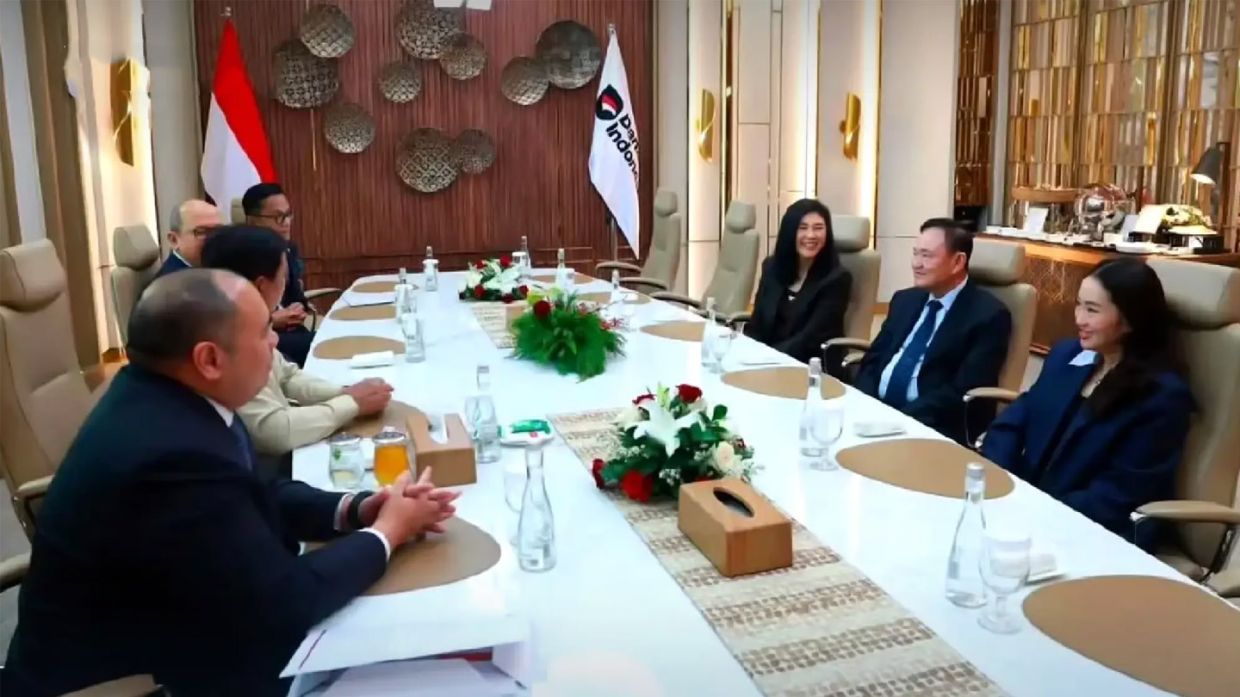
The Shinawatra family's political influence extended across Southeast Asia this week with a high-profile gathering in Jakarta, where three former Thai prime ministers convened with Indonesian President Prabowo Subianto to chart investment pathways and economic cooperation. The July 9 meeting brought together Thaksin Shinawatra, his sister Yingluck, and niece Paetongtarn at the Danantara building, Indonesia's premier state investment management institution, signalling the family's continued relevance in regional economic and political circles despite their turbulent history in Thai domestic politics.
Thaksin, who led Thailand from 2001 to 2006 before his controversial ouster in a military coup, has maintained a sophisticated international profile through advisory roles that keep him connected to major economic initiatives beyond Thailand's borders. His appointment to Danantara's advisory board positions him as a bridge between Thai business interests and Indonesia's strategic development agenda. Yingluck, who served as prime minister from 2011 until her removal in 2014, has similarly sought influence through international channels following her conviction in absentia and self-imposed exile. Paetongtarn, the family's newest entrant into the premiership following her 2024 election, represents the third generation's attempt to consolidate Shinawatra political and economic power in a region where family networks often transcend national boundaries.
The Indonesian Cabinet Secretariat, through its official channels, framed the gathering as a strategic engagement reflecting Jakarta's broader ambitions to deepen international partnerships during a period of significant geopolitical flux. According to Cabinet Secretary Teddy Indra Wijaya, the meeting exemplified Indonesia's commitment to broadening cooperation with influential global figures and international leaders at a moment when regional economic dynamics are rapidly shifting. This framing suggests that Prabowo's administration views engagement with established regional power brokers like the Shinawatra family as instrumental to positioning Indonesia advantageously within Southeast Asia's evolving economic landscape.
Danantara itself represents a critical component of Indonesia's economic transformation strategy. As a state-owned investment management entity tasked with optimising and developing strategic national assets, the agency wields substantial influence over Indonesia's long-term development trajectory. The presence of Danantara's senior leadership—including group chief executive Rosan Roeslani, chief operating officer Dony Oskaria, and chief investment officer Pandu Sjahrir—underscored the meeting's substantive nature. These executives engage directly with major capital deployment decisions affecting Indonesia's infrastructure, resource management, and industrial development, making their participation a signal that discussions were intended to yield concrete outcomes rather than serve as ceremonial diplomacy.
The substantive agenda centred on identifying investment opportunities compatible with Indonesia's long-term growth objectives while exploring asset management approaches that could benefit Thai and potentially Malaysian interests aligned with the Shinawatra network. For Malaysian observers, the meeting carries implications regarding how Thai business families leverage connections to shape regional investment flows and development priorities. The focus on sustainable economic development strategies suggests discussions extended beyond simple profit-seeking to encompass broader frameworks for strategic resource allocation—an area where Thai expertise in managing complex, cross-border financial arrangements has historically proven influential.
Thaksin's specific role as an advisory council member provides him with insight into Indonesia's strategic thinking around national asset management and investment prioritisation. His recommendations during the July 9 discussion likely reflected accumulated expertise from his substantial business background and international economic networks. The informal, warm atmosphere noted by the Cabinet Secretariat—itself a carefully curated descriptor—suggests the parties viewed discussions as collaborative rather than transactional, implying potential for sustained engagement beyond this single meeting. Such diplomatic language typically masks substantive negotiations concerning access to investment opportunities, preferential terms, or preferred positioning within Indonesia's development pipeline.
The meeting followed an earlier private gathering at Prabowo's residence, where the president hosted Thaksin and family members in settings designed to foster personal rapport and confidentiality. These dual-venue encounters—one formal and agency-focused, another intimate and residence-based—reflect sophisticated diplomatic practice where substantive negotiation occurs in structured settings while relationship-building and trust-development happen in more relaxed environments. For regional analysts tracking cross-border business influence and political networking, such patterns reveal how former heads of state maintain relevance and economic leverage despite lacking formal governmental authority.
The timing of these interactions merits consideration within Southeast Asia's broader political economy. Prabowo's administration, relatively recently consolidated, appears eager to cultivate relationships with influential international figures capable of attracting capital and strategic partnerships. The Shinawatra family's demonstrated ability to mobilise resources and maintain business networks across multiple jurisdictions makes them attractive interlocutors for Indonesian officials seeking to accelerate development initiatives. Simultaneously, the family's access to Prabowo signals their continued importance despite legal challenges, exile situations, and political reversals that might have diminished other political families' influence.
For Malaysia and the wider region, this Jakarta engagement illustrates how elite networks operate in Southeast Asia's political economy, transcending formal governmental structures while remaining deeply enmeshed with state institutions. The Shinawatra family's positioning within Danantara's advisory structure and their cultivation of direct presidential access exemplifies the region's characteristic blending of family business networks, state institutions, and political influence. These relationships shape investment patterns, development priorities, and economic opportunities across Southeast Asia in ways often invisible to public scrutiny but consequential for how capital flows and strategic assets are deployed throughout the region.

