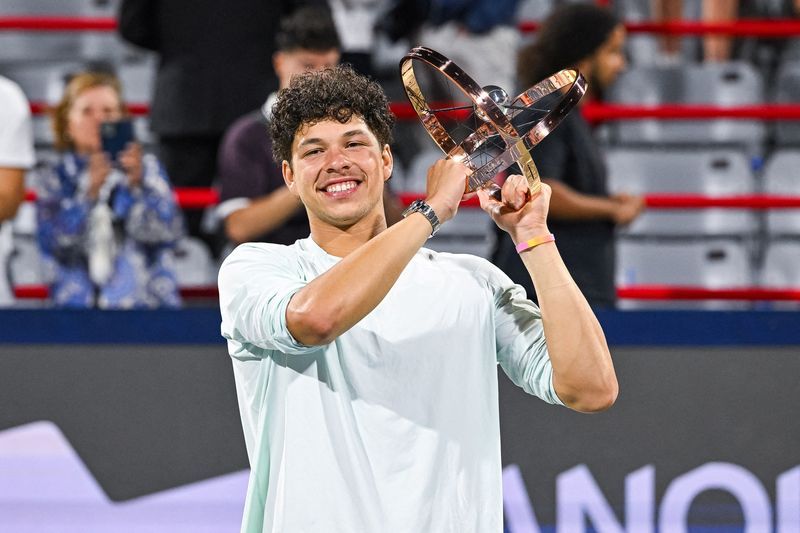
Ben Shelton approaches the US Open with a determination born from both disappointment and recent triumph. The 23-year-old American tennis star, ranked ninth globally, heads to New York seeking redemption after an inconsistent season at major tournaments, yet energised by his commanding defence of the Canadian Open crown. His journey through 2024 has embodied the unpredictability that elite sports routinely delivers—a campaign he himself has described as a "roller coaster" that has nonetheless yielded four titles and critical momentum entering Grand Slam season's final act.
The contrast between Shelton's performance at major championships and his success at other events underscores a narrative familiar to emerging tennis talent: breakthrough ability exists alongside fragments of inconsistency. While he reached the Australian Open quarter-finals, demonstrating solid form on hard courts early in the year, his subsequent showings proved far more troubling. The French Open saw him exit at the second round, a disappointing result on clay that suggested tactical vulnerabilities. Far worse was his first-round elimination at Wimbledon, a result that would have raised questions about his readiness for the season's defining moments. Yet these setbacks, rather than crushing his confidence, appear to have crystallised his focus.
The Canadian Open victory provides the psychological foundation Shelton requires at this crucial juncture. His triumph over Brandon Nakashima was emphatic—he surrendered no sets throughout the tournament, a dominant performance that speaks to both physical conditioning and mental acuity. Shelton's post-victory analysis revealed a player who has identified the specific elements requiring refinement. He spoke of becoming more "clinical" and "focused," of developing elite returning skills, and of marrying defensive stability with offensive aggression. These are not vague aspirations but concrete technical improvements a professional athlete recognises within himself.
Shelton's progression on hard courts throughout the season provides a foundation for optimism about his US Open prospects. Each tournament has apparently brought incremental improvements, a trajectory suggesting he enters New York at an upward inflection point rather than struggling against plateauing performance. His ability to identify and articulate these improvements suggests a player with genuine self-awareness—the capacity to analyse one's game critically and implement changes systematically rather than hoping results simply shift through external factors.
The broader American tennis narrative weighs upon Shelton's shoulders more heavily than typical for a single player. No American man has captured the US Open singles title since Andy Roddick's triumph in 2003 over Juan Carlos Ferrero, a drought now spanning two decades. That absence has become increasingly conspicuous as the sport's global landscape has shifted. Shelton has emerged as perhaps the most credible American candidate to end that hiatus, a status that brings both opportunity and pressure. The weight of national expectation, for some athletes, becomes a destabilising force; for others, it transforms into fuel.
Former champion Roddick recently endorsed Shelton's credentials as a serious contender, a validation carrying particular weight given Roddick's intimate familiarity with Grand Slam competition at the highest level. In an August podcast episode, Roddick suggested that if the tournament's traditional favourites—Jannik Sinner and Carlos Alcaraz—were not performing optimally, Shelton possessed the capability to mount a genuine title challenge. This assessment carries added intrigue following Sinner's withdrawal from this year's event, removing one of the most formidable obstacles from the draw's upper half.
Shelton's semi-final appearance at the 2023 US Open demonstrates he has previously navigated the tournament's psychological and physical demands with considerable success. That performance established proof of concept—he can sustain the intensity required across multiple rounds at this venue. However, reaching the final represents an entirely different undertaking, requiring not only sustained excellence but also the fortune of favorable matchups and the absence of the minor injuries or mental lapses that plague even elite competitors over a fortnight's competition.
The philosophical perspective Shelton articulated in Montreal reflects maturity beyond his years. Tennis's relentless calendar—while offering continuous opportunity—presents psychological challenges that less experienced athletes frequently underestimate. The blessing and curse of perpetual competition requires athletes to maintain motivation and focus across multiple venues and surfaces, to recover from disappointment swiftly, and to recognise that singular performances can indeed reshape trajectories. Shelton's awareness of this dynamic suggests he understands that Grand Slam tournaments, while significant, represent waypoints in a longer narrative rather than definitive statements about a player's capabilities.
For Malaysian and Southeast Asian tennis observers, Shelton's trajectory warrants attention as North American tennis seeks to reassert itself in a landscape increasingly dominated by European and Asian players. The potential emergence of a genuine American contender at major tournaments carries implications for the sport's competitive balance and commercial interest patterns that extend beyond American borders. Moreover, Shelton represents the type of generational talent that defines global sport—a player young enough to accumulate multiple titles yet experienced enough to understand what genuine championship performance demands.
The question now centres not on whether Shelton possesses sufficient talent for success at major tournaments, but rather whether he can maintain the elevated standards he demonstrated in Montreal while navigating the intensified scrutiny and opposition that accompanies a genuine US Open contender. His season's arc—from disappointing early Grand Slam results through the restorative victory in Canada—positions him as a compelling narrative entering a tournament that historically produces dramatic transformations. Whether Shelton's individual circumstances will align with the opportunity presented by Sinner's absence and the tournament's relative openness remains uncertain. What seems evident is that an American tennis talent who can genuinely challenge for a major title would represent a significant development in contemporary professional tennis.

