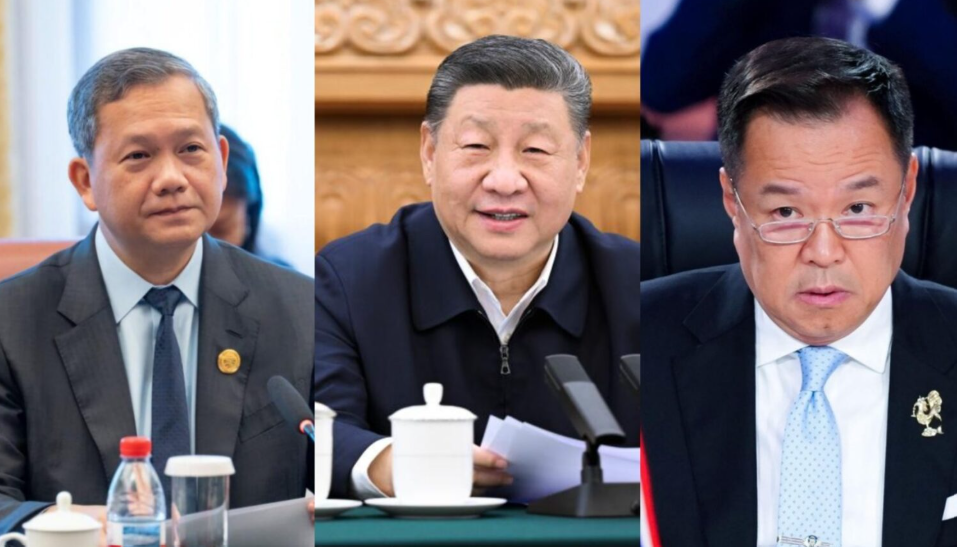
Hun Manet and Anutin Chanvirakul, the prime ministers of Cambodia and Thailand respectively, are set to converge on Shanghai on 17 July for the opening of the World AI Conference 2026, an event scheduled under the personal invitation of Chinese President Xi Jinping. The high-profile gathering presents a potential diplomatic opening in a region where territorial tensions have festered for months without meaningful progress toward resolution. While both leaders will attend the technology-focused conference, observers are keenly watching to see whether Beijing will leverage the occasion to accelerate peace negotiations, or whether the visit will amount to little more than a ceremonial gathering with carefully orchestrated photo opportunities.
Cambodia's delegation is notably substantial in composition and seniority. Manet will travel from 15 to 17 July accompanied by Foreign Minister Prak Sokhonn, Defence Minister Tea Seiha, and Sun Chanthol, the first vice-chairman of the Council for the Development of Cambodia. Thailand's contingent will be led by Anutin and Foreign Minister Sihasak Phuangketkeow. The magnitude of these delegations underscores the diplomatic weight both governments are placing on the trip, suggesting intentions that extend well beyond attendance at a conference dedicated to artificial intelligence and technological advancement.
Bilateral meetings with Chinese leadership have been scheduled for both Southeast Asian leaders. Each prime minister will hold separate talks with Xi as well as Chinese Premier Li Qiang. These one-on-one sessions constitute the real diplomatic substance of the visit, offering backchannels through which substantive discussions about border tensions could theoretically occur. Cambodia's foreign ministry emphasised in a prepared statement that the visit represents "shared commitment" to deepening relations and advancing the Comprehensive Strategic Partnership of Cooperation, including what it termed the Diamond Cooperation Framework and the construction of an "all-weather Cambodia-China Community with a Shared Future in the new era." Thailand echoed similar language about strengthening the bilateral Comprehensive Strategic Cooperative Partnership.
Yet the core question persists: will Beijing actually use its substantial leverage as a major trading partner of both nations to facilitate substantive border negotiations? The last time Manet and Anutin met formally around a negotiating table was December 2024, more than six months before the Shanghai gathering. A previous encounter at the 3rd Asean Future Forum in Hanoi during early June saw the two leaders exchange handshakes for assembled media, but observers noted that the border dispute was conspicuously absent from any substantive agenda.
The territorial conflict between Cambodia and Thailand represents one of Southeast Asia's most persistent frozen conflicts. Portions of Cambodian territory remain under Thai military occupation, a situation that has displaced approximately 20,000 Cambodian civilians who remain unable to return to their homes. The dispute, which centres on demarcation of their shared border and control of strategically important territory, has periodically erupted into military confrontations and represents a significant drag on regional stability and bilateral relations.
Some analysts harbour cautious optimism that China might use the Shanghai forum as a catalyst for renewed negotiations. The reasoning is straightforward: Beijing maintains sophisticated economic and strategic relationships with both nations and has demonstrated willingness to mediate regional disputes when doing so aligns with Chinese interests in promoting stability within its sphere of influence. However, more sceptical observers question whether China possesses sufficient leverage over Thailand's military establishment to force meaningful concessions or behavioural change.
Kin Phea, director of the International Relations Institute at the Royal Academy of Cambodia, articulated this core structural problem. In his assessment, the fundamental obstacle to resolution may not lie with civilian governments, which have ostensibly demonstrated willingness to negotiate, but rather with Thailand's military apparatus, which retains substantial autonomous power. "The Thai military has not implemented the measures that their civilian government agreed with their Cambodian counterparts," Phea observed, suggesting that Thailand's military allows itself to "arbitrarily carry out their actions, including encroaching on Cambodian sovereign territory." This dynamic means that agreements reached between civilian leaders may prove insufficient if military forces operate with relative autonomy from civilian political authority.
Phea advocated for a more assertive Chinese diplomatic posture. He contended that Beijing should utilise its position to actively push both countries toward the negotiating table and encourage resolution through diplomatic mechanisms grounded in international law. Specifically, he called for China to assume a more robust role as arbitrator, capable of constraining military adventurism and returning both nations to normalcy. He referenced the December 2025 Fuxian Consensus, a China-brokered agreement in which both nations had ostensibly committed to peaceful resolution and diplomatic engagement.
The Fuxian Consensus, though representing an important diplomatic achievement, has proven hollow in execution. According to Phea's analysis, Thailand has failed to honour its commitments under that framework. He demanded that Thailand be compelled to respect the consensus, specifically by withdrawing military forces from occupied territories and returning to substantive engagement with the Joint Boundary Commission. The phrase "forced to" is revealing, suggesting that voluntary compliance cannot be assumed without external pressure of significant magnitude.
China's willingness to exert such pressure will likely determine the ultimate significance of the Shanghai gathering. Beijing has previously brokered regional agreements and maintains sufficient economic leverage over both Cambodia and Thailand to theoretically influence their behaviour. However, the Thai military's autonomous power base presents complications. Thailand's defence establishment has historically resisted external pressure when it perceived national security interests at stake, and territorial control along the Cambodian border has long occupied a prominent position within Thai military strategic thinking.
For Malaysia and other Southeast Asian nations, the Cambodia-Thailand dispute represents a cautionary case study in the challenges of border management and the complications that arise when military institutions operate beyond effective civilian control. The situation also illustrates Beijing's emerging role as a regional mediator and the strategic importance China places on maintaining stability within its broader sphere of influence, particularly among nations that border or neighbour China itself.
The Shanghai conference represents an opportunity, but hardly a guaranteed breakthrough. Whether Manet and Anutin will depart with concrete agreements advancing border negotiations, or merely with photographs documenting their attendance, likely depends upon both the intensity of Chinese diplomatic pressure and the Thai military's willingness to subordinate institutional interests to civilian leadership directives. In the absence of such alignment, even a high-profile gathering hosted by Xi Jinping may yield little more than ceremonial acknowledgment of a dispute that will continue festering unresolved.

