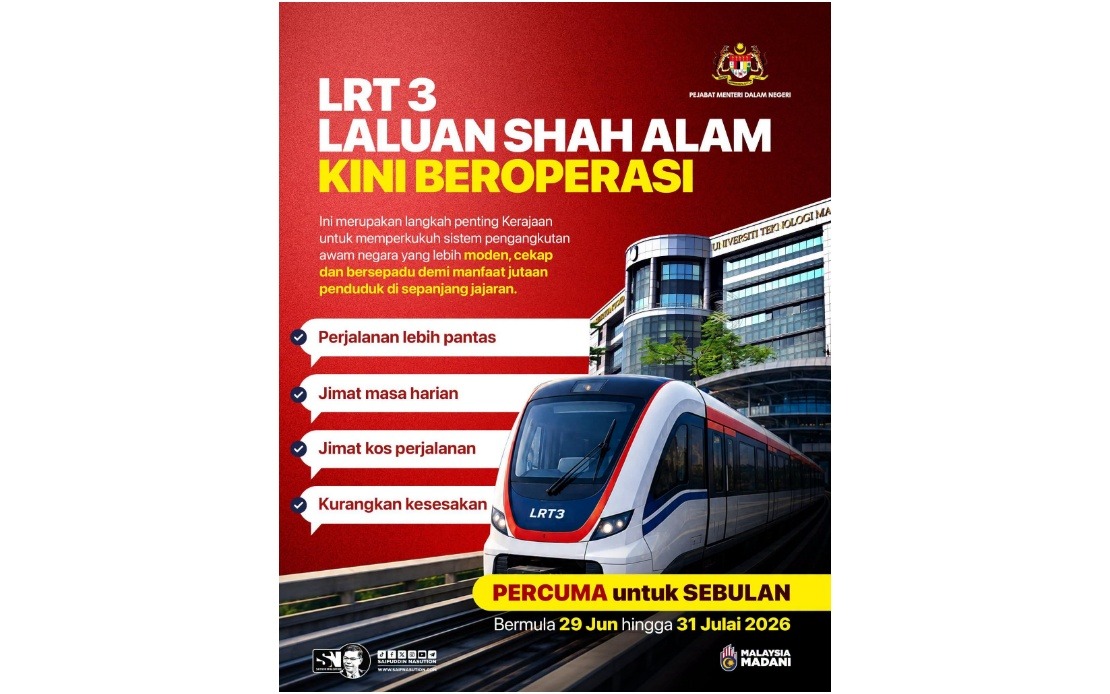
The opening of the Shah Alam Line LRT3 marks another significant step in the MADANI Government's broader agenda to transform Malaysia's public transport landscape, according to Home Minister Datuk Seri Saifuddin Nasution Ismail. Speaking on the occasion of the line's operations beginning, Saifuddin characterised the new rail corridor as tangible proof of the administration's commitment to delivering modern infrastructure that directly enhances the daily experiences of ordinary Malaysians. This framing positions the project beyond mere transport infrastructure, positioning it as a fundamental pillar of the government's vision for improved living standards across the nation.
The Shah Alam Line LRT3 directly addresses one of the Klang Valley's most persistent challenges: severe traffic congestion along major commuter corridors. The region, which encompasses Shah Alam, Klang, Subang and surrounding areas, experiences some of Malaysia's heaviest traffic volumes, particularly during peak hours. By introducing a dedicated rail alternative, the new line offers commuters a viable escape from road gridlock that has plagued the region for years. The expansion of rapid transit options is particularly significant given the Klang Valley's status as an economic and residential powerhouse, hosting a substantial portion of the country's workforce and commercial activity.
Beyond congestion relief, Saifuddin highlighted the multifaceted benefits that the new corridor delivers to its users. Shorter journey times represent a tangible advantage for the estimated hundreds of thousands of daily commuters who traverse these routes to reach workplaces, educational institutions or conduct essential errands. The reduction in commuting duration carries profound implications for work-life balance and productivity. Additionally, the financial savings accruing to regular users cannot be overstated—in a region where transportation costs constitute a significant household expense, the availability of affordable public transit directly improves household budgets, particularly for lower-income workers and students who rely heavily on commuter services.
The government's positioning of the LRT3 project as a strategic investment reflects a deliberate policy approach to strengthen Malaysia's metropolitan transport infrastructure. Rather than viewing public transport as a social service delivered at a loss, the MADANI administration frames it as an investment in human capital and economic efficiency. When workers spend less time commuting and households retain more disposable income, the multiplier effects ripple through the broader economy. Businesses benefit from more punctual employees, schools see improved attendance, and local economies experience increased consumer spending power. This systems-thinking approach differentiates the current government's public transport philosophy from previous administrations.
Prime Minister Datuk Seri Anwar Ibrahim's decision to launch the line with a promotional fare initiative demonstrates a sophisticated understanding of public adoption patterns. The free travel period, running from June 29 to July 31, represents more than a simple subsidy—it functions as a behavioral intervention designed to lower the psychological and financial barriers to trial. Many Malaysians, accustomed to private vehicle convenience, harbour hesitations about public transport despite its objective advantages. By eliminating the financial risk of experimentation, the promotion removes a key obstacle to mode-switching. The inclusion of feeder bus services in the free period further addresses the critical last-mile connectivity challenge that has historically limited the effectiveness of rail networks in Southeast Asia.
Saifuddin's explicit encouragement for residents and workers to abandon private vehicles temporarily underscores the government's recognition that infrastructure alone cannot achieve modal shift. Changing transport behavior requires deliberate messaging and psychological permission-giving. The Home Minister's colloquial tone—urging people to "leave your car behind for a while"—speaks directly to commuters' practical concerns whilst maintaining optimism about the transformative potential of the experience. His invocation of religious sentiment ("insya-Allah") adds an additional cultural dimension to the appeal, framing public transport adoption as aligned with personal welfare and community benefit.
The targeting of specific communities—Shah Alam residents, Klang workers, Subang students—reflects data-driven policy implementation. These areas represent distinct user cohorts with particular commuting patterns and pain points. Students benefit from affordable access to educational institutions; workers gain time savings and cost reductions; residents enjoy reduced neighbourhood congestion. By personalizing the appeal to different groups rather than broadcasting generic messaging, the government demonstrates sophisticated marketing and policy communication. This segmentation approach acknowledges that public transport adoption motives vary across demographic and geographic populations.
For Malaysian regional context, the LRT3 launch arrives at a critical juncture in Southeast Asia's urban development trajectory. Cities across the region grapple with mounting congestion as motorization rates accelerate faster than road construction capacity. The Klang Valley's experience—and Malaysia's response—provides instructive lessons for Thailand, Indonesia, Vietnam and the Philippines as they contemplate their own rapid transit investments. The emphasis on integration between rail and feeder bus services, in particular, addresses a vulnerability that has limited effectiveness of rail-only approaches in lower-density Southeast Asian contexts where populations remain more geographically dispersed than in East Asian metropolitan areas.
The economic implications of the LRT3 extend beyond immediate user benefits to encompass property development patterns and urban land utilization. Transit-oriented development theories predict that proximity to high-capacity public transport increases land values and encourages mixed-use development that concentrates residential, commercial and employment opportunities. Over the medium to long term, the Shah Alam Line LRT3 may catalyse urban densification along its corridor, potentially reshaping settlement patterns across the western Klang Valley. For property investors, commuters contemplating residential relocation and businesses seeking prime commercial sites, the new rail line fundamentally alters the attractiveness and accessibility calculations that guide investment decisions.
The free-fare promotional strategy also carries significant implications for Prasarana Malaysia Bhd, the state-owned operator managing the system. The promotional period generates ridership data that operators can leverage to understand usage patterns, identify operational inefficiencies and optimize service delivery once commercial fares commence. Transit agencies across Malaysia and Southeast Asia traditionally struggle with incomplete information about actual user flows, preferences and demand elasticity. The high-volume promotional period provides invaluable real-world behavioral data that can inform timetabling, fleet deployment and service enhancement decisions for years to come.
Government officials accompanying the launch—including Saifuddin—emphasize that public transport expansion constitutes a cornerstone of the MADANI framework rather than an isolated project. This messaging strategy establishes continuity and coherence across the administration's policy portfolio, suggesting that citizens can expect sustained commitment to transport infrastructure beyond the immediate political cycle. For stakeholders evaluating the credibility of government transport promises—from business associations planning supply chains to workers making residence decisions—this framing provides important confidence signals about long-term policy stability.

