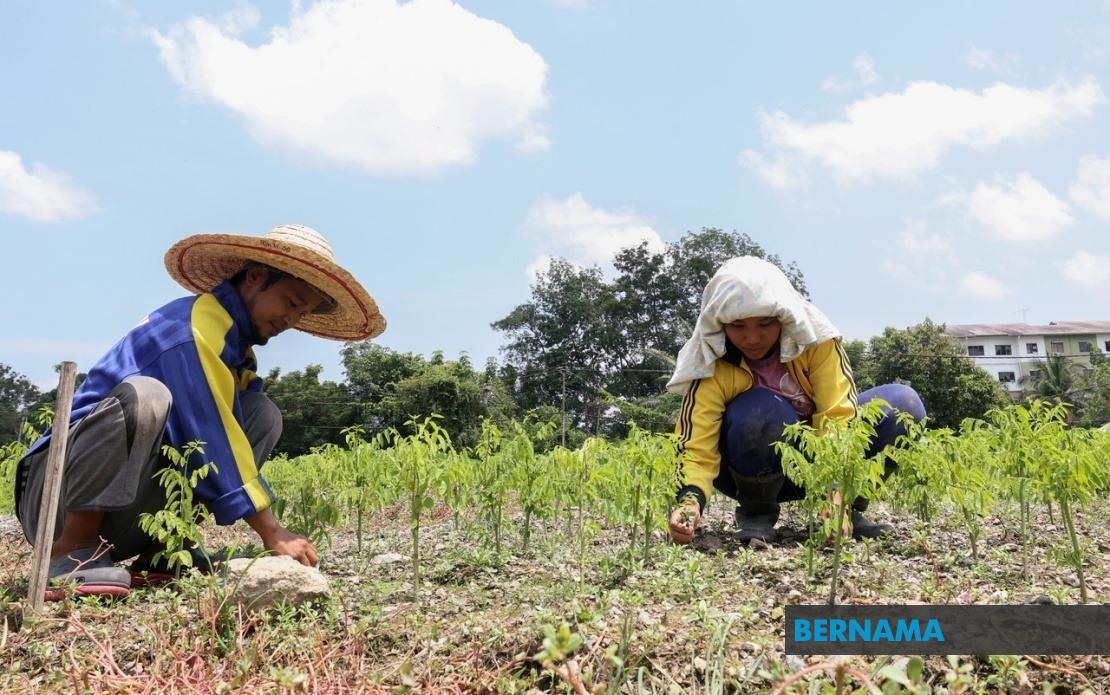
Abnormally high temperatures sweeping across 17 locations nationwide have begun to take a measurable toll on Malaysia's agricultural productivity, with farming communities reporting unprecedented challenges in maintaining viable crop yields. The phenomenon, which has reached Sabah's Sandakan district alongside multiple peninsular regions, transcends mere inconvenience for rural residents—it represents an emerging agricultural crisis that threatens food security and farmer livelihoods across diverse ecosystems.
Farmers working the vegetable plots around Batu 7 in Sandakan have become unwilling experts in heat adaptation, radically restructuring their cultivation routines to combat moisture depletion in soil and plants. Firyanus Salamba, a 33-year-old grower managing commercial vegetable production, describes a labour-intensive transformation of daily farm management. Standard irrigation practices have become obsolete; what once required a single watering cycle now demands three separate applications, executed during morning hours, the midday peak, and evening. This tripling of labour input and resource consumption reflects the desperation required merely to maintain survival rates for temperature-sensitive species.
Despite aggressive intervention through increased watering frequency, the fundamental productivity equation has shifted unfavourably. Yields across multiple vegetable varieties—okra, sweet shoots, and mustard greens—continue declining relative to normal-weather seasons. This paradox, wherein elevated input produces diminished output, points to physiological stress extending beyond simple hydration deficits. Chilli cultivation has proven particularly vulnerable, with plants manifesting such severe heat intolerance that even intensive water management fails to ensure their persistence through the growing season.
The meteorological authority confirmed this crisis trajectory on August 25, when the Malaysian Meteorological Department issued a Level 1 hot weather alert encompassing the affected 17 zones. This classification represents the cautionary threshold—the initial warning stage—triggered when daily maximum temperatures sustain 35 to 37 degrees Celsius for no fewer than three consecutive calendar days. The fact that entire regions have met or exceeded this temperature standard for extended periods indicates conditions moving beyond seasonal variation into climatic anomaly territory.
Geographic distribution of the alert reveals a nation-wide phenomenon rather than isolated regional weather event. Peninsular Malaysia accounts for eleven affected areas: in Perak, the districts of Larut and Matang, Kuala Kangsar, Kampar, and Batang Padang face sustained heat; Kelantan's Kuala Krai confronts similar pressures; Pahang experiences strain across Kuantan, Raub, Temerloh, and Pekan; while Selangor's Hulu Selangor and Gombak regions endure elevated temperatures. Sabah contributes five affected areas—Telupid, Tenom, Sandakan, Pitas, and Beluran—while Sarawak reports stress in Marudi alone.
The horticultural sector, often overlooked in agricultural policy discussions, faces parallel threats of equivalent severity. Operators of flower nurseries throughout affected regions report management difficulties mirroring those confronting vegetable farmers. Maintaining aesthetic and commercial viability in flowering plants now requires minimum twice-daily irrigation cycles, a sharp departure from conventional cultivation schedules. The threat transcends mere aesthetic concern; flowers represent significant export commodities and domestic commercial activity across Malaysia's regions. Wilting and mortality rates accelerating under heat stress translate directly into financial losses for nursery operators who possess limited adaptive capacity.
The underlying mechanism driving these agricultural disruptions reveals climate change's increasingly direct impact on Southeast Asian food production systems. Heat-induced stress disrupts photosynthetic efficiency, accelerates water loss through transpiration, and compromises pollination processes for crop species dependent on insect reproduction. Soil moisture depletion outpaces natural replenishment rates, creating aridity challenges that supplementary irrigation alone cannot fully address. These cascading physiological impacts occur across diverse plant species, suggesting systemic environmental shift rather than species-specific vulnerability.
The economic implications ripple through agricultural communities with particular severity in Sabah, where tropical climate conditions typically favour temperature-stable operations. Farmers must absorb increased water costs, elevated electricity consumption for irrigation pumps, and labour expansion—all while witnessing declining harvests and reduced product quality. Market prices may initially spike due to constrained supply, benefiting producers marginally, yet sustained production difficulties create competitive disadvantage against unaffected regions and international suppliers. The cumulative effect threatens farm viability, particularly for smallholder operators lacking capital reserves to sustain extended low-productivity periods.
Sectorwide, the heat wave incident crystallises urgent policy questions regarding agricultural adaptation infrastructure in Malaysia. Water supply security, irrigation system modernisation, crop variety diversification toward heat-tolerant cultivars, and contingency support mechanisms for affected farmers demand governmental attention. Regional cooperation through ASEAN frameworks could facilitate knowledge-sharing regarding climate adaptation strategies successfully deployed in comparable tropical environments facing analogous pressures.
The immediate concern remains the near-term trajectory of the heat phenomenon. Whether temperatures moderate in coming weeks or intensify determines whether current impacts represent temporary disruption or transition toward structural agricultural challenges. Meteorological forecasting will prove crucial for farmer decision-making regarding replanting schedules, water resource allocation, and income planning. Meanwhile, Sandakan and its fellow affected communities have already absorbed significant losses, establishing this heat wave as a cautionary marker of environmental fragility within Malaysia's agricultural sector.

