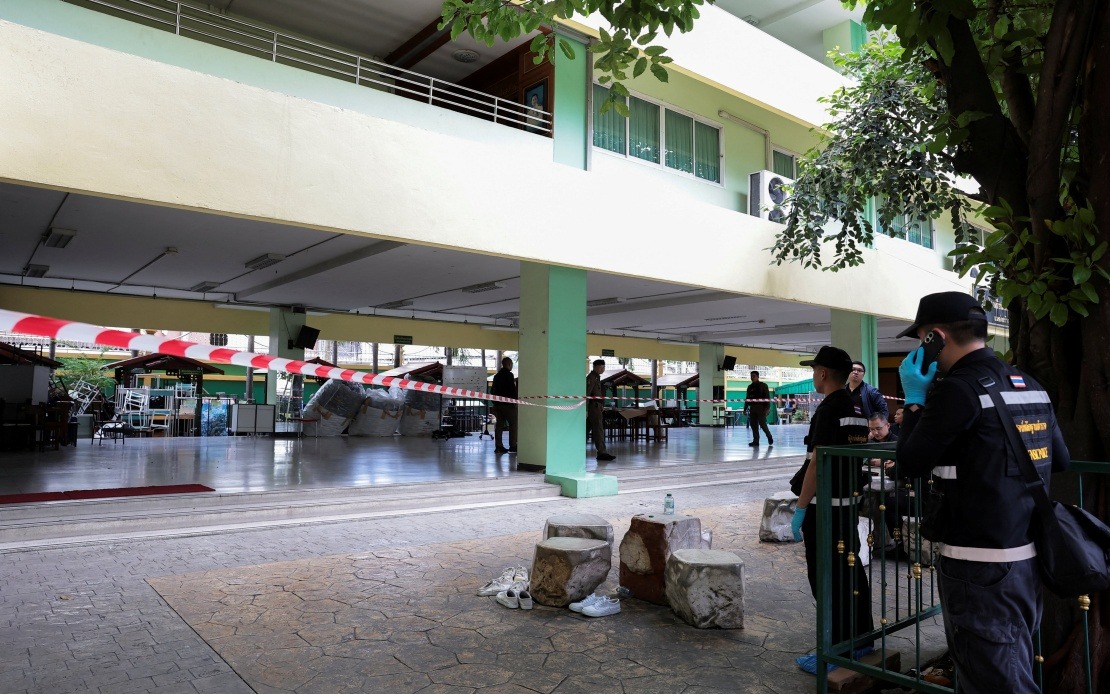
A shooting rampage at a school northwest of Bangkok has claimed seven lives, including those of three educators and three pupils, with another fifteen individuals sustaining injuries in what represents a fresh tragedy for Thailand's education system. The incident unfolded at Debsirin Nonthaburi School in Bang Kruai district on Friday morning around 10 am, when a student at the institution opened fire on the campus. The deceased comprise the three teachers, three students, and the perpetrator himself, according to Lieutenant General Trairong Piwpan, the Royal Thai Police's deputy inspector-general and spokesperson, who addressed journalists at the scene.
Authorities have confirmed that the suspect, a student enrolled at the school, used a 9mm handgun to carry out the attack. Police investigation revealed that the firearm belonged to the shooter's grandfather, indicating a significant lapse in weapon security within a family setting. Officers recovered thirty-four rounds of ammunition found outside the magazine at the scene, suggesting the attacker had considerable firepower available during the assault. The ease with which a young person accessed a family member's registered firearm highlights persistent vulnerabilities in Thailand's gun ownership oversight, despite existing regulations intended to govern the possession and carrying of weapons.
The immediate aftermath saw coordinated emergency responses that prevented further casualties. School authorities swiftly evacuated teachers and students to the nearby Chanrat Wittaya School to ensure their safety away from the active threat. Meanwhile, parents and guardians received instructions to collect their children from the evacuation site, mobilising the community response to the crisis. Hospital officials recorded that fifteen individuals requiring medical treatment were transported for urgent care, with two patients classified as suffering serious injuries necessitating intensive attention. The national police chief subsequently issued directives for the Police General Hospital to dispatch psychologists to provide mental health support and counselling to those traumatised by the violence.
Government leadership swiftly responded to the tragedy with Interior Minister and Prime Minister Anutin Charnvirakul visiting the scene and expressing deep sorrow over the loss of life. His statements conveyed formal condolences to the bereaved families while acknowledging the gravity of the incident, describing it as a terrible occurrence that demanded urgent assistance for the injured and affected communities. Beyond expressions of sympathy, however, Anutin drew a direct connection between the shooting and the government's firearms policy stance, using the incident as an opportunity to reinforce the administration's rationale for declining to renew permits for individuals seeking to carry or possess weapons.
The Prime Minister's comments reflect a broader policy position that emerged following this tragedy, with authorities suggesting that stricter gun ownership restrictions represent a necessary safeguard against similar incidents. By explicitly linking the government's refusal to extend firearm permits to the day's events, Anutin attempted to construct a narrative in which administrative decisions on weapon regulation directly address public safety concerns. This rhetorical strategy positioned the incident as vindication for the current administration's approach to reducing civilian firearm ownership, even as questions remain about how an existing permit holder's grandson accessed the weapon so readily.
The shooting at Debsirin Nonthaburi School represents the second such campus assault within a six-month period in Thailand, raising serious questions about school security and the underlying factors contributing to extreme violence among young people. In February of this year, an eighteen-year-old gunman opened fire at a school located in Hat Yai, in Songkhla province in southern Thailand, killing the school director and injuring multiple other individuals before law enforcement apprehended him at the scene. The recurrence of school shootings within such a compressed timeframe suggests that isolated incidents may not adequately explain the phenomenon, pointing instead toward deeper systemic issues including mental health support deficiencies, educational pressures, and access to weapons among youth populations.
For Malaysia and other Southeast Asian nations, these recurring incidents in Thailand warrant serious consideration regarding educational institution security protocols and mental health services available to students. Many Malaysian schools operate without comprehensive threat assessment programmes or emergency response drills, leaving campuses vulnerable to similar violence. The Thai experience demonstrates that even nations with formal firearm regulations struggle to prevent access by determined individuals within family structures, a concern equally applicable across the region where intergenerational weapon ownership within households remains common in rural and semi-urban areas.
The psychological dimensions of these attacks merit attention from regional policymakers and educators. Both the February Hat Yai shooting and the Nonthaburi incident involved young people, suggesting that factors influencing youth aggression and violent ideation warrant urgent investigation. Schools throughout Southeast Asia would benefit from strengthened counselling services, peer support systems, and identification protocols for students displaying warning signs of potential violence. The absence of comprehensive mental health infrastructure in many schools across the region may contribute to escalation of minor conflicts into tragic outcomes.
Thailand's approach to post-incident response, including the deployment of psychologists to affected communities, provides a model that other Southeast Asian nations might consider adopting more systematically. Trauma-informed care in the immediate aftermath of mass violence can significantly impact long-term psychological outcomes for survivors and witnesses. Malaysian educational authorities, for instance, might benefit from establishing permanent psychological support teams trained to deploy rapidly following school-based crises, ensuring that affected students and staff receive professional assistance during critical periods following traumatic events.
The broader policy implications extend to firearms regulation across Southeast Asia, where Thailand's experience offers cautionary lessons. The fact that the Nonthaburi shooter accessed a weapon through family channels suggests that permit conditions requiring secure storage and limited access among household members require strengthened enforcement mechanisms. Malaysia and its neighbours might examine whether current firearm permit conditions adequately address intergenerational access scenarios, particularly among firearms registered to retirees or elderly individuals whose supervision of weapons within their homes may diminish over time.
Moving forward, Thai authorities face the challenge of implementing meaningful reforms that address not only immediate security concerns but also underlying social and psychological factors contributing to school-based violence. Regional cooperation on sharing data regarding youth violence risk factors, threat assessment methodologies, and evidence-based intervention programmes could strengthen collective capacity to prevent future incidents. The recurring nature of school shootings in Thailand within recent months demands comprehensive investigation into whether specific schools, communities, or demographic groups experience disproportionate risks that might suggest targeted prevention strategies.

