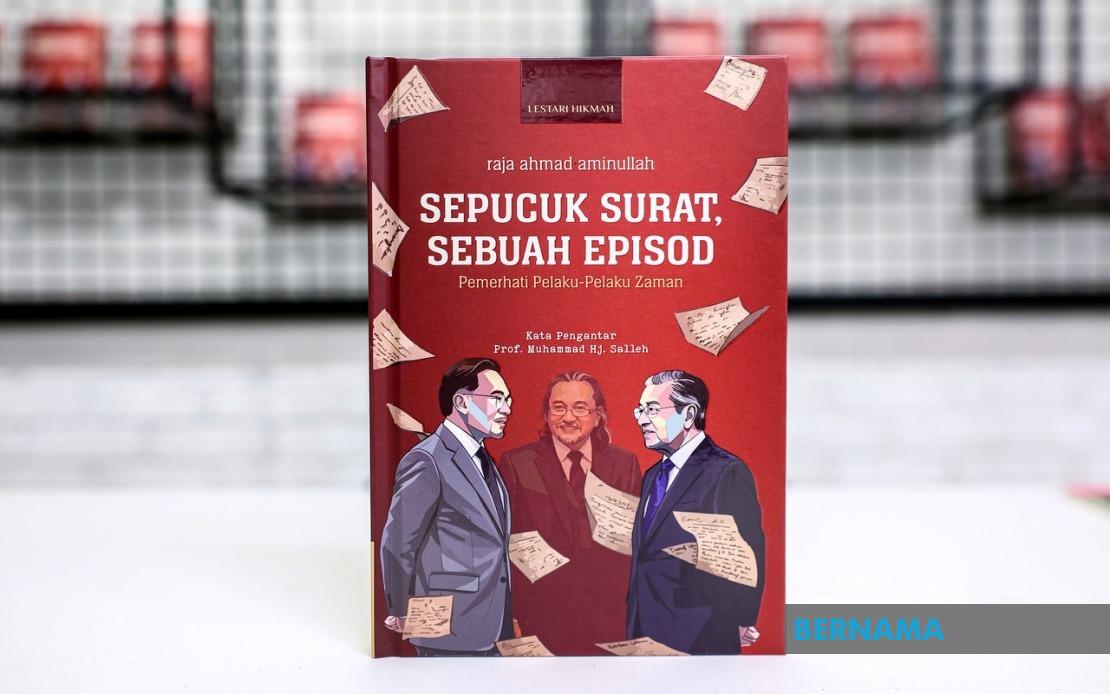
A new book launched in Kuala Lumpur this week provides an uncommon window into the private correspondence of Malaysia's influential personalities through the eyes of cultural figure Raja Ahmad Aminullah, known affectionately as Pak Engku. The publication, titled "Sepucuk Surat Sebuah Episod: Rakaman Pelaku-Pelaku Zaman," brings together a curated selection of personal letters and exchanges spanning roughly a quarter-century, creating what amounts to an intimate documentary record of the people who have left their imprint on the nation's development.
During the book's unveiling event, Raja Ahmad was clear about his intentions in assembling this collection. Rather than positioning the work as a partisan political document, he characterised it as a socio-cultural archive reflecting his observations of the communities and environments he has inhabited. This distinction matters considerably, as it signals an attempt to transcend the conventional lens through which political memoirs are often viewed in Malaysia, where such publications frequently become vehicles for score-settling or hagiography.
Raja Ahmad articulated his philosophical approach to documentary writing with particular emphasis. He stressed that his writings emerge from careful observation of societal dynamics and the cultural issues reverberating through Malaysian communities, rather than from engagement with the machinery of political power. His disinterest in adversarial politics and the mechanics of political manoeuvring suggests a deliberate positioning of the book outside contemporary partisan debates, even as it inevitably touches upon figures who have dominated Malaysia's political landscape.
The author made explicit clarifications regarding the scope and subject matter of his compilation. In doing so, he named two towering figures in Malaysian politics—Tun Dr Mahathir Mohamad and Datuk Seri Anwar Ibrahim—only to emphasise that the book is not fundamentally about either of them, nor indeed about himself. Instead, he framed it as a temporal snapshot capturing observations from approximately 25 years earlier, presented as material from which contemporary and future readers might extract lessons and insights applicable to their own times.
The National Book Council of Malaysia, through director Mohd Khair Ngadiron, lent official credibility to the launch ceremony, signalling institutional recognition of the work's cultural and historical significance. The gathering itself reflected the book's intended audience and cultural positioning, drawing together artists, literary practitioners, academics, and individuals who have maintained long associations with Raja Ahmad, suggesting an intellectual rather than purely commercial readership base.
Raja Ahmad's motivation for preserving these particular memories and documenting his own historical role speaks to broader questions about legacy and collective memory in Malaysia. By framing the work as material for future generations to contemplate within an expanded analytical framework, he positions the letters and observations as primary source material for scholars and historians rather than as contemporary political intervention. This approach acknowledges that historical understanding often requires temporal distance to be fully appreciated and accurately contextualised.
The conceptual framework underlying the publication—treating personal correspondence as socio-cultural documentation rather than political testimony—offers Malaysian readers a different entry point for understanding the nation's recent past. Rather than focusing on decision-making processes or political calculations, the work reportedly emphasises the human dimensions, lived experiences, and observational nuances that accompany high-profile public roles. Such an approach can illuminate aspects of historical events that formal political narratives often overlook or understate.
For the wider Southeast Asian context, the emergence of such reflective works from cultural figures carries particular resonance. Malaysia's regional standing and the trajectories of its leaders have influenced broader patterns of development across Southeast Asia. Accordingly, intimate perspectives on these figures and the eras in which they operated may offer valuable context for understanding the region's evolution during the past two and a half decades, particularly for readers in neighbouring countries seeking deeper understanding of Malaysian decision-making and social development.
The physical publication details reflect a conscious positioning of the work across different market segments. Published by Lestari Hikmah, the 169-page volume exists in dual formats—a softcover edition priced at RM30 and a hardcover version at RM80—making it accessible to diverse reader categories ranging from casual browsers to serious collectors and scholars. Distribution through conventional bookstores alongside online channels and selected events indicates an integrated marketing approach designed to reach both mainstream and specialist audiences.
Raja Ahmad's insistence that he is merely an inconsequential recorder of historical moments, despite his considerable cultural prominence, reflects a studied humility regarding the interpretive role of those who document their times. By downplaying his own significance while elevating the importance of the observations and correspondence he has compiled, he invites readers to focus on the broader historical currents and personalities rather than on his own editorial perspective or interpretative interventions.
For Malaysian readers interested in literature, history, and social sciences, the publication arrives as a potential reference resource offering more personal and humanised perspectives on public figures than conventional biographies or political histories typically provide. The emphasis on the socio-cultural dimensions rather than strategic political calculations suggests that readers will encounter these prominent Malaysians in less formal, more relatable contexts, potentially revealing character dimensions and interpersonal dynamics that formal official records do not capture.
The launch of "Sepucuk Surat Sebuah Episod" ultimately represents a particular approach to historical documentation suited to contemporary Malaysia's maturation as a nation capable of reflecting upon its own recent past with nuance and complexity. By positioning personal correspondence as material worthy of preservation and collective study, Raja Ahmad validates the idea that individual observations and private exchanges constitute legitimate historical evidence, not merely political memoir or personal vanity project.

