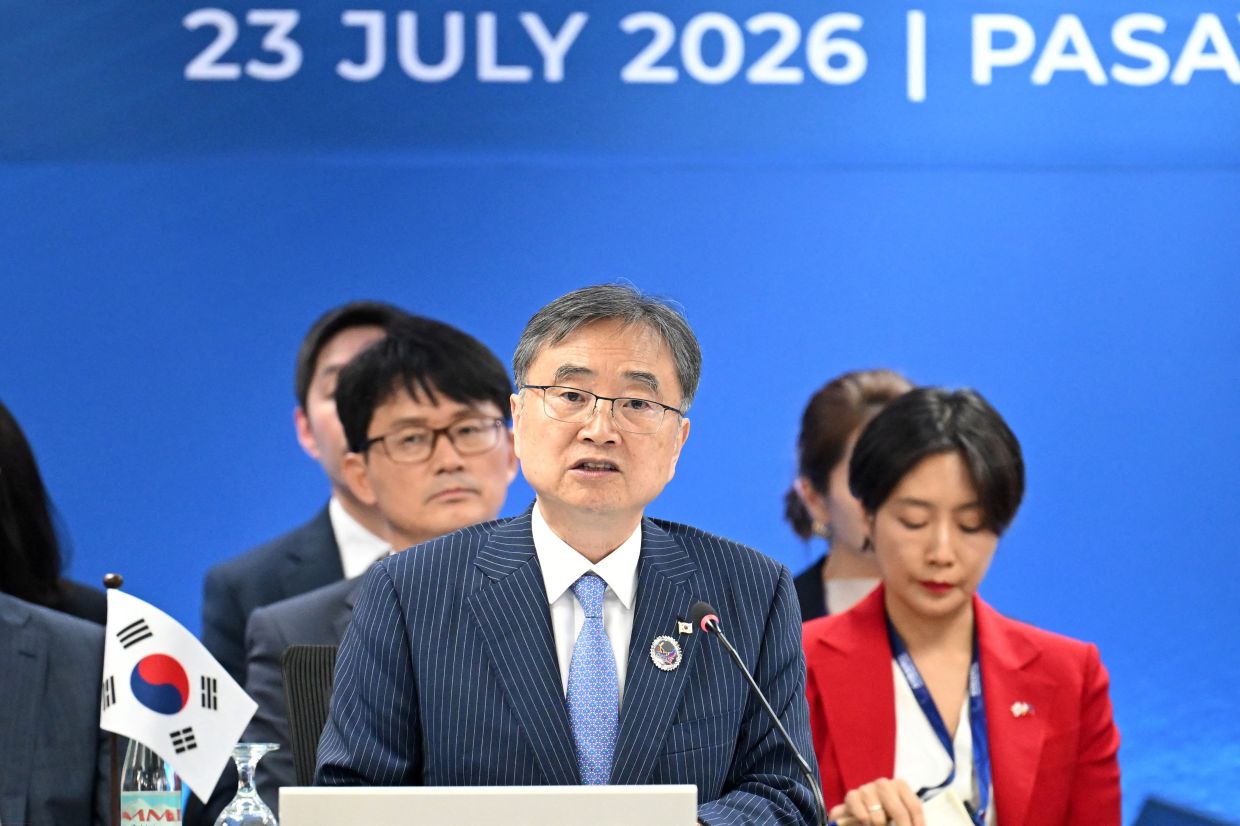
South Korea's diplomatic establishment is showing visible signs of strain as two key cabinet ministers publicly sparred this week over how best to approach North Korea, casting doubt on the coherence of President Lee Jae Myung's evolving policy toward the isolated regime. The clash between Foreign Minister Cho Hyun and Unification Minister Chung Dong-young highlights the inherent tensions within Seoul's pivot toward engagement after years of adversarial posturing, and analysts warn that such internal divisions could be precisely what Pyongyang needs to dismiss South Korean overtures as ephemeral and unreliable.
The immediate flashpoint came when Chung unveiled a series of engagement initiatives at a Wednesday policy meeting with President Lee, proposing notably the revival of four-party talks involving both Koreas, the United States, and China. Rather than endorsing these ideas, Foreign Minister Cho dismissed them before reporters as "idealistic" and pointedly noted that the proposals lacked approval from other government departments. Cho's public rebuke was notably blunt for interagency diplomacy, effectively signalling that the Foreign Ministry had not been consulted or did not consent to the Unification Ministry's direction. Chung responded by defending idealism itself as a necessary tool for catalysing real-world change, a rhetorical parry that underscored the philosophical gulf separating the two officials.
This disagreement reflects deeper disagreement over strategy within Lee's administration. The government has formally abandoned the "denuclearisation-first" framework that dominated South Korean policy under previous conservative administrations, replacing it with a "peace-first" approach intended to lower barriers to dialogue. Under this rubric, Seoul has engaged in a series of unilateral concessions, including suspending anti-North Korean loudspeaker broadcasts that Pyongyang has long objected to, while simultaneously urging United States President Donald Trump to pursue direct talks with North Korean leader Kim Jong Un. The Unification Ministry appears to champion a more aggressive pursuit of this reconciliation track, whilst the Foreign Ministry seemingly counsels caution and the need for broader consensus before committing Seoul to specific initiatives.
The timing of the dispute is particularly awkward for Seoul's diplomatic ambitions. Since Lee assumed office, his administration has been working methodically to persuade North Korea to respond to a string of goodwill gestures, hoping to rekindle channels of communication that have atrophied dramatically over the past several years. However, the public airing of ministerial disagreement sends the opposite signal, suggesting to Pyongyang that Seoul's policy framework remains contested and unstable. Lim Eul-chul, a Korea specialist at Kyungnam University, warned that the internal rift "exposed internal differences and weakening policy momentum," and more critically, that such divisions would reinforce North Korean scepticism about whether any agreements brokered with Seoul could survive changes in political leadership or departmental personnel.
The practical consequences of South Korean policy incoherence have been evident in deteriorating inter-Korean relations. Since the onset of the Covid-19 pandemic, bilateral ties have deteriorated sharply, culminating in Kim Jong Un's 2024 announcement that North Korea would abandon the goal of reunification altogether and subsequently demolish joint inter-Korean industrial and cultural projects on its own territory. These moves represented not merely rhetorical shifts but concrete reversals of decades of engagement infrastructure. Dialogue between the capitals has since collapsed almost entirely, and North Korea has tightened border controls to an extent that has drastically reduced defections. The most recent data illustrates the scale of the rupture: just 63 North Koreans crossed into South Korea during the first half of 2026, a staggering decline from the 1,047 who defected during the comparable period in 2019.
The diplomatic vacuum created by these deteriorating conditions has been accompanied by a subtle but significant reorientation of South Korean human rights policy toward North Korea. Under Lee's administration, advocates and civil society groups monitoring conditions in the North report that the government has downgraded human rights concerns in its diplomatic messaging, ostensibly to avoid antagonising Pyongyang and thereby derailing engagement efforts. Whilst Seoul co-sponsored a United Nations resolution on North Korean human rights last year, implementation of related advocacy activities appears to have slowed considerably. Some activist organisations have had funding dry up as international donors reassess their support in light of what they perceive as Seoul's deprioritisation of the issue. Kim Tae-Hoon, former president of the human rights advocacy group PSCORE, described the situation as "very, very difficult," reflecting the disillusionment among activists who fear that the pursuit of diplomatic normalisation is being purchased at the cost of principled advocacy for vulnerable North Korean populations.
The Foreign and Unification ministries have since sought to contain the damage from their public disagreement, issuing a joint statement pledging continued policy coordination whilst declining further elaboration. The presidential Blue House similarly refrained from immediate comment, suggesting an effort to let the situation cool without adding new fuel to the controversy. Yet the restraint appears more tactical than substantive; observers suggest that the underlying policy tensions are unlikely to dissolve without a clearer hierarchy of decision-making authority or a more inclusive process for vetting major initiatives before public announcement. The incident reveals the structural weakness in Lee's approach: a government committed to engagement with North Korea but lacking the internal discipline or consensus to pursue it coherently.
For regional observers, particularly in Southeast Asia where countries have watched Korean peninsula developments with keen interest, the ministerial clash underscores the fragility of Seoul's diplomatic reset. Malaysia and other ASEAN states, which have historically positioned themselves as potential mediators or hosts for inter-Korean negotiations, may now view prospects for renewed dialogue more cautiously. The perception of disunity in Seoul could embolden North Korea to delay response to reconciliation offers, betting that South Korean domestic politics might produce a more amenable interlocutor. Conversely, should hardline voices gain influence within the Lee administration, the entire engagement framework could reverse course, echoing the frequent policy swings that have characterised Korean peninsula diplomacy over the past two decades.

