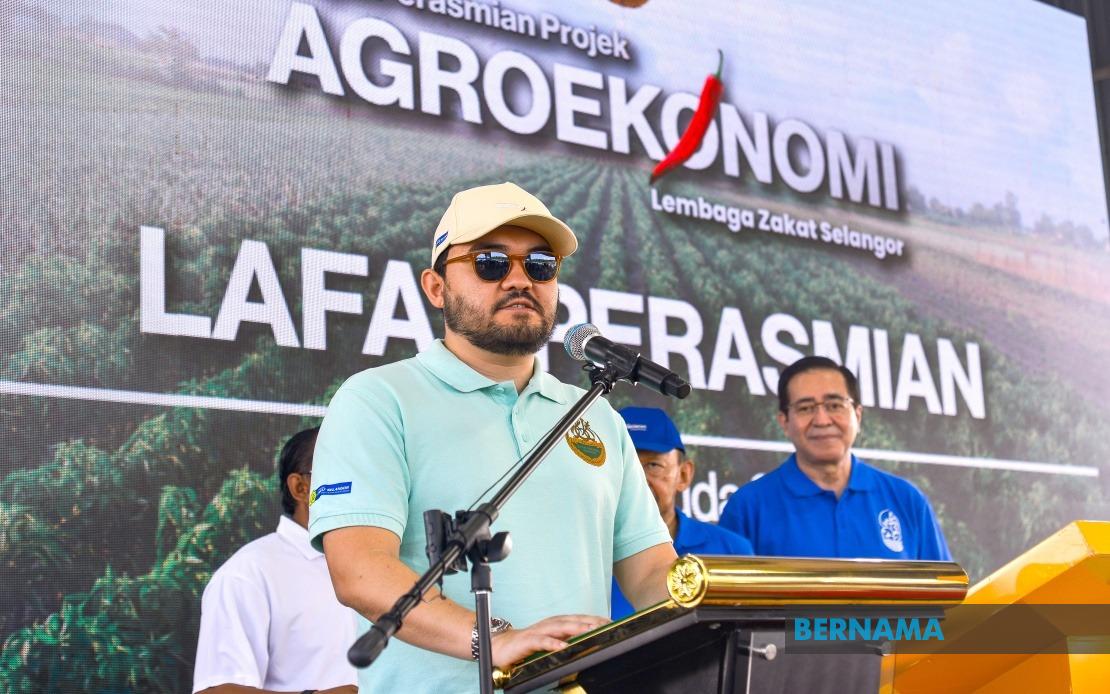
The Selangor Zakat Board has taken a significant step in reshaping its approach to community welfare by inaugurating an ambitious agricultural venture aimed at transforming the livelihoods of underprivileged asnaf recipients. Launched on July 1 at the sprawling 110-acre Laman Agro Ehsan facility in Bukit Beruntung by Raja Muda of Selangor Tengku Amir Shah Sultan Sharafuddin Idris Shah, the RM26 million Agroeconomic Project represents a departure from conventional zakat distribution models, instead anchoring itself on productive capacity-building and sustainable wealth generation through the agricultural sector.
The initiative reflects evolving thinking within Malaysia's Islamic charitable institutions about how to address poverty more comprehensively. Rather than limiting assistance to immediate cash transfers or consumables, Zakat Selangor has invested substantially in physical infrastructure and human capital development. The project encompasses 76 of its 110 acres in active agro-development operations, with a primary focus on intensive chilli cultivation using modern fertigation techniques. This technological approach to farming allows participants to maximise yields on limited land, a crucial consideration in densely populated Selangor where agricultural space remains constrained.
The scale of participation underscores the board's commitment to meaningful programme implementation. Forty-eight carefully selected asnaf participants have been enrolled in a three-year structured development programme designed to build their technical competency and business acumen simultaneously. The screening process, conducted in collaboration with the Kuala Langat Area Farmers' Organisation, prioritised candidates demonstrating both genuine need and capacity for learning, ensuring programme resources reach those most likely to succeed. Each participant manages a half-acre cultivation plot containing approximately 2,000 chilli seedlings, with the entire farming complex generating around 96,000 planting units per growing cycle.
Financial projections attached to the scheme provide tangible incentives for participant commitment. Once production systems stabilise and participants master crop management protocols, individual monthly income could reach RM4,000, substantially exceeding typical minimum wage and offering a genuine pathway toward economic dignity for participating families. For beneficiaries like Norfhadilah Mohd Shafiin, a 45-year-old mother of five, and Raimi Rusydi Rodi, a father of two, these income prospects represent transformative opportunities. Both participants emphasised how the programme extended beyond financial provision to equip them with practical agricultural knowledge and self-reliance—outcomes far more durable than welfare cheques.
The supportive infrastructure surrounding the agricultural activities demonstrates the comprehensive nature of Zakat Selangor's intervention. Beyond farming plots and technical training, participants receive fully subsidised accommodation at the Prima Beruntung housing area throughout the programme duration. This housing provision eliminates a major expense burden for low-income families, allowing them to redirect earnings toward household investments, children's education, or business expansion. Combined with hands-on guidance in crop monitoring and field management, the holistic support system substantially increases participant likelihood of success.
Financial sustainability of the project itself rests on collaborative partnership arrangements that distribute the investment burden across multiple institutions. Beyond Zakat Selangor's core funding, the Pilgrims Fund Board, RHB Islamic Bank Berhad, and Cagamas Berhad have contributed RM2.07 million through wakalah arrangements—structured partnerships where institutions direct resources toward shared social objectives. This collaborative model demonstrates how Malaysia's Islamic financial ecosystem can mobilise capital for community development, spreading financial risk while amplifying social impact.
The project carries particular significance for Selangor, Malaysia's most economically developed yet highly urbanised state where poverty remains concentrated among specific populations despite overall prosperity. Agricultural-based intervention provides an especially fitting response, channelling participants toward a sector where barriers to entry are lower than in services or manufacturing, while leveraging the state's existing agricultural infrastructure and technical expertise. For the broader Muslim community in Selangor, the initiative validates the principles of productive zakat deployment—using Islamic charitable resources not merely to alleviate immediate suffering but to engineer genuine economic transformation.
From a policy perspective, the Selangor model offers instructive lessons for other state zakat boards and social welfare agencies across Southeast Asia. It demonstrates that substantial investment in capability-building infrastructure, combined with patient mentorship and housing security, can convert welfare dependency into productive engagement. The three-year timeframe acknowledges that economic transformation requires sustained commitment rather than episodic intervention. Participants gain not only income but expanded self-confidence and entrepreneurial capabilities transferable to other ventures after programme completion.
The involvement of high-level state leadership, notably the Raja Muda's formal launch and engagement with participants, signals institutional commitment while elevating the social status of beneficiaries from passive aid recipients to productive community contributors. This symbolic dimension matters significantly, as it reframes asnaf participation from stigmatised welfare dependency toward recognised economic contribution. Participant testimonies highlight this dignity dimension—the emphasis on learning, capability acquisition, and community collaboration rather than mere subsistence.
Looking forward, the project's success or otherwise will depend substantially on factors beyond physical infrastructure. Market demand for chilli cultivation must remain robust to sustain projected income levels across multiple growing cycles. Supply chain development for efficient produce marketing will prove critical, as individual farmers cannot easily access wholesale or export channels independently. Technical extension services must remain consistently available to troubleshoot crop problems and adapt cultivation practices to climate variations. Selangor Zakat Board will need to maintain intensive engagement even as participants progress, gradually transitioning toward autonomy while retaining safety-net support for crisis situations.
The programme further illustrates how Islamic charitable institutions can leverage their sizeable asset bases and stakeholder networks toward structured development interventions. With zakat contributions potentially numbering in hundreds of millions annually across Malaysia, channelling even modest portions into carefully designed capability-building projects could substantially expand economic opportunities for vulnerable populations. The Selangor initiative sets a template demonstrating that such ambition is operationally feasible, financially sustainable through partnership arrangements, and capable of delivering measurable improvements in participant welfare and dignity.

