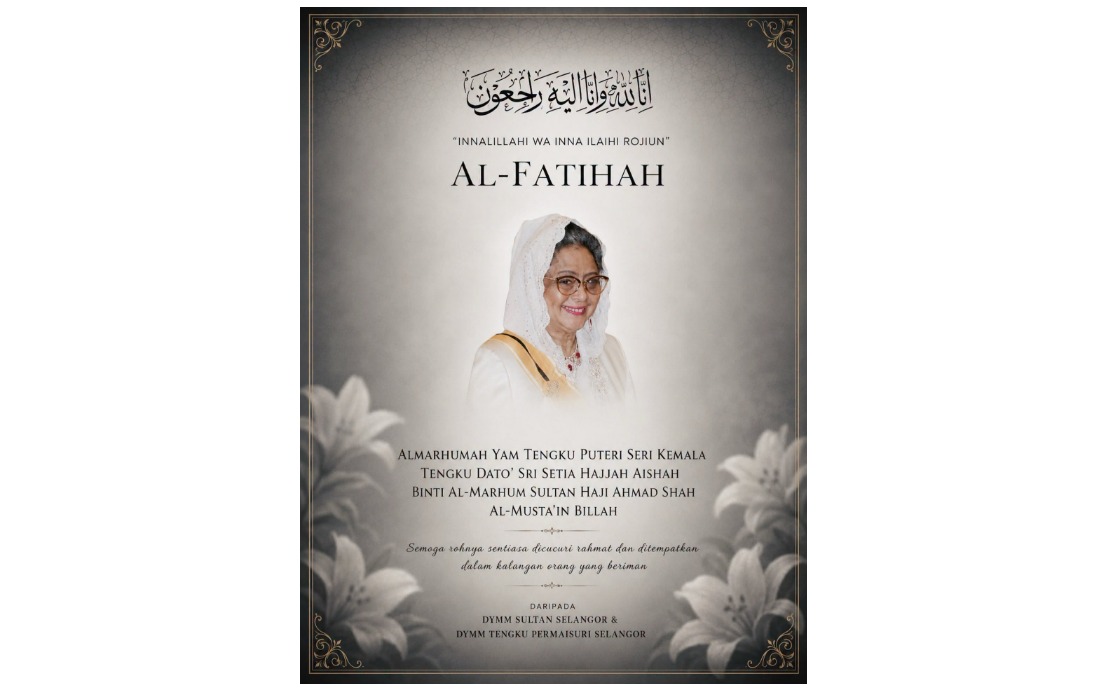
The Sultan of Selangor, Sultan Sharafuddin Idris Shah, and Tengku Permaisuri Selangor Tengku Permaisuri Norashikin have formally extended their condolences to Al-Sultan Abdullah Ri'ayatuddin Al-Mustafa Billah Shah, the Sultan of Pahang, following the passing of his elder sister. Tengku Datuk Seri Aishah, also known as Tengku Puteri Seri Kemala, died on August 26 at a hospital in Kuala Lumpur, marking a significant loss within Malaysia's royal circles and prompting expressions of sympathy from neighbouring states.
The Selangor Royal Office released an official statement conveying the grief felt by Sultan Sharafuddin and his consort over Tengku Datuk Seri Aishah's death. In their message, the senior royals articulated their sadness and extended prayers for the deceased, invoking Islamic blessings for her soul. The formal acknowledgement reflects the deep bonds of kinship that characterise relationships among Malaysia's different state monarchies, where such expressions of condolence serve both as personal gestures and as public affirmations of royal solidarity.
Tengku Datuk Seri Aishah expired at 9.15 pm on the evening of August 26 at a medical facility in the nation's capital. Her death, occurring within the royal household, represented a moment of collective reflection within Malaysia's monarchical institution, as members of the extended royal family and political establishment took time to acknowledge the loss. The timing and circumstances of her passing appeared to have prompted immediate and coordinated responses from senior figures across the Malaysian federation.
Arrangements for her final rites proceeded according to established protocols governing royal burials. Her remains were scheduled to be transported to the Pahang Royal Mausoleum located in Pekan, the royal town in the east coast state. The funeral and subsequent entombment would be conducted with the full ceremonial honours accorded to members of the Pahang royal lineage, observing both Islamic funeral traditions and the distinctive customs observed within Pahang's monarchical household.
The expression of sympathy from Selangor's royal household underscores the intricate web of familial relationships connecting Malaysia's various sultanates. While each state maintains its own distinct royal institution with sovereign powers over its domain, the members of these ruling families remain bound by blood ties and institutional fellowship. Such occasions of loss become opportunities for these relationships to be formally acknowledged and publicly demonstrated, reinforcing the sense of collective identity that characterises the Malaysian monarchy as a unified institution.
Within the Malaysian constitutional framework, the Sultan of Pahang occupies a position of considerable significance. The state of Pahang itself comprises a substantial portion of peninsular Malaysia, and its ruler maintains important ceremonial and administrative responsibilities within the federation. A death within the immediate royal family of any of the major sultanates therefore carries implications beyond the state itself, as it touches upon the broader solidarity among Malaysia's monarchical establishment.
The condolence message released by the Selangor Royal Office specifically invoked Islamic prayers for the deceased, requesting that Tengku Datuk Seri Aishah be granted divine mercy and placed among the righteous. The phrase "Al-Fatihah," used as a closing, represents a traditional Islamic expression offered for the deceased. This religious dimension of the formal condolence reflects the manner in which Malaysia's royal institutions seamlessly integrate Islamic faith with constitutional monarchy, with religious observance forming an integral component of state ceremonial practice.
For readers in Malaysia and the broader Southeast Asian region, the passing of senior members of royal households carries cultural and symbolic weight that extends beyond immediate family circumstances. In a region where monarchical institutions command deep respect and continue to play central roles in national identity and stability, such losses are marked by substantial public attention and formal commemoration. The coordinated expression of sympathy from neighbouring sultanates demonstrates the functional unity of Malaysia's federated royal system, despite the constitutional autonomy of individual state rulers.
The Pahang Sultan's position within Malaysia's political and ceremonial hierarchy meant that his sister's death would likely receive significant attention across the country. As a state ruler, Al-Sultan Abdullah Ri'ayatuddin Al-Mustafa Billah Shah balances both ceremonial duties and substantive involvement in state governance. The loss of a sibling, particularly an elder sister, represents a personal matter that intersects with his public role, and the formal acknowledgement from other state rulers would provide both comfort and reaffirmation of the solidarity that binds Malaysia's monarchical establishment.
The arrangements for Tengku Datuk Seri Aishah's burial in Pekan reflected the deep historical connections between the Pahang royal family and the state's traditional capital. The Pahang Royal Mausoleum serves as the resting place for significant members of the Pahang sultanate, and her interment there would position her within the historical continuum of the state's ruling lineage. The conduct of funeral rites with full royal honours ensured that her status and familial connections received appropriate public recognition, cementing her place within the formal record of the Pahang monarchy.

