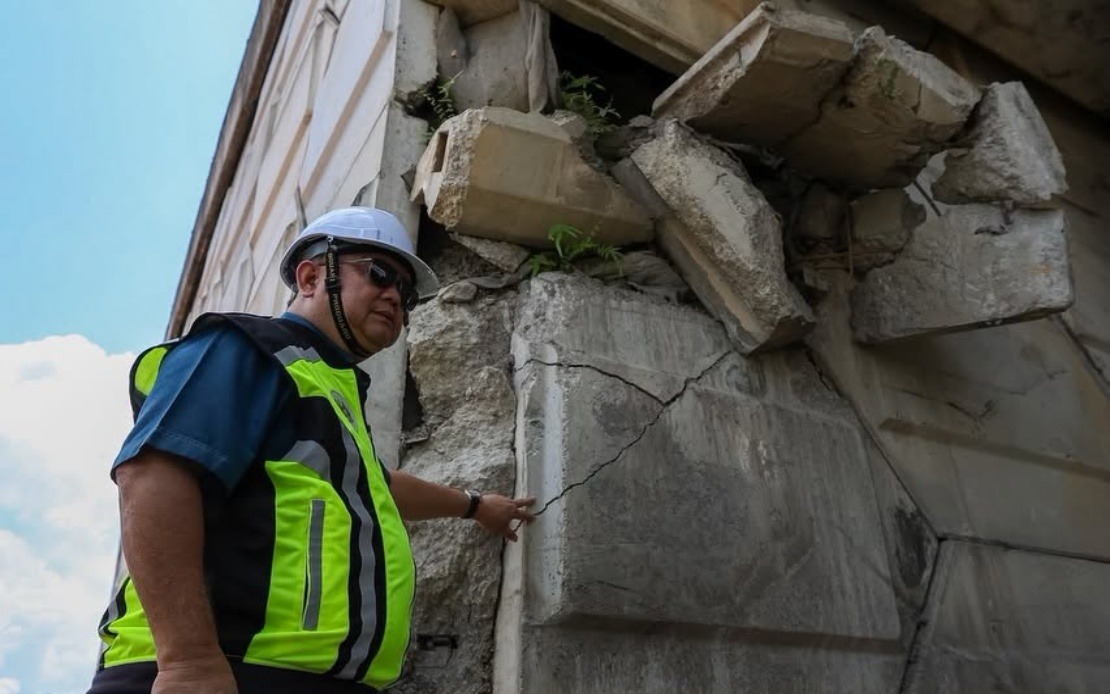
Works Minister Datuk Seri Alexander Nanta Linggi has pledged that the Selangau-Mukah Interchange Flyover on the Pan Borneo Highway will be progressively reopened only after comprehensive safety assessments confirm the integrity of its infrastructure has been fully restored. The commitment came after the minister personally inspected the accident site in Sibu on July 6, where he outlined a structured approach to both the repair works and the eventual restoration of traffic flow across the critical East Malaysian route.
The flyover's Ramp 1 was closed following a collision with a palm oil tanker that fundamentally compromised its structural soundness. Technical investigators at the scene determined that the impact had caused significant damage to part of the retaining wall assembly, rendering the route unsafe for the volume of commercial and passenger traffic that typically depends on this section of the Pan Borneo Highway. The decision to implement a complete closure, rather than limiting access, reflected the severity of the structural concerns that emerged during the initial post-incident assessment.
Nanta's statement revealed that the repair strategy would involve controlled structural interventions designed to restore the stability of the compromised sections. Critically, the minister indicated that routes which remain unaffected by the collision damage would be progressively returned to service as individual repair phases are completed and independently verified. This phased approach aims to balance the necessity of maintaining absolute safety standards with the recognition that a blanket closure creates substantial disruption to regional connectivity and commerce.
The closure has generated considerable anxiety among the commuting public, particularly among residents and commercial operators who depend on the Bintulu-Mukah-Sibu corridor for daily mobility and business operations. Nanta acknowledged this strain, noting that the inconvenience is substantial and understood. However, he made unambiguous that premature reopening would be subordinated to demonstrated evidence that the structure poses no risk to road users. This position aligns with international best practices in post-accident infrastructure recovery, where structural certification must precede public access.
The minister emphasized the importance of transparency and engagement with affected communities regarding the incident and recovery timeline. He noted that public concerns—whether articulated through traditional media channels or via social media platforms—deserve serious institutional attention, particularly where these concerns relate to the safety record and ongoing operations of major transport corridors. This stance reflects growing recognition among Malaysian policymakers that stakeholder communication during infrastructure crises can either mitigate or exacerbate public confidence in state management of critical assets.
Three operational priorities were formally articulated by Nanta to guide the reconstruction effort. First, maintaining rigorous safety standards for all road users represents the non-negotiable foundation of the repair program. Second, active project oversight aims to prevent unnecessary scheduling delays that could extend the disruption beyond what is technically required. Third, systematic communication of alternative routing options, current access restrictions, and real-time progress updates must flow continuously to the travelling public and media.
The Selangau-Mukah Interchange represents a vital node in Sarawak's transport infrastructure, particularly for the movement of agricultural products, petro-chemical goods, and passenger traffic between the coastal and central regions of the state. The extended closure therefore carries economic implications extending beyond inconvenience to individual commuters, affecting supply chains and business operations across the region. For Malaysian readers monitoring regional development, this incident underscores the vulnerability of large infrastructure projects to unexpected failure and the complex trade-offs between repair timelines and safety imperatives.
The Pan Borneo Highway itself has been a transformative project for East Malaysia since its development, but its concentration as a critical transport artery also means that localized infrastructure failures can have cascading effects across the broader regional economy. The Selangau-Mukah Interchange, as one of several major interchanges along this route, had been designed to facilitate efficient traffic distribution and reduce congestion at key commercial junctions. Its temporary loss of capacity therefore creates bottlenecks that alternative routes cannot fully absorb.
Nanta's personal site visit and detailed public statement suggest that the Works Ministry is treating this incident with appropriate seriousness at the ministerial level. The explicit commitment to close monitoring of reconstruction work, coupled with the promise that reopening will be conditional on demonstrated safety restoration, attempts to restore public confidence in the integrity of both the infrastructure itself and the competence of the management response. For Malaysian stakeholders, this engagement represents a test case in how the government addresses major infrastructure incidents and manages the communication of recovery timelines.

