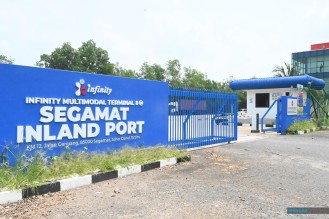
Segamat Inland Port (SIP) is targeting the handling of more than 6,000 twenty-foot equivalent units (TEUs) of containers by December, marking a significant milestone in the facility's resurrection as a critical node in Malaysia's evolving inland logistics infrastructure. The port has already shifted approximately 1,000 TEUs during its first operational month following a restart in late June, establishing a promising trajectory as it ramps up capacity and deepens its engagement with the region's industrial base.
Managed by Infinity Logistics & Transport, SIP's reactivation represents a deliberate pivot toward rail-based cargo handling across a sprawling geographic footprint encompassing northern Johor, southern Pahang, southern Negeri Sembilan, and Melaka. According to SIP manager Samuel Ho, the facility's revival directly supports the Malaysian government's broader strategy of shifting freight from congested highways to the rail network through its Road to Rail initiative, developed collaboratively with Keretapi Tanah Melayu Bhd. This reorientation addresses longstanding inefficiencies within the country's supply chain, where road-dependent distribution has historically constrained capacity and driven up operational costs for manufacturers and logistics operators across the region.
The rationale for prioritising rail transport extends beyond mere convenience. Ho emphasised that rail freight substantially improves safety outcomes compared to highway trucking, which exposes shipments to accident risks and unpredictable delays stemming from traffic congestion. A single freight train journey replaces the equivalent of roughly 80 container trucks, dramatically reducing diesel consumption and associated emissions. For a country grappling with air quality challenges and escalating fuel costs, this operational efficiency constitutes both an environmental and economic imperative, particularly as industrial clustering in secondary cities intensifies demand for logistics solutions.
For more than a decade, SIP remained largely dormant despite its operational infrastructure, a stagnation rooted in the practical constraints of single-track rail operations. Under that configuration, freight movements were subordinated to passenger train schedules, rendering the facility economically unviable and forcing shippers toward road-based alternatives. The completion of double-tracking to Johor fundamentally transformed SIP's operational calculus. The facility can now accommodate up to four cargo receiving and dispatch cycles weekly, compared with a single weekly slot under the previous single-track regime. This fourfold increase in scheduling flexibility directly enables SIP to compete with established container ports and attract shippers previously committed to road distribution or distant maritime facilities.
The completed rail infrastructure upgrade unlocks access to Malaysia's primary maritime gateways—Port Klang, Port of Tanjung Pelepas, and Johor Port in Pasir Gudang—positioning SIP as a seamless intermodal link for containers arriving via deep-sea vessels. This connectivity addresses a critical gap in the regional logistics architecture, particularly for manufacturers in industrial zones across northern Johor, including the districts of Batu Pahat and Kluang, which have historically faced geographic disadvantages in accessing containerised freight services. By functioning as a rail-based gateway, SIP promises to democratise access to international container networks for industries previously dependent on highway haulage.
Beyond immediate cargo-handling objectives, Ho articulated an expansive vision for SIP as an economic catalyst capable of attracting foreign and domestic investment into surrounding industrial zones. The facility's operational footprint currently spans 20.23 hectares in its inaugural phase, adjoining Segamat Railway Station, with comprehensive development envisioned across three sequential phases. The first phase has already generated over 200 direct employment opportunities for local residents, with projections indicating substantial job creation across security, logistics, warehouse management, and allied sectors upon completion of subsequent phases. For a region experiencing outmigration pressures and employment uncertainties, this employment stimulus carries profound socioeconomic implications.
SIP's educational dimension further distinguishes its strategic positioning within Malaysia's logistics ecosystem. The facility is collaborating with Universiti Tun Hussein Onn Malaysia (UTHM) to cultivate expertise in rail-based inland port operations, providing students and researchers with fieldwork exposure and supporting applied research initiatives. This knowledge-sharing architecture ensures that SIP contributes not merely to immediate cargo volumes but to institutional capacity-building within Malaysia's technical workforce, establishing models potentially transferable to future inland port developments in other regions.
The facility's historical trajectory underscores the transformative power of infrastructure investment when coupled with operational restructuring. SIP was originally established and commenced operations in 1997 but languished for decades, demonstrating how even well-positioned logistics assets can become economically redundant when supporting infrastructure remains inadequate. Transport Minister Anthony Loke Siew Fook, who officiated the formal relaunching on June 25, 2026, positioned SIP as emblematic of the government's commitment to supply chain modernisation and economic decentralisation, explicitly linking the facility's success to job creation, congestion mitigation, and enhanced logistics efficiency nationwide.
The quantified impact projections amplify SIP's systemic significance. The facility is anticipated to displace approximately 18,000 lorry movements—encompassing both trailers and container trucks—from Malaysian highways monthly. This reduction addresses multiple policy objectives simultaneously: alleviating congestion on primary corridors, improving road safety through reduced heavy-vehicle density, and optimising the utilisation of existing rail infrastructure that has historically operated below capacity. For Malaysian drivers and commuters, particularly those traversing the congested Johor-bound corridors, this diversion of freight traffic translates into tangible improvements in journey times and accident prevention.
From a regional perspective, SIP's revival carries implications extending beyond Malaysia's borders. As Southeast Asian manufacturing increasingly integrates into global supply chains and competes for market access, the efficiency of inland logistics networks becomes a decisive competitive factor. Countries investing in multimodal transportation—particularly rail-based inland ports—position their industrial bases to capture export opportunities more effectively than competitors constrained by road-dependent systems. Malaysia's deliberate reactivation of SIP signals confidence in its industrial future and capability to support high-velocity cargo flows, potentially attracting regional headquarters and distribution operations from multinational corporations evaluating relocation sites across Southeast Asia.
The trajectory from dormancy to operational revival encapsulates broader shifts within Malaysian infrastructure policy. Rather than perpetually constructing greenfield facilities, the government increasingly recognises the economic logic of reactivating and optimising existing assets whose original potential was unrealised. SIP exemplifies this pragmatic approach, where strategic rail investments—specifically the double-tracking project—retroactively activated previously stranded capacity. As SIP progresses toward its 6,000-TEU target and advances into subsequent development phases, its performance will likely inform policy decisions regarding analogous inland logistics facilities elsewhere in Malaysia, particularly in Peninsular Malaysia's secondary cities where manufacturing clusters remain underserved by efficient intermodal freight infrastructure.

