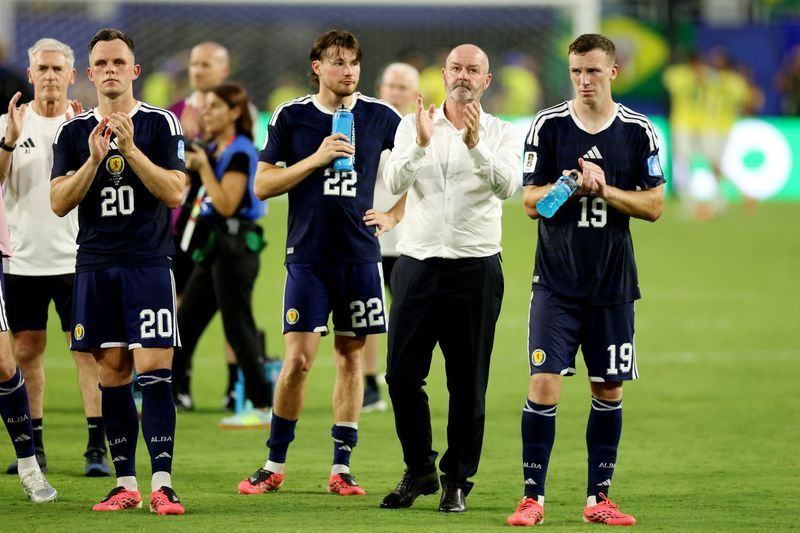
Scotland's first World Cup appearance in 28 years looks set to end in disappointment following a lopsided 3-0 loss to Brazil in their final Group C encounter in Miami on Wednesday. Coach Steve Clarke was scathing in his post-match assessment, attributing the heavy defeat to fundamental errors in defending rather than superior Brazilian execution alone. The manner of the loss—where Scotland gifted possession and created opportunities for an opponent renowned for clinical finishing—left Clarke convinced his team would not survive the competition despite technically retaining slim qualification hopes.
While Scotland currently occupies sixth place among the eight third-placed teams that could advance from the group stage, Clarke's pessimism reflects realistic expectations about how other teams will perform in their remaining fixtures. With 20 group matches still to play across the tournament, the Scottish manager acknowledged that at least two additional sides would likely accumulate enough points to leapfrog his team. The mathematics of World Cup progression, where eight third-placed teams proceed alongside group winners and runners-up, offers theoretical salvation for Scotland's three-point tally, yet Clarke's reading of the competitive landscape suggests the window for advancement has effectively closed.
The fundamental issue, according to Clarke, stemmed from Scotland's inability to respect Brazil's attacking prowess through disciplined defending. He described the performance as one where his team essentially handed the South American giants their goals through poor positioning, lazy marking, and vulnerable transitions from defence to attack. While acknowledging that goalkeeper Angus Gunn produced several important saves and that Scotland fashioned a couple of half-chances, Clarke emphasised that his players failed to execute the fundamental defensive principles required to compete at the highest level. The contrast between what Scotland attempted and what they were capable of executing proved cavernous.
Clark's criticism, however, stopped short of attacking the character or commitment of his players. The former Chelsea fullback recognised that this same group of players had achieved the remarkable feat of qualifying for a World Cup after a 28-year absence—an accomplishment that secured passage for Scotland's passionate supporters to the United States. Clarke distinguished between disappointment at underperformance and anger at the squad's fundamental dedication to the cause. Instead of casting blame, he appeared frustrated that his team had not risen to the occasion when it mattered most, suggesting that Scotland possessed greater capabilities than their Brazilian display demonstrated.
Beyond the immediate disappointment of elimination, Clarke identified systemic weaknesses within Scottish football that extend far beyond the current group of players. Witnessing the physical intensity, power, and technical proficiency of both Morocco and Brazil prompted him to articulate concerns about the development pipeline in Scottish football. Clarke suggested that Scotland requires structural improvements in youth development and player cultivation if the nation hopes to regularly compete on the world stage. The implication was stark: Scotland cannot simply qualify for tournaments and expect competitive results without addressing how young footballers are identified, trained, and prepared for elite international competition.
The gap between Scotland's aspirations and capabilities became evident when Clarke reflected on the standard of opposition encountered in the group stage. Morocco and Brazil both demonstrated attributes—physical robustness, technical skill, and attacking efficiency—that highlighted deficiencies in Scottish football's current product. Clarke's analysis suggested that Scottish clubs and the national pathway must produce players capable of withstanding and matching the intensity of modern international football. Without such structural investment and improvement, Clarke implied that Scotland would continue to struggle in tournaments regardless of qualification achievement.
Yet Clarke's perspective on the supporters who travelled to America offered a counterweight to his criticism of the players. The Scottish fans, colloquially known as the Tartan Army, earned universal praise as ambassadors for their nation throughout the tournament. Clarke ensured that the supporters understood they would not have experienced a World Cup in the United States without the efforts of the players now facing elimination. He emphasised that the players deserved recognition for achieving qualification, an accomplishment that meant Scottish supporters could attend a World Cup rather than remain at home watching from their sofas as they had for nearly three decades.
Clark's comments reflected an understanding that qualification itself represented a significant achievement in Scottish football's recent history. The player group that secured passage to Qatar and subsequently to the tournament in the United States had already surpassed expectations simply by reaching the finals. While Clarke clearly believed higher performance standards were necessary and achievable, he appeared conscious of contextualising the players' contributions within Scottish football's broader struggles in international competition. The distinction he drew between acknowledging accomplishment and demanding improvement offered a nuanced assessment of where Scottish football stands.
For Malaysian and Southeast Asian football observers, Scotland's exit carries relevance regarding the challenges smaller nations face in world football. Scotland's combination of passionate support, recent qualification success, and structural limitations mirrors dynamics in other smaller footballing nations across Asia and Europe. The tension between achieving qualification—often requiring sustained excellence over qualifying campaigns—and performing competitively in tournaments represents a perennial challenge for nations outside football's traditional powerhouses. Scotland's experience suggests that qualification, while important, differs fundamentally from tournament success, a lesson applicable across global football.
Scotland's campaign ultimately demonstrates how quickly World Cup dreams can unravel once competition begins. Despite reaching the finals, the Scots' defeat to Brazil and their apparent failure to progress from the group stage underscore the gap between qualifying accomplishment and tournament performance. Clarke's identification of systemic issues in Scottish football—youth development, physical preparation, technical training—points toward the long-term work required to sustain competitiveness. Whether Scotland can translate this disappointment into meaningful structural reform or whether they return to periodic qualification attempts followed by early elimination remains a question that extends beyond the current World Cup cycle into Scottish football's future development.

